Neurological Rehabilitation Department A and CaRMA Lab, I.R.C.C.S. Fondazione Santa Lucia Rome Rome, Italy.
Front Hum Neurosci. 2014 Jun 25;8:475. doi: 10.3389/fnhum.2014.00475. eCollection 2014.
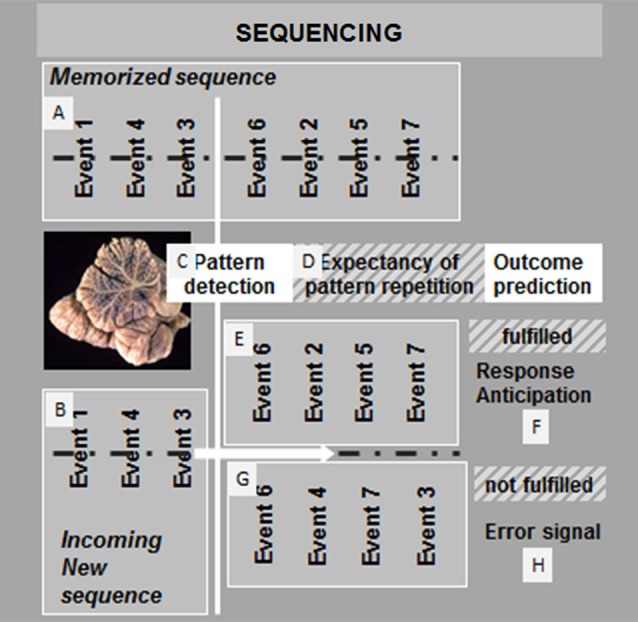
The cerebellum is an important contributor to feedforward control mechanisms of the central nervous system, and sequencing-the process that allows spatial and temporal relationships between events to be recognized-has been implicated as the fundamental cerebellar mode of operation. By adopting such a mode and because cerebellar activity patterns are sensitive to a variety of sensorimotor-related tasks, the cerebellum is believed to support motor and cognitive functions that are encoded in the frontal and parietal lobes of the cerebral cortex. In this model, the cerebellum is hypothesized to make predictions about the consequences of a motor or cognitive command that originates from the cortex to prepare the entire system to cope with ongoing changes. In this framework, cerebellar predictive mechanisms for locomotion are addressed, focusing on sensorial and motoric sequencing. The hypothesis that sequence recognition is the mechanism by which the cerebellum functions in gait control is presented and discussed.
小脑是中枢神经系统前馈控制机制的重要贡献者,而序列处理(允许识别事件之间的空间和时间关系的过程)已被认为是小脑的基本运作模式。通过采用这种模式,并且由于小脑活动模式对各种与感觉运动相关的任务敏感,因此小脑被认为支持在大脑皮层的额叶和顶叶中编码的运动和认知功能。在该模型中,小脑被假设为对源自皮层的运动或认知命令的后果做出预测,以便为整个系统做好应对正在进行的变化的准备。在此框架内,探讨了针对运动的小脑预测机制,重点关注感觉和运动序列。提出并讨论了序列识别是小脑在步态控制中发挥作用的机制的假设。