Lee Shou-Wu, Lee Teng-Yu, Lien Han-Chung, Yang Sheng-Shun, Yeh Hong-Zen, Chang Chi-Sen
Division of Gastroenterology, Department of Internal Medicine, Taichung Veterans General Hospital, Taichung, Taiwan, ROC.
Med Princ Pract. 2014;23(5):460-4. doi: 10.1159/000363661. Epub 2014 Jul 8.
The aim of this study was to investigate the effect of gender on symptom presentation and quality of life of patients with erosive esophagitis (EE) and nonerosive reflux disorder (NERD).
Medical records from patients with gastroesophageal reflux disease (GERD) between January and December 2009 were reviewed. The patients were assigned to either the EE or the NERD group. The general demographic data, the modified Chinese GERDQ scores and the Short Form (SF)-36 life quality questionnaire scores of the two groups of patients were compared.
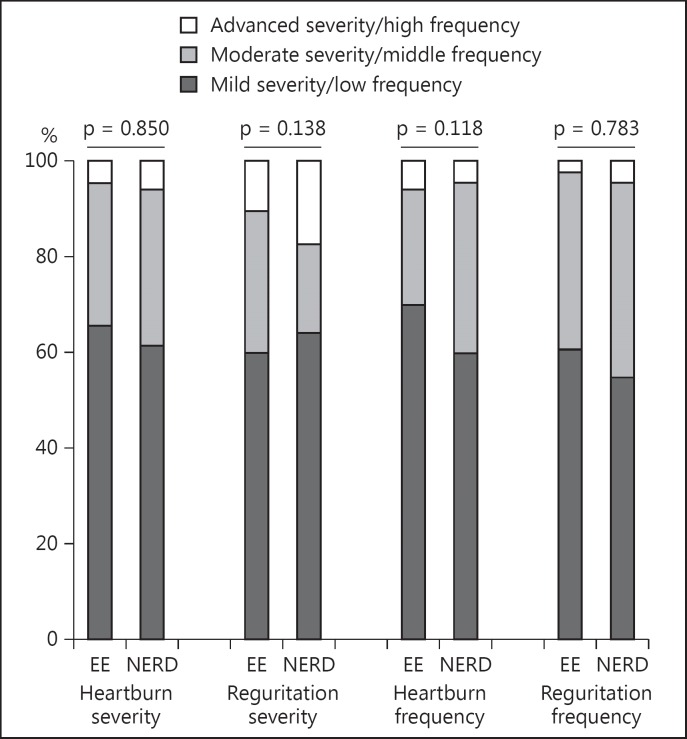
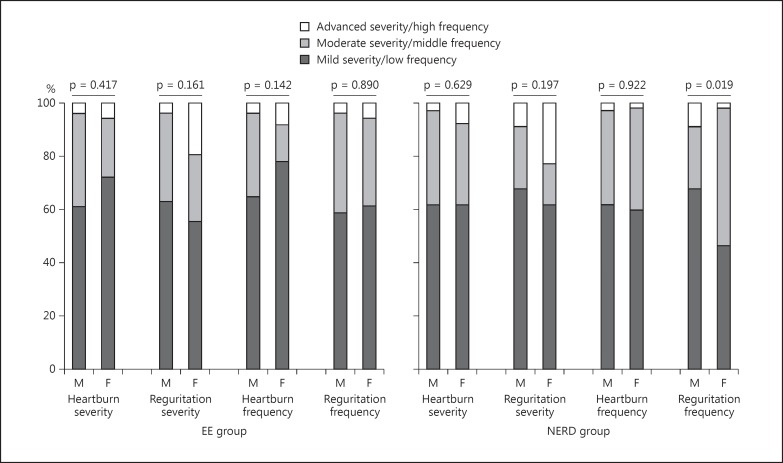
Of the 261 patients, 87 (33.3%), 86 (33.0%) and 88 (33.7%) patients were classified into the EE, the NERD and the control groups, respectively. The patients in the EE group were significantly older (48.94 ± 17.38 vs. 43.34 ± 12.67 years), were predominately male (58.6 vs. 39.5%), had more frequently hiatal hernia (34.5 vs 17.4%), had a higher body weight (67.57 ± 15.13 vs. 61.06 ± 11.08 kg) and a higher body mass index (24.09 ± 4.61 vs. 22.68 ± 3.12) than those in the NERD group. The GERD-specific symptom scores and the general life quality scores of the EE and the NERD groups were similar, and both groups had lower life quality scores than the control group did. The female patients with NERD had a higher frequency of GERD symptoms and lower quality of life scores. Gender had no effect on symptom scores or life quality scores in the EE group.
The GERD-specific symptom severity and general quality of life scores of the EE and the NERD patients were similar. Gender had a great influence on symptom presentation and quality of life in patients with NERD, but not in those with EE.
本研究旨在调查性别对糜烂性食管炎(EE)和非糜烂性反流病(NERD)患者症状表现及生活质量的影响。
回顾了2009年1月至12月间胃食管反流病(GERD)患者的病历。将患者分为EE组或NERD组。比较两组患者的一般人口统计学数据、改良的中国GERDQ评分和简短健康调查(SF)-36生活质量问卷评分。
261例患者中,分别有87例(33.3%)、86例(33.0%)和88例(33.7%)患者被分为EE组、NERD组和对照组。EE组患者年龄显著更大(48.94±17.38岁 vs. 43.34±12.67岁),男性占比更高(58.6% vs. 39.5%),食管裂孔疝更为常见(34.5% vs 17.4%),体重更高(67.57±15.13 kg vs. 61.06±11.08 kg),体重指数也更高(24.09±4.61 vs. 22.68±3.12)。EE组和NERD组的GERD特异性症状评分及总体生活质量评分相似,且两组的生活质量评分均低于对照组。NERD女性患者的GERD症状发生率更高,生活质量评分更低。性别对EE组患者的症状评分或生活质量评分无影响。
EE和NERD患者的GERD特异性症状严重程度及总体生活质量评分相似。性别对NERD患者的症状表现及生活质量有很大影响,但对EE患者无影响。