Division of Oral Biology, College of Dentistry, The Ohio State University, Columbus, OH, USA.
Division of Periodontology, School of Dental Sciences and Institute of Cellular Medicine, Newcastle University, Newcastle upon Tyne, UK.
ISME J. 2015 Jan;9(1):268-72. doi: 10.1038/ismej.2014.114. Epub 2014 Jul 11.
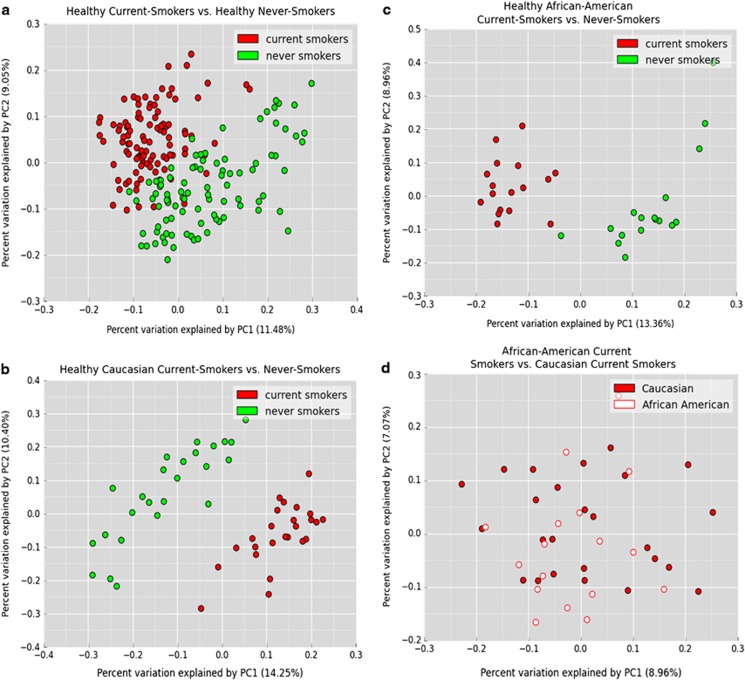
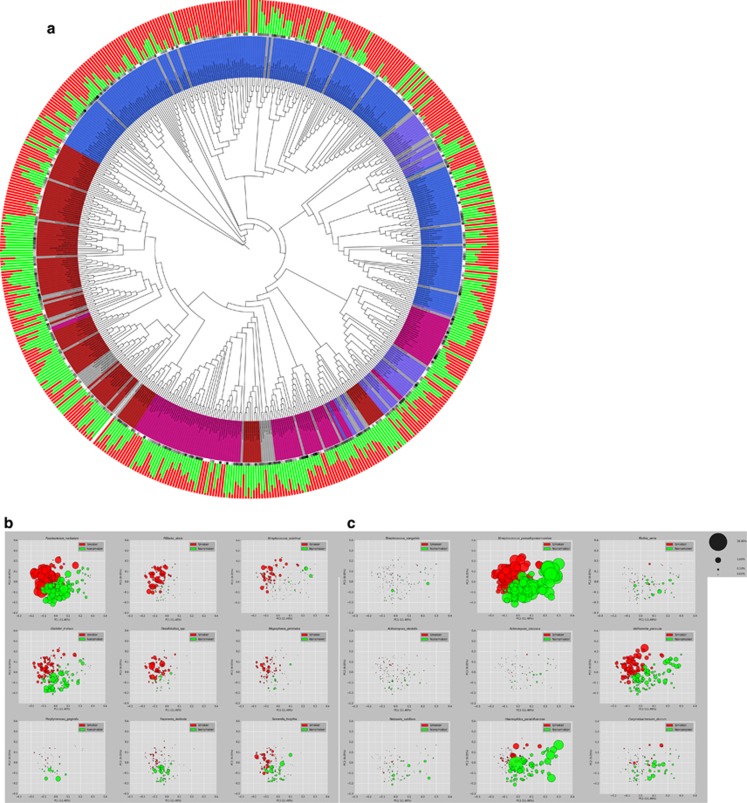
Dysbiotic oral bacterial communities have a critical role in the etiology and progression of periodontal diseases. The goal of this study was to investigate the extent to which smoking increases risk for disease by influencing the composition of the subgingival microbiome in states of clinical health. Subgingival plaque samples were collected from 200 systemically and periodontally healthy smokers and nonsmokers. 16S pyrotag sequencing was preformed generating 1,623,713 classifiable sequences, which were compared with a curated version of the Greengenes database using the quantitative insights into microbial ecology pipeline. The subgingival microbial profiles of smokers and never-smokers were different at all taxonomic levels, and principal coordinate analysis revealed distinct clustering of the microbial communities based on smoking status. Smokers demonstrated a highly diverse, pathogen-rich, commensal-poor, anaerobic microbiome that is more closely aligned with a disease-associated community in clinically healthy individuals, suggesting that it creates an at-risk-for-harm environment that is primed for a future ecological catastrophe.
失调的口腔细菌群落在牙周病的病因和进展中起着关键作用。本研究的目的是通过研究吸烟对龈下微生物组组成的影响,来确定吸烟在多大程度上增加了疾病的风险,而这些影响是在临床健康状态下产生的。从 200 名系统性和牙周健康的吸烟者和非吸烟者中采集龈下菌斑样本。进行 16S 焦磷酸测序,生成 1,623,713 个可分类序列,并使用微生物生态定量分析工具(QIIME)与 Greengenes 数据库的经过修正版本进行比较。吸烟者和从不吸烟者的龈下微生物群落在所有分类水平上都不同,主坐标分析显示,根据吸烟状况,微生物群落存在明显的聚类。吸烟者表现出一种高度多样、富含病原体、共生体贫乏、厌氧的微生物组,与临床健康个体中与疾病相关的群落更为接近,这表明它创造了一个有潜在危害的环境,为未来的生态灾难做好了准备。