
两种风险的故事:吸烟、糖尿病与龈下微生物群
A tale of two risks: smoking, diabetes and the subgingival microbiome.
作者信息
Ganesan Sukirth M, Joshi Vinayak, Fellows Megan, Dabdoub Shareef M, Nagaraja Haikady N, O'Donnell Benjamin, Deshpande Neeta Rohit, Kumar Purnima S
机构信息
Division of Periodontology, College of Dentistry, The Ohio State University, Coloumbus, OH, USA.
Maratha Mandal's NathajiRao G. Halgekar Institute of Dental Sciences and Research Center, Rajiv Gandhi University, Belgaum, India.
出版信息
ISME J. 2017 Sep;11(9):2075-2089. doi: 10.1038/ismej.2017.73. Epub 2017 May 23.
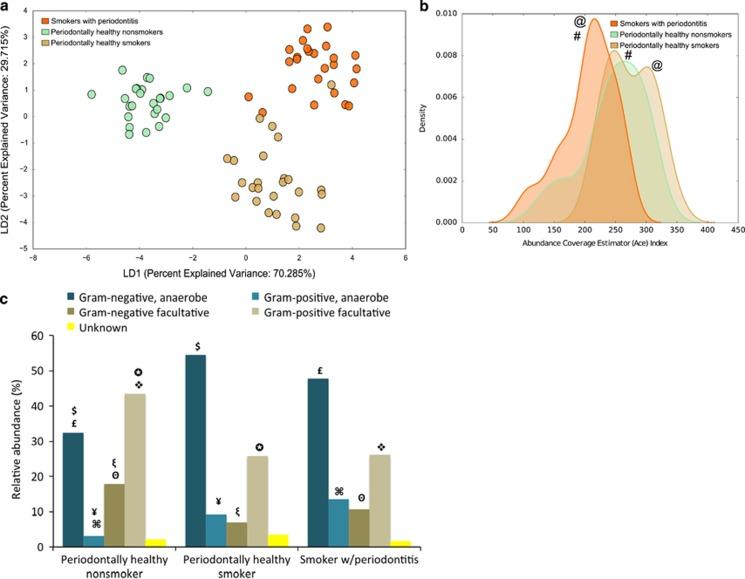
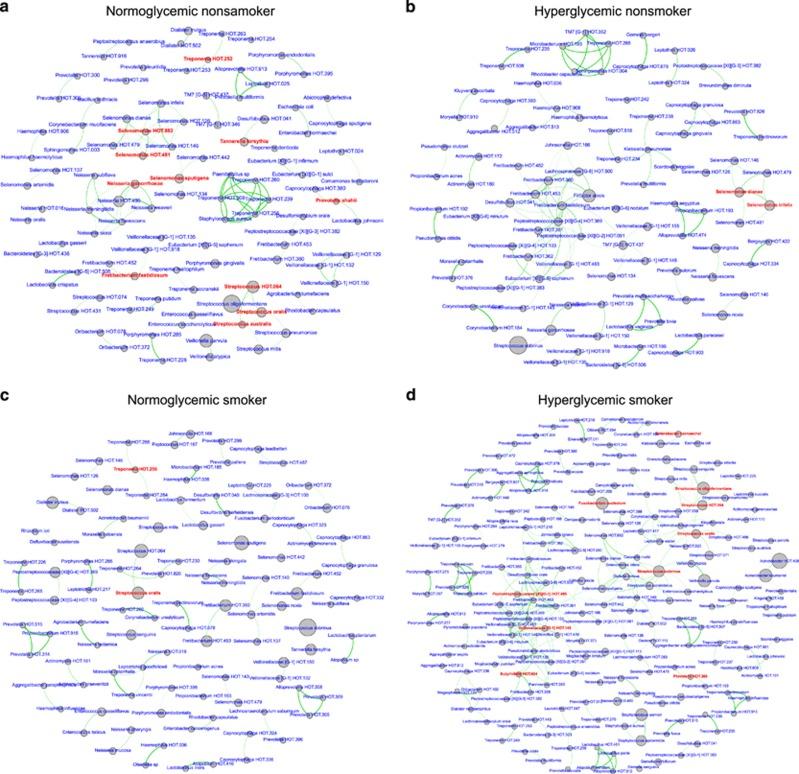
Although smoking and diabetes have been established as the only two risk factors for periodontitis, their individual and synergistic impacts on the periodontal microbiome are not well studied. The present investigation analyzed 2.7 million 16S sequences from 175 non-smoking normoglycemic individuals (controls), smokers, diabetics and diabetic smokers with periodontitis as well as periodontally healthy controls, smokers and diabetics to assess subgingival bacterial biodiversity and co-occurrence patterns. The microbial signatures of periodontally healthy smokers, but not diabetics, were highly aligned with the disease-associated microbiomes of their respective cohorts. Diabetics were dominated by species belonging to Fusobacterium, Parvimonas, Peptostreptococcus, Gemella, Streptococcus, Leptotrichia, Filifactor, Veillonella, TM7 and Terrahemophilus. These microbiomes exhibited significant clustering based on HbA1c levels (pre-diabetic (<6.5%), diabetic (6.5-9.9%), diabetics >10%). Smokers with periodontitis evidenced a robust core microbiome (species identified in at least 80% of individuals) dominated by anaerobes, with inter-individual differences attributable largely to the 'rare biosphere'. Diabetics and diabetic smokers, on the other hand, were microbially heterogeneous and enriched for facultative species. In smokers, microbial co-occurrence networks were sparse and predominantly congeneric, while robust inter-generic networks were observed in diabetics and diabetic smokers. Smoking and hyperglycemia impact the subgingival microbiome in distinct ways, and when these perturbations intersect, their synergistic effect is greater than what would be expected from the sum of each effect separately. Thus, this study underscores the importance of early intervention strategies in maintaining health-compatible microbiomes in high-risk individuals, as well as the need to personalize these interventions based on the environmental perturbation.
尽管吸烟和糖尿病已被确认为仅有的两种牙周炎风险因素,但它们对牙周微生物群的个体影响和协同影响尚未得到充分研究。本研究分析了来自175名非吸烟血糖正常个体(对照组)、吸烟者、糖尿病患者以及患有牙周炎的糖尿病吸烟者,以及牙周健康的对照组、吸烟者和糖尿病患者的270万个16S序列,以评估龈下细菌的生物多样性和共生模式。牙周健康的吸烟者而非糖尿病患者的微生物特征与各自队列中与疾病相关的微生物群高度一致。糖尿病患者中以属于梭杆菌属、微小单胞菌属、消化链球菌属、孪生球菌属、链球菌属、纤毛菌属、纤毛菌属、韦荣球菌属、TM7和土栖嗜热菌属的物种为主。这些微生物群根据糖化血红蛋白水平(糖尿病前期(<6.5%)、糖尿病(6.5 - 9.9%)、糖尿病患者>10%)表现出显著的聚类。患有牙周炎的吸烟者有一个以厌氧菌为主的强大核心微生物群(在至少80%的个体中鉴定出的物种),个体间差异主要归因于“稀有生物圈”。另一方面,糖尿病患者和糖尿病吸烟者的微生物具有异质性,兼性物种丰富。在吸烟者中,微生物共生网络稀疏且主要是同属的,而在糖尿病患者和糖尿病吸烟者中观察到强大的异属网络。吸烟和高血糖以不同方式影响龈下微生物群,当这些干扰因素相互交叉时,它们的协同作用大于分别考虑每种作用时的预期之和。因此,本研究强调了早期干预策略在高危个体中维持与健康相容的微生物群的重要性,以及根据环境干扰对这些干预进行个性化的必要性。



 Zotero 插件