Department of Pediatrics, Arkansas Children's Hospital Research Institute, University of Arkansas for Medical Sciences , Little Rock, AR , USA.
Rossignol Medical Center , Irvine, CA , USA.
Front Pediatr. 2014 Jun 27;2:66. doi: 10.3389/fped.2014.00066. eCollection 2014.
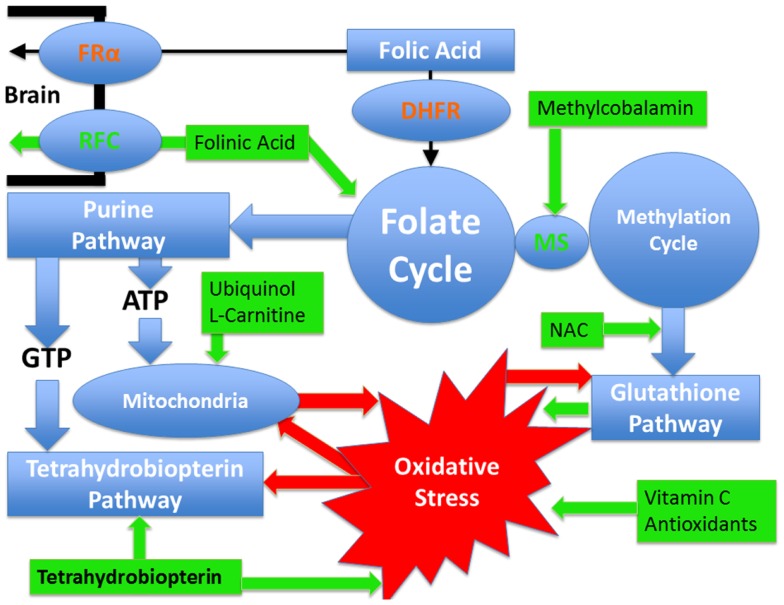
Recent studies point to the effectiveness of novel treatments that address physiological abnormalities associated with autism spectrum disorder (ASD). This is significant because safe and effective treatments for ASD remain limited. These physiological abnormalities as well as studies addressing treatments of these abnormalities are reviewed in this article. Treatments commonly used to treat mitochondrial disease have been found to improve both core and associated ASD symptoms. Double-blind, placebo-controlled (DBPC) studies have investigated l-carnitine and a multivitamin containing B vitamins, antioxidants, vitamin E, and co-enzyme Q10 while non-blinded studies have investigated ubiquinol. Controlled and uncontrolled studies using folinic acid, a reduced form of folate, have reported marked improvements in core and associated ASD symptoms in some children with ASD and folate related pathway abnormities. Treatments that could address redox metabolism abnormalities include methylcobalamin with and without folinic acid in open-label studies and vitamin C and N-acetyl-l-cysteine in DBPC studies. These studies have reported improved core and associated ASD symptoms with these treatments. Lastly, both open-label and DBPC studies have reported improvements in core and associated ASD symptoms with tetrahydrobiopterin. Overall, these treatments were generally well-tolerated without significant adverse effects for most children, although we review the reported adverse effects in detail. This review provides evidence for potentially safe and effective treatments for core and associated symptoms of ASD that target underlying known physiological abnormalities associated with ASD. Further research is needed to define subgroups of children with ASD in which these treatments may be most effective as well as confirm their efficacy in DBPC, large-scale multicenter studies.
最近的研究表明,针对与自闭症谱系障碍(ASD)相关的生理异常的新型治疗方法是有效的。这是非常重要的,因为目前针对 ASD 的安全有效的治疗方法仍然有限。本文综述了这些生理异常以及针对这些异常的治疗方法的研究。已经发现,常用于治疗线粒体疾病的治疗方法可以改善核心和相关 ASD 症状。双盲、安慰剂对照(DBPC)研究已经调查了左旋肉碱和一种含有 B 族维生素、抗氧化剂、维生素 E 和辅酶 Q10 的多种维生素,而非盲研究则调查了泛醇。使用叶酸的对照和非对照研究,一种还原形式的叶酸,已经报道了一些 ASD 儿童和与叶酸相关途径异常的核心和相关 ASD 症状有明显改善。可以解决氧化还原代谢异常的治疗方法包括甲钴胺和叶酸在开放标签研究中和维生素 C 和 N-乙酰-L-半胱氨酸在 DBPC 研究中。这些研究报告称,这些治疗方法可改善核心和相关 ASD 症状。最后,开放标签和 DBPC 研究都报告了四氢生物蝶呤治疗后核心和相关 ASD 症状的改善。总的来说,这些治疗方法在大多数儿童中通常耐受性良好,没有明显的不良反应,尽管我们详细审查了报告的不良反应。这篇综述为 ASD 的核心和相关症状提供了潜在安全有效的治疗方法,这些治疗方法针对与 ASD 相关的已知生理异常。需要进一步的研究来确定这些治疗方法可能对哪些亚组的 ASD 儿童最有效,并在 DBPC、大规模多中心研究中确认其疗效。