Department of Orthopaedics, Jichi Medical University, Shimotsuke, Tochigi, Japan.
Global Spine J. 2014 Jun;4(2):77-82. doi: 10.1055/s-0034-1366973. Epub 2014 Jan 27.
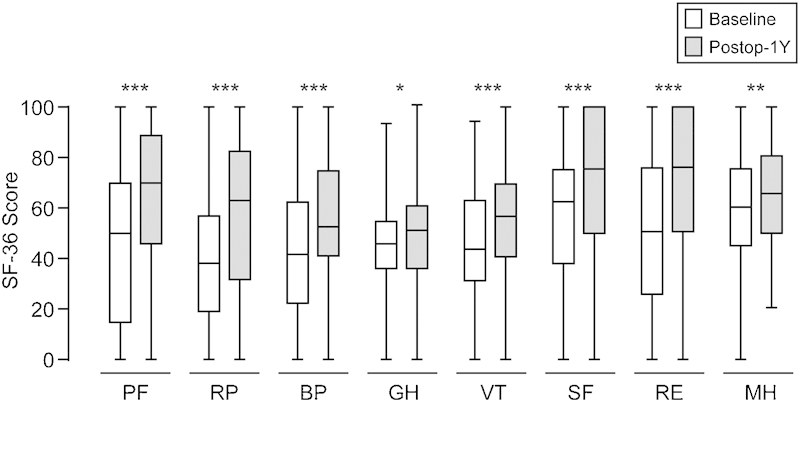
Study design Prospective cohort study. Objective The purpose of the present study was to identify the predictors of patient satisfaction with outcome after cervical laminoplasty for compressive cervical myelopathy. Methods A cohort of 143 patients with compressive myelopathy who underwent cervical double-door laminoplasty between 2008 and 2011 was studied prospectively. The principal outcome was patient satisfaction with outcome at 1 year after surgery. Patient satisfaction was graded on an ordinal scale from 1 to 7. Subjective health-related quality of life (QOL) and objective disease-specific outcome was measured by Short Form-36 (SF-36) and the Japanese Orthopaedic Association (JOA) score, respectively, before surgery and at 1-year follow-up. We evaluated the association between patient satisfaction at 1-year follow-up and various baseline parameters, including patient demographics, duration of symptoms, comorbidities, imaging findings, JOA score, and SF-36 scores. Results A total of 116 patients completed subjective and objective follow-up for a minimum of 1 year. Of 116 patients, 95 patients (81.9%) were satisfied with the outcome ("satisfied a little" or more). The unsatisfied group ("neutral" or less) showed significantly lower baseline SF-36 scores in bodily pain (BP), general health perceptions (GH), and vitality (VT) domains compared with the satisfied group. At the 1-year follow-up, SF-36 scores showed significant differences between the groups in all eight domains, whereas the JOA score showed no significant difference. Conclusions Lower baseline QOL measured by SF-36 scores, specifically in BP, GH, and VT domains, are associated with lower satisfaction with outcome after cervical laminoplasty.
前瞻性队列研究。目的:本研究旨在确定颈椎管狭窄症患者接受颈椎双开门椎板成形术后对疗效满意度的预测因素。方法:前瞻性研究了 2008 年至 2011 年间接受颈椎双开门椎板成形术的 143 例压迫性脊髓病患者。主要结局是术后 1 年患者对疗效的满意度。满意度评分采用 1 到 7 的等级量表进行评定。术前和术后 1 年分别采用健康相关生活质量量表(SF-36)和日本矫形协会(JOA)评分评估主观健康相关生活质量(QOL)和客观疾病特异性结局。评估了 1 年随访时患者满意度与各种基线参数之间的关系,包括患者人口统计学特征、症状持续时间、合并症、影像学表现、JOA 评分和 SF-36 评分。结果:共有 116 例患者完成了至少 1 年的主观和客观随访。在 116 例患者中,95 例(81.9%)对治疗结果满意(“稍有满意”或更满意)。不满意组(“中立”或更不满意)在基线时 SF-36 评分的身体疼痛(BP)、总体健康感觉(GH)和活力(VT)维度明显低于满意组。在 1 年随访时,两组在所有 8 个维度的 SF-36 评分均存在显著差异,而 JOA 评分则无显著差异。结论:SF-36 评分较低的基线 QOL,特别是在 BP、GH 和 VT 维度,与颈椎椎板成形术后的疗效满意度较低相关。