Department of Psychiatry, Chonbuk National University Medical School, Jeonju, Republic of Korea.
Department of Psychiatry, Chonbuk National University Medical School, Jeonju, Republic of Korea. ; Research Institute of Clinical Medicine of Chonbuk National University-Biomedical, Research Institute of Chonbuk National University Hospital, Jeonju, Republic of Korea.
Psychiatry Investig. 2014 Jul;11(3):258-65. doi: 10.4306/pi.2014.11.3.258. Epub 2014 Jul 21.
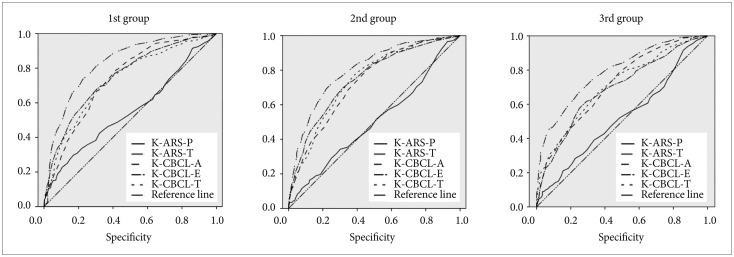
The purpose of this study is to examine the validity of primary screening tools for attention deficit hyperactivity disorder (ADHD) in a community-based sample of children using the Korean version of the Child Behavior Checklist (K-CBCL) and the Korean version of the ADHD Rating Scale (K-ARS).
A large-scale community-based study for ADHD screening was conducted in the Jeollabuk province in the Republic of Korea. In 2010-2011, we surveyed a total of 49,088 first- and fourth-grade elementary school students. All of the participants in this study were assessed by the K-ARS-Parent version (K-ARS-P) and the K-ARS-Teacher version (K-ARS-T) as the primary screening instruments. The Diagnostic Interview Schedule for Children Version IV (DISC-IV) was used for confirming the diagnosis of ADHD. DISC-IV was administered to subjects who received top 10% scores in the K-ARS-P or K-ARS-T tests.
Of the 3,085 subjects who completed the DISC-IV, 1,215 were diagnosed as having ADHD. A reasonable level of sensitivity, specificity, and negative predictive value were obtained when the total K-ARS-P scores were ≥90th percentile. The positive predictive value and specificity increased significantly when the total K-ARS-P scores were ≥90th percentile, T scores were ≥60 in the attention problems of K-CBCL, and T scores were ≥63 in the total problems of K-CBCL.
These results suggested that the K-ARS-P could effectively serve as a primary screening tool to identify elementary school children with ADHD in the community. Also, there might be some increment in the effectiveness of K-ARS-P when combined with K-CBCL-A and K-CBCL-T as a secondary screening tool.
本研究旨在使用儿童行为检查表(K-CBCL)韩文版和注意缺陷多动障碍评定量表(K-ARS)韩文版,对以社区为基础的儿童样本中的注意力缺陷多动障碍(ADHD)的主要筛查工具进行有效性验证。
在韩国全罗北道进行了一项大规模的社区 ADHD 筛查研究。在 2010-2011 年,我们对总共 49088 名一、四年级的小学生进行了调查。本研究中的所有参与者均通过 K-ARS-Parent 版本(K-ARS-P)和 K-ARS-Teacher 版本(K-ARS-T)进行评估,作为主要的筛查工具。使用儿童诊断访谈表第四版(DISC-IV)对 ADHD 进行确诊。DISC-IV 仅对 K-ARS-P 或 K-ARS-T 测试中得分最高的前 10%的受试者进行评估。
在完成 DISC-IV 的 3085 名受试者中,有 1215 名被诊断为 ADHD。当总分 K-ARS-P 达到第 90 百分位数时,可获得合理的灵敏度、特异性和阴性预测值。当总分 K-ARS-P 达到第 90 百分位数,K-CBCL 的注意力问题 T 分数达到≥60,K-CBCL 的总问题 T 分数达到≥63 时,阳性预测值和特异性显著增加。
这些结果表明,K-ARS-P 可有效作为一种主要的筛查工具,用于识别社区中的 ADHD 小学生。此外,当与 K-CBCL-A 和 K-CBCL-T 结合作为二级筛查工具时,K-ARS-P 的有效性可能会有所提高。