Hirooka Kazuyuki, Tenkumo Kaori, Nitta Eri, Sato Shino
Department of Ophthalmology, Kagawa University Faculty of Medicine, 1750-1 Ikenobe, Miki, Kagawa 761-0793, Japan.
J Ophthalmol. 2014;2014:801967. doi: 10.1155/2014/801967. Epub 2014 Jul 17.
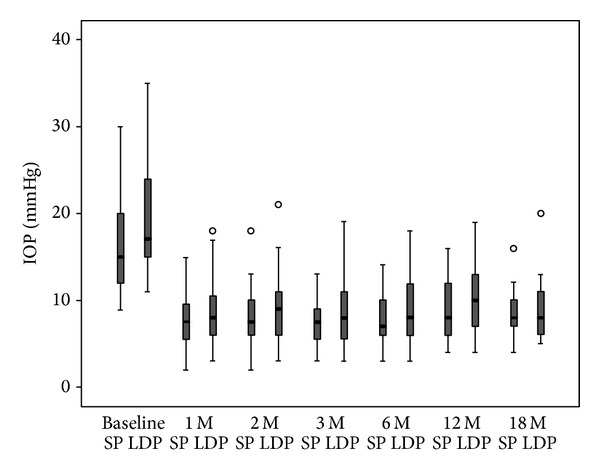
Background. To investigate the correlation between intraocular pressure (IOP) fluctuation with postural change and IOP in relation to the time course after trabeculectomy. Methods. A total of 29 patients who had previously undergone primary trabeculectomy with mitomycin C were examined. IOP was obtained at 1, 2, 3, 6, and 12 months and then every 6 months postoperatively. Results. The postural IOP difference before surgery was 3.0 ± 1.8 mmHg, which was reduced to 0.9 ± 1.1 mmHg at 1 month, 1.0 ± 1.0 mmHg at 2 months, 1.3 ± 2.0 mmHg at 3 months, 1.3 ± 1.4 mmHg at 6 months, 1.4 ± 1.5 mmHg at 12 months, and 1.1 ± 0.7 mmHg at 18 months after trabeculectomy (P < 0.01 each visit). The filtering surgery failed in 7 out of 29 eyes. Postural IOP changes were less than 3 mmHg in those patients who did not require needle revision at every visit. However, in patients who did require needle revision, the increase in the posture-induced IOP was greater than 3 mmHg prior to the increase in the sitting position IOP. Conclusions. Assessment of postural IOP changes after trabeculectomy might be potentially useful for predicting IOP changes after trabeculectomy.
背景。研究小梁切除术后眼压(IOP)随体位变化的波动与眼压随时间变化的相关性。方法。共检查了29例先前接受过丝裂霉素C辅助的原发性小梁切除术的患者。在术后1、2、3、6和12个月时测量眼压,之后每6个月测量一次。结果。术前体位性眼压差异为3.0±1.8 mmHg,小梁切除术后1个月降至0.9±1.1 mmHg,2个月时为1.0±1.0 mmHg,3个月时为1.3±2.0 mmHg,6个月时为1.3±1.4 mmHg,12个月时为1.4±1.5 mmHg,18个月时为1.1±0.7 mmHg(每次随访P<0.01)。29只眼中有7只眼滤过手术失败。每次随访时无需针刺修复的患者,体位性眼压变化小于3 mmHg。然而,在确实需要针刺修复的患者中,体位性眼压升高大于3 mmHg发生在坐位眼压升高之前。结论。小梁切除术后体位性眼压变化的评估可能有助于预测小梁切除术后的眼压变化。