Wasielica-Poslednik Joanna, Schmeisser Julian, Hoffmann Esther M, Weyer-Elberich Veronika, Bell Katharina, Lorenz Katrin, Pfeiffer Norbert
Department of Ophthalmology, University Medical Center, Johannes Gutenberg- University, Mainz, Germany.
Institute for Medical Biostatistics, Epidemiology and Informatics (IMBEI), University Medical Center, Johannes Gutenberg University, Mainz, Germany.
PLoS One. 2017 Oct 4;12(10):e0185246. doi: 10.1371/journal.pone.0185246. eCollection 2017.
Intraocular pressure (IOP) fluctuation is considered as a risk factor for glaucoma progression. We investigated IOP values and IOP fluctuation before and after trabeculectomy (TE) with mitomycin C (MMC) measured by 48-hour diurnal-nocturnal-IOP-profiles (DNP).
Pre- and postoperative DNPs of 92 eyes undergoing primary TE with MMC were analysed. Each 48-hour IOP-profile involved 10 IOP measurements (8:00 a.m., 2:00 p.m., 6:00 p.m., and 9:00 p.m. in sitting and at 00:00 in supine position). The "preoperative DNP" was performed a few weeks before TE. The "postoperative DNP" was performed at least six months (range: 6 months-2 years) after TE. Mean IOP values and IOP fluctuations were calculated.
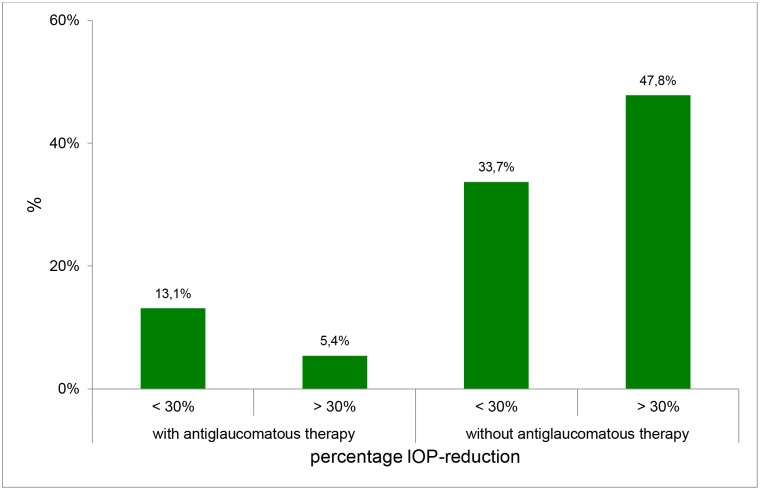
After TE with MMC mean IOP was reduced from 16.94±3.83 to 11.26±3.77 mmHg at daytime and from 18.17±4.26 to 11.76±3.90 mmHg at night. At daytime mean IOP-fluctuation decreased from 8.61±4.19 to 4.92±2.52 mmHg, at night from 3.15±2.95 to 1.99±1.82 mmHg. Mean IOP was lower on the second day of the preoperative DNP. This effect was not present in the postoperative DNP. Preoperatively, IOP was controlled in all eyes with a mean of 3.22±0.94 antiglaucomatous agents. Postoperatively, IOP≤15 mmHg was achieved in 71.7%, IOP≤18 mmHg in 77.1% and a decrease in IOP of >30% in 47.8% without antiglaucomatous therapy. Postoperatively, pseudophakia was associated by a higher mean IOP-fluctuation compared to the phakic eyes.
TE with MMC significantly reduces both mean IOP-values and IOP- fluctuations at day and night at least 6 months postoperatively. The effect of TE on the IOP fluctuation was less pronounced in pseudophakic eyes.
眼压(IOP)波动被认为是青光眼进展的一个危险因素。我们通过48小时昼夜眼压剖面图(DNP)研究了小梁切除术(TE)联合丝裂霉素C(MMC)前后的眼压值和眼压波动情况。
分析了92例行原发性TE联合MMC治疗的患眼的术前和术后DNP。每48小时眼压剖面图包括10次眼压测量(上午8:00、下午2:00、下午6:00和晚上9:00坐位时测量,仰卧位0:00时测量)。“术前DNP”在TE前几周进行。“术后DNP”在TE后至少6个月(范围:6个月至2年)进行。计算平均眼压值和眼压波动情况。
TE联合MMC治疗后,白天平均眼压从16.94±3.83 mmHg降至11.26±3.77 mmHg,夜间从18.17±4.26 mmHg降至11.76±3.90 mmHg。白天平均眼压波动从8.61±4.19 mmHg降至4.92±2.52 mmHg,夜间从3.15±2.95 mmHg降至1.99±1.82 mmHg。术前DNP第二天平均眼压较低。术后DNP中不存在这种效应。术前,所有患眼眼压均通过平均3.22±0.94种抗青光眼药物得到控制。术后,71.7%的患眼眼压≤15 mmHg,77.1%的患眼眼压≤18 mmHg,47.8%的患眼在未使用抗青光眼治疗的情况下眼压降低>30%。术后,与有晶状体眼相比,人工晶状体眼的平均眼压波动更高。
TE联合MMC可在术后至少6个月显著降低昼夜平均眼压值和眼压波动。TE对人工晶状体眼眼压波动的影响不太明显。