• 文献检索
  • 文档翻译
  • 深度研究
  • 学术资讯
  • Suppr Zotero 插件Zotero 插件
  • 邀请有礼
  • 套餐&价格
  • 历史记录
应用&插件
Suppr Zotero 插件Zotero 插件浏览器插件Mac 客户端Windows 客户端微信小程序
定价
高级版会员购买积分包购买API积分包
服务
文献检索文档翻译深度研究API 文档MCP 服务
关于我们
关于 Suppr公司介绍联系我们用户协议隐私条款
关注我们

Suppr 超能文献

核心技术专利:CN118964589B侵权必究
粤ICP备2023148730 号-1Suppr @ 2026

文献检索

告别复杂PubMed语法,用中文像聊天一样搜索,搜遍4000万医学文献。AI智能推荐,让科研检索更轻松。

立即免费搜索

文件翻译

保留排版,准确专业,支持PDF/Word/PPT等文件格式,支持 12+语言互译。

免费翻译文档

深度研究

AI帮你快速写综述,25分钟生成高质量综述,智能提取关键信息,辅助科研写作。

立即免费体验

银纳米颗粒对四种食源性病原体的抗菌作用。

Antibacterial effect of silver nanoparticles against four foodborne pathogens.

作者信息

Zarei Mehdi, Jamnejad Amirhesam, Khajehali Elahe

机构信息

Department of Food Hygiene, Faculty of Veterinary Medicine, Shahid Chamran University of Ahvaz, Ahvaz, IR Iran.

Department of Food Hygiene, Faculty of Veterinary Medicine, Shiraz University of Medical Sciences, Shiraz, IR Iran.

出版信息

Jundishapur J Microbiol. 2014 Jan;7(1):e8720. doi: 10.5812/jjm.8720. Epub 2014 Jan 1.

DOI:10.5812/jjm.8720
PMID:25147658
原文链接:https://pmc.ncbi.nlm.nih.gov/articles/PMC4138668/
Abstract

BACKGROUND

There is increased demand for improved disinfection methods due to microorganisms resistant to multiple antimicrobial agents. Numerous types of disinfectants are available with different properties; but the proper disinfectant must be carefully selected for any specific application to obtain the desired antimicrobial effect.

OBJECTIVES

Antimicrobial effect of a commercial nanosilver product, NanoCid® L2000, against some foodborne pathogens was evaluated.

MATERIALS AND METHODS

Minimum inhibitory concentrations (MIC) were determined by monitoring the growth of bacteria at 600 nm, after 24 hours incubation at 35°C. Minimum bactericidal concentrations (MBC) were determined based on 3 log decrease in the viable population of the pathogens after incubation of nutrient agar plates at 35°C for 24 hours. The required exposure time for 3 log reduction in the viable population of the tested pathogens was determined as the minimum exposure time for efficient bactericidal activity.

RESULTS

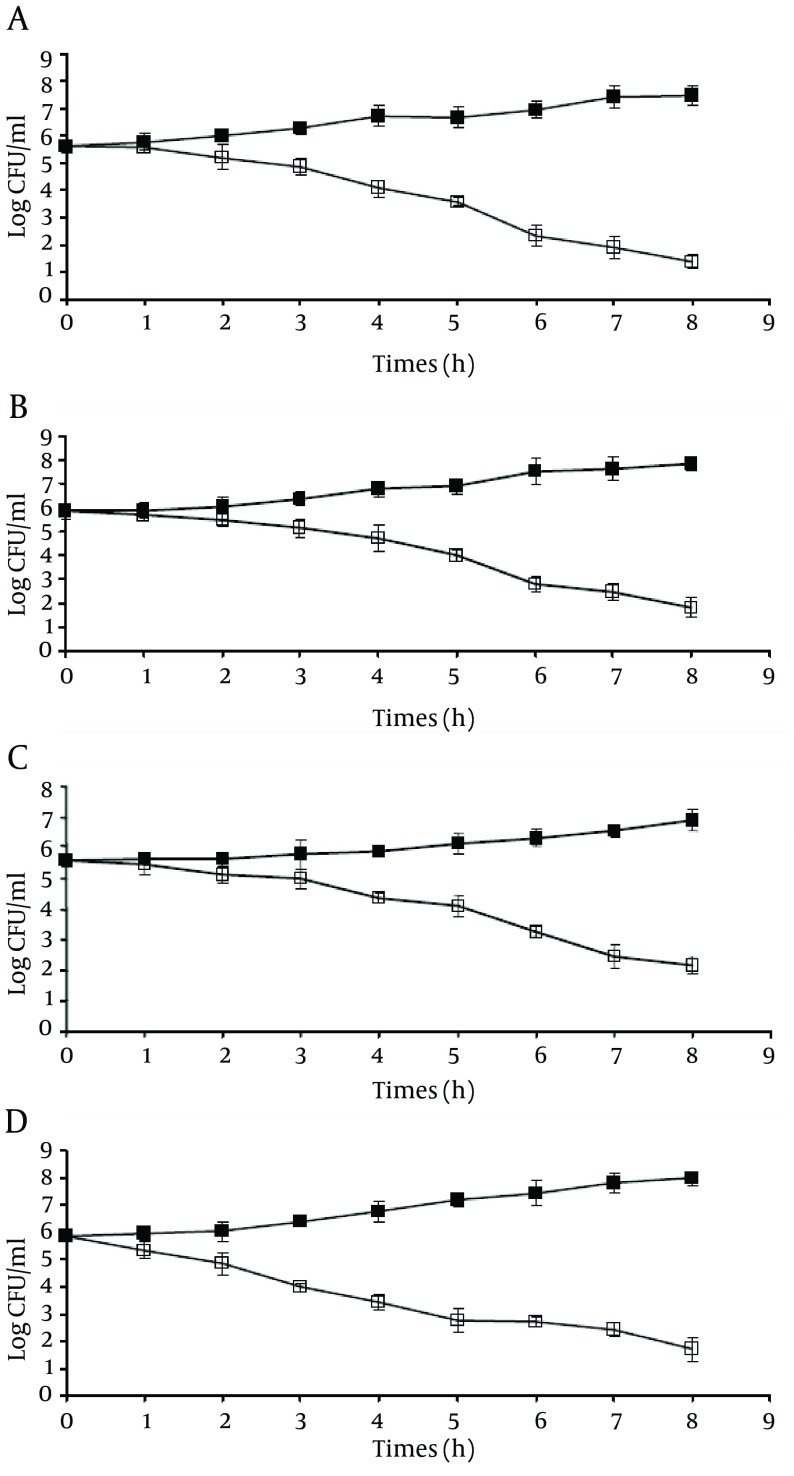
The MIC values of Ag NPs against tested pathogens were in the range of 3.12-6.25 µg/mL. While Listeria monocytogenes showed the MIC value of 6.25 µg/mL, Escherichia coli O157:H7, Salmonella typhimurium and Vibrio parahaemolyticus all showed the MIC values of 3.12 µg/mL. However, all the pathogens showed the same MBC value of 6.25 µg/mL. To obtain an efficient bactericidal activity against E. coli O157:H7 and S. typhimurium, the exposure time should be at least ca. 6 hours., while this time was ca. 5 hours for V. parahaemolyticus and ca. 7 hours for L. monocytogenes.

CONCLUSIONS

Silver nanoparticles showed great antibacterial effectiveness on four important foodborne pathogens. Therefore, Ag NPs could be a good alternative for cleaning and disinfection of equipment and surfaces in food-related environments.

摘要

背景

由于微生物对多种抗菌剂产生耐药性,对改进消毒方法的需求日益增加。有多种具有不同特性的消毒剂可供选择;但对于任何特定应用,必须仔细选择合适的消毒剂以获得所需的抗菌效果。

目的

评估一种商业纳米银产品NanoCid® L2000对某些食源性病原体的抗菌效果。

材料与方法

通过在35°C孵育24小时后,于600 nm处监测细菌生长来确定最低抑菌浓度(MIC)。基于在35°C孵育营养琼脂平板24小时后病原体活菌数量减少3个对数来确定最低杀菌浓度(MBC)。将测试病原体活菌数量减少3个对数所需的暴露时间确定为有效杀菌活性的最短暴露时间。

结果

银纳米颗粒对测试病原体的MIC值在3.12 - 6.25 µg/mL范围内。单核细胞增生李斯特菌的MIC值为6.25 µg/mL,而大肠杆菌O157:H7、鼠伤寒沙门氏菌和副溶血性弧菌的MIC值均为3.12 µg/mL。然而,所有病原体的MBC值均为6.25 µg/mL。要对大肠杆菌O157:H7和鼠伤寒沙门氏菌获得有效的杀菌活性,暴露时间至少应为约6小时,而对副溶血性弧菌此时间约为5小时,对单核细胞增生李斯特菌约为7小时。

结论

银纳米颗粒对四种重要的食源性病原体显示出强大的抗菌效果。因此,银纳米颗粒可作为食品相关环境中设备和表面清洁与消毒的良好替代品。
https://cdn.ncbi.nlm.nih.gov/pmc/blobs/7769/4138668/14064ccd2a09/jjm-07-8720-i001.jpg

相似文献

1
Antibacterial effect of silver nanoparticles against four foodborne pathogens.银纳米颗粒对四种食源性病原体的抗菌作用。
Jundishapur J Microbiol. 2014 Jan;7(1):e8720. doi: 10.5812/jjm.8720. Epub 2014 Jan 1.
2
Survival of foodborne pathogens (Escherichia coli O157:H7, Salmonella Typhimurium, Staphylococcus aureus, Listeria monocytogenes, and Vibrio parahaemolyticus) in raw ready-to-eat crab marinated in soy sauce.食源性病原体(大肠杆菌O157:H7、鼠伤寒沙门氏菌、金黄色葡萄球菌、单核细胞增生李斯特菌和副溶血性弧菌)在生的即食酱油腌制蟹中的存活情况。
Int J Food Microbiol. 2016 Dec 5;238:50-55. doi: 10.1016/j.ijfoodmicro.2016.08.041. Epub 2016 Aug 30.
3
Facile Synthesis, Characterization, and Antimicrobial Assessment of a Silver/Montmorillonite Nanocomposite as an Effective Antiseptic against Foodborne Pathogens for Promising Food Protection.银/蒙脱石纳米复合材料的简便合成、表征及抗菌评估,作为一种有前景的食品保护用食品病原体有效防腐剂。
Molecules. 2023 Apr 25;28(9):3699. doi: 10.3390/molecules28093699.
4
Synergistic antibacterial activity of compact silver/magnetite core-shell nanoparticles core shell against Gram-negative foodborne pathogens.紧密型银/磁铁矿核壳纳米颗粒对革兰氏阴性食源性病原体的协同抗菌活性。
Front Microbiol. 2022 Sep 2;13:929491. doi: 10.3389/fmicb.2022.929491. eCollection 2022.
5
Antibacterial Activity of Caffeic Acid Combined with UV-A Light against Escherichia coli O157:H7, Salmonella enterica Serovar Typhimurium, and Listeria monocytogenes.没食子酸联合 UV-A 光对大肠杆菌 O157:H7、鼠伤寒沙门氏菌和单核细胞增生李斯特菌的抗菌活性。
Appl Environ Microbiol. 2021 Jul 13;87(15):e0063121. doi: 10.1128/AEM.00631-21.
6
Inactivation of Listeria monocytogenes, Escherichia coli O157:H7, and Salmonella typhimurium with compounds available in households.利用家庭中可得的化合物对单核细胞增生李斯特菌、大肠杆菌O157:H7和鼠伤寒沙门氏菌进行灭活。
J Food Prot. 2009 Jun;72(6):1201-8. doi: 10.4315/0362-028x-72.6.1201.
7
Antimicrobial effect of electrolyzed oxidizing water against Escherichia coli O157:H7 and Listeria monocytogenes on fresh strawberries (Fragaria x ananassa).电解氧化水对新鲜草莓(凤梨草莓)上大肠杆菌O157:H7和单核细胞增生李斯特菌的抗菌作用
J Food Sci. 2007 Nov;72(9):M397-406. doi: 10.1111/j.1750-3841.2007.00531.x.
8
Antibacterial potential of silver nanoparticles (SP-AgNPs) synthesized from (Wight) Walp. against selected foodborne pathogens.从(怀特)瓦尔普合成的银纳米颗粒(SP-AgNPs)对选定食源性病原体的抗菌潜力。
Heliyon. 2023 Nov 22;9(12):e22771. doi: 10.1016/j.heliyon.2023.e22771. eCollection 2023 Dec.
9
Application of antimicrobial ice for reduction of foodborne pathogens (Escherichia coli O157:H7, Salmonella Typhimurium, Listeria monocytogenes) on the surface of fish.抗菌冰在减少鱼表面食源性病原体(大肠杆菌O157:H7、鼠伤寒沙门氏菌、单核细胞增生李斯特菌)方面的应用。
J Appl Microbiol. 2004;97(5):916-22. doi: 10.1111/j.1365-2672.2004.02343.x.
10
Attachment and colonization by Escherichia coli O157:H7, Listeria monocytogenes, Salmonella enterica subsp. enterica serovar Typhimurium, and Staphylococcus aureus on stone fruit surfaces and Survival through a simulated commercial export chain.大肠杆菌 O157:H7、单核细胞增生李斯特菌、肠炎沙门氏菌亚种肠炎血清型 Typhimurium 和金黄色葡萄球菌在核果表面的黏附和定殖及其在模拟商业出口链中的存活。
J Food Prot. 2010 Jul;73(7):1247-56. doi: 10.4315/0362-028x-73.7.1247.

引用本文的文献

1
Advancing food safety with biogenic silver nanoparticles: Addressing antimicrobial resistance, sustainability, and commercial viability.利用生物源银纳米颗粒推进食品安全:应对抗菌耐药性、可持续性及商业可行性
Food Chem X. 2025 Feb 20;26:102298. doi: 10.1016/j.fochx.2025.102298. eCollection 2025 Feb.
2
Green Synthesis and Characterization of Silver Nanoparticles Using Extracts to Investigate Their Antibacterial Potential.利用提取物进行银纳米颗粒的绿色合成及其表征以研究其抗菌潜力
Int J Nanomedicine. 2024 Dec 11;19:13319-13338. doi: 10.2147/IJN.S475656. eCollection 2024.
3
Antibacterial Activity and Mechanisms of Action of Inorganic Nanoparticles against Foodborne Bacterial Pathogens: A Systematic Review.

本文引用的文献

1
Retracted: Characterization of enhanced antibacterial effects of novel silver nanoparticles.撤回:新型银纳米颗粒增强抗菌效果的表征
Nanotechnology. 2007 May 4;18(22). doi: 10.1088/0957-4484/18/22/225103.
2
The bactericidal effect of silver nanoparticles.银纳米颗粒的杀菌作用。
Nanotechnology. 2005 Oct;16(10):2346-53. doi: 10.1088/0957-4484/16/10/059. Epub 2005 Aug 26.
3
Vibrios as causal agents of zoonoses.弧菌作为人畜共患病的病原体。
无机纳米颗粒对食源性病原体的抗菌活性及作用机制:系统评价。
IET Nanobiotechnol. 2024 Jan 16;2024:5417924. doi: 10.1049/2024/5417924. eCollection 2024.
4
Green Synthesis and Characterization of Biologically Synthesized and Antibiotic-Conjugated Silver Nanoparticles followed by Post-Synthesis Assessment for Antibacterial and Antioxidant Applications.生物合成及抗生素共轭银纳米颗粒的绿色合成与表征,以及合成后用于抗菌和抗氧化应用的评估
ACS Omega. 2024 Apr 15;9(17):18909-18921. doi: 10.1021/acsomega.3c08927. eCollection 2024 Apr 30.
5
The effect of nanosilver-based preparation on microbiological quality of poultry litter.纳米银制剂对家禽粪便微生物质量的影响。
Arch Anim Breed. 2023 Dec 11;66(4):421-431. doi: 10.5194/aab-66-421-2023. eCollection 2023.
6
Biogenic silver nanoparticles and cinnamaldehyde as an effective sanitizer for fresh sweet grape tomatoes.生物源银纳米颗粒和肉桂醛作为新鲜甜葡萄番茄的有效消毒剂
J Food Sci Technol. 2023 Sep;60(9):2477-2485. doi: 10.1007/s13197-023-05770-8. Epub 2023 May 30.
7
Review of Antimicrobial Nanocoatings in Medicine and Dentistry: Mechanisms of Action, Biocompatibility Performance, Safety, and Benefits Compared to Antibiotics.医学和牙科抗菌纳米涂层的综述:与抗生素相比,其作用机制、生物相容性表现、安全性和益处。
ACS Nano. 2023 Apr 25;17(8):7064-7092. doi: 10.1021/acsnano.2c12488. Epub 2023 Apr 7.
8
The anti-adherence activity and bactericidal effect of GO against Streptococcus mutans from Iraqi dental patients.GO 对伊拉克牙科患者口腔变形链球菌的抗黏附活性和杀菌作用。
Odontology. 2023 Oct;111(4):863-869. doi: 10.1007/s10266-023-00791-3. Epub 2023 Feb 15.
9
Antibacterial Activity of Biodegradable Films Incorporated with Biologically-Synthesized Silver Nanoparticles and the Evaluation of Their Migration to Chicken Meat.含有生物合成银纳米颗粒的可生物降解薄膜的抗菌活性及其向鸡肉迁移的评估
Antibiotics (Basel). 2023 Jan 15;12(1):178. doi: 10.3390/antibiotics12010178.
10
Emerging Trends in Advanced Translational Applications of Silver Nanoparticles: A Progressing Dawn of Nanotechnology.银纳米颗粒高级转化应用的新兴趋势:纳米技术的黎明曙光
J Funct Biomater. 2023 Jan 14;14(1):47. doi: 10.3390/jfb14010047.
Vet Microbiol. 2010 Jan 27;140(3-4):310-7. doi: 10.1016/j.vetmic.2009.03.015. Epub 2009 Mar 13.
4
Silver nanoparticles as a new generation of antimicrobials.银纳米颗粒作为新一代抗菌剂。
Biotechnol Adv. 2009 Jan-Feb;27(1):76-83. doi: 10.1016/j.biotechadv.2008.09.002. Epub 2008 Sep 30.
5
Strain specificity in antimicrobial activity of silver and copper nanoparticles.银和铜纳米颗粒抗菌活性的菌株特异性
Acta Biomater. 2008 May;4(3):707-16. doi: 10.1016/j.actbio.2007.11.006. Epub 2007 Nov 26.
6
Comparative evaluation of silver-containing antimicrobial dressings and drugs.含银抗菌敷料与药物的对比评估
Int Wound J. 2007 Jun;4(2):114-22. doi: 10.1111/j.1742-481X.2007.00316.x.
7
Antimicrobial effects of silver nanoparticles.银纳米颗粒的抗菌作用。
Nanomedicine. 2007 Mar;3(1):95-101. doi: 10.1016/j.nano.2006.12.001.
8
Does the antibacterial activity of silver nanoparticles depend on the shape of the nanoparticle? A study of the Gram-negative bacterium Escherichia coli.银纳米颗粒的抗菌活性是否取决于纳米颗粒的形状?对革兰氏阴性细菌大肠杆菌的一项研究。
Appl Environ Microbiol. 2007 Mar;73(6):1712-20. doi: 10.1128/AEM.02218-06. Epub 2007 Jan 19.
9
Topical delivery of silver nanoparticles promotes wound healing.银纳米颗粒的局部递送可促进伤口愈合。
ChemMedChem. 2007 Jan;2(1):129-36. doi: 10.1002/cmdc.200600171.
10
Antimicrobial effect of surgical masks coated with nanoparticles.涂覆纳米颗粒的外科口罩的抗菌效果
J Hosp Infect. 2006 Jan;62(1):58-63. doi: 10.1016/j.jhin.2005.04.015. Epub 2005 Aug 15.