Charafeddine Lama, Tamim Hani, Hassouna Habiba, Akel Randa, Nabulsi Mona
Department of Pediatrics and Adolescent Medicine, American University of Beirut Medical Center, P,O, Box: 11-0236, Riad El-Solh, 1107 2020 Beirut, Lebanon.
BMC Res Notes. 2014 Aug 31;7:584. doi: 10.1186/1756-0500-7-584.
Accurate measurement of body temperature is critical for the assessment of a newborn's general well-being. In nursery settings, the gold standard rectal thermometry has been replaced by the axillary method. However, evidence pertaining to the agreement between axillary and rectal thermometry in the newborn is controversial. In this cross-sectional study, the agreement between axillary and rectal temperature in newborns, as well as the effects of neonatal, maternal and environmental factors on this agreement were investigated.
The mean difference between axillary and rectal temperatures was compared in stable term and preterm newborns using paired t-test for the means of differences, Pearson correlation coefficient (r), and the Bland-Altman plot. Stepwise multivariate regression assessed predictors of this difference in the overall group and by gestational age categories.
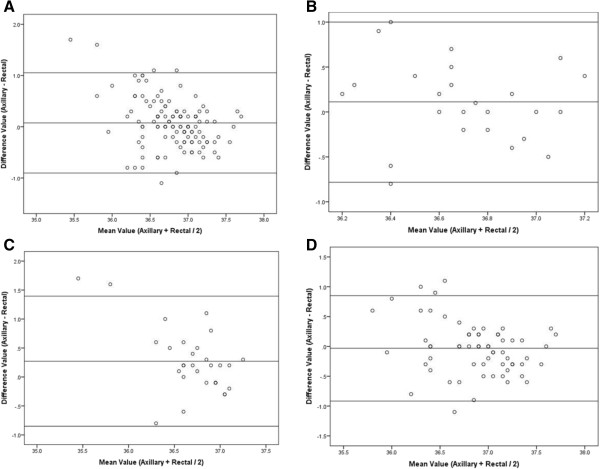
The study included 118 newborns with gestational ages ranging from 29 to 41 weeks, median birth weight of 2980 grams (IQR: 2321.3-3363.8). Axillary and rectal temperatures correlated significantly (r = 0.5, p = 0.000) and had similar overall means but differed in 34-36 weeks gestation newborns (p = 0.01). Correlation between both methods increased with advancing gestational age being highest in term newborns (r = 0.6, p = 0.000). Bland-Altman plots revealed good agreement in gestational ages above 29 weeks. The difference between measurements increased with Cesarean delivery (ß = 0.2; 95% CI: 0.02, 0.38), but decreased with advancing chronological age (ß = -0.01; 95% CI: -0.02,-0.01), and with gestational age (ß = -0.05; 95% CI: -0.08,-0.01).
In clinically stable term and preterm infants, axillary thermometry is as reliable as rectal measurement. Predictors of agreement between the two methods include gestational age, chronological age and mode of delivery. Further studies are needed to confirm this agreement in sick newborns and in extremely premature infants.
准确测量体温对于评估新生儿的总体健康状况至关重要。在新生儿护理环境中,金标准的直肠测温法已被腋温测量法所取代。然而,关于新生儿腋温和直肠测温之间一致性的证据存在争议。在这项横断面研究中,调查了新生儿腋温和直肠温度之间的一致性,以及新生儿、母亲和环境因素对这种一致性的影响。
使用差异均值的配对t检验、Pearson相关系数(r)和Bland-Altman图,比较足月儿和早产儿腋温和直肠温度的平均差异。逐步多元回归评估了总体组以及按胎龄分类的该差异的预测因素。
该研究纳入了118例胎龄为29至41周的新生儿,中位出生体重为2980克(四分位间距:2321.3 - 3363.8)。腋温和直肠温度显著相关(r = 0.5,p = 0.000),总体均值相似,但在孕34 - 36周的新生儿中存在差异(p = 0.01)。两种方法之间的相关性随着胎龄的增加而增加,在足月儿中最高(r = 0.6,p = 0.000)。Bland-Altman图显示胎龄超过29周时一致性良好。测量差异随着剖宫产的增加而增加(β = 0.2;95%置信区间:0.02,0.38),但随着实际年龄的增加而减小(β = -0.01;95%置信区间:-0.02,-0.01),以及随着胎龄增加而减小(β = -0.05;95%置信区间:-0.08,-0.01)。
在临床状况稳定的足月儿和早产儿中,腋温测量与直肠测量一样可靠。两种方法之间一致性的预测因素包括胎龄、实际年龄和分娩方式。需要进一步研究以证实患病新生儿和极早产儿中这两种方法的一致性。