Medical Division, Maccabi Healthcare Services, Tel Aviv, Israel ; Faculty of Medicine, Ben-Gurion University, Beer Sheva, Israel.
Medical Division, Maccabi Healthcare Services, Tel Aviv, Israel ; Faculty of Medicine, Tel-Aviv University, Tel Aviv, Israel.
Isr J Health Policy Res. 2014 Aug 29;3:29. doi: 10.1186/2045-4015-3-29. eCollection 2014.
One of the major challenges health care systems face in modern time is treating chronic disorders. In recent years, the increasing occurrence of multiple chronic disorders (MCC) in single individuals has compounded the complexity of health care. In 2008, it was estimated that worldwide as many as one quarter of the population between the ages of sixty five to sixty nine suffered from two or more chronic conditions and this prevalence rose with age. Clinical guidelines provide guidance for management of single disorders, but not for MCC. The aim of the present study was the study of the prevalence, distribution and impact of MCC in a large Israeli health system.
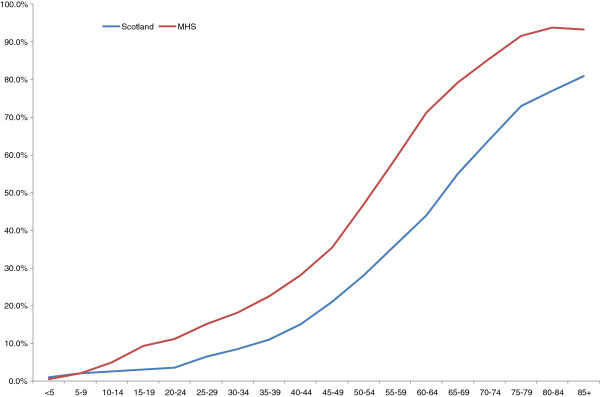
We performed a cross-sectional study of MCC in the Maccabi Healthcare System (MHS), Israel's second largest healthcare service, providing care for approximately two million people. Data regarding chronic conditions was collected through electronic medical records and organizational records, as was demographic and socioeconomic data. Age and sex specific data were compared with previously published data from Scotland.
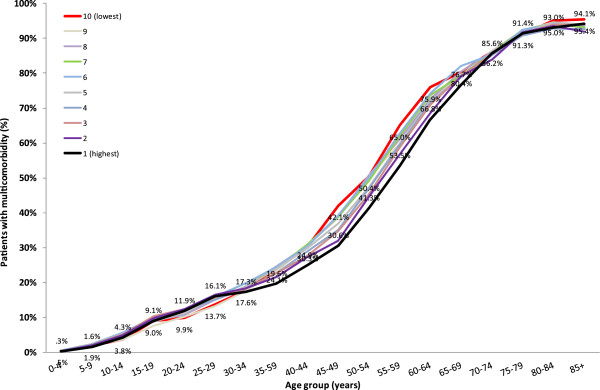
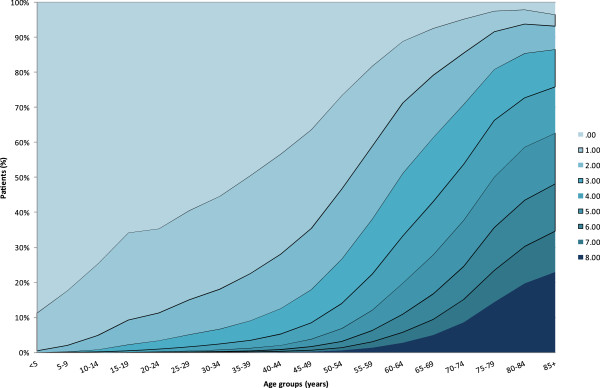
Two thirds of the population had two or more chronic disorders. This is significantly higher than previously published rates. A correlation between patient age and number of chronic disorders was found, as was a correlation between number of chronic disorders and low socioeconomic status, with the exception of children due to a high prevalence of learning disabilities, asthma, and visual disturbances.
MCC is very prevalent in the MHS population, increases with age, and except for children is more prevalent in lower socioeconomic classes, possibly due to the a combination of the structure of the Israeli universal insurance and requirements of the ministry of education for exemptions and benefits. A higher than previously reported prevalence of MCC may be due to the longtime use of use of integrated electronic medical records.
To effectively deal with MCC health care systems must devise strategies, including but not limited to, information technologies that enable shared teamwork based on clinical guidelines which address the problem of multiple, as opposed to single chronic disorders in patients.
现代医疗保健系统面临的主要挑战之一是治疗慢性疾病。近年来,单一患者中多种慢性疾病(MCC)的发生率不断增加,使医疗保健的复杂性进一步加剧。据估计,2008 年全球 65 至 69 岁人群中,有四分之一以上患有两种或两种以上的慢性疾病,且这种发病率随着年龄的增长而上升。临床指南为单一疾病的管理提供了指导,但不适用于 MCC。本研究的目的是研究大型以色列卫生系统中 MCC 的流行率、分布和影响。
我们对以色列第二大医疗保健服务机构 Maccabi 医疗保健系统(MHS)中的 MCC 进行了横断面研究,为大约 200 万人提供医疗服务。通过电子病历和组织记录收集有关慢性疾病的数据,以及人口统计学和社会经济数据。将年龄和性别特定数据与苏格兰先前发表的数据进行比较。
三分之二的人口患有两种或两种以上的慢性疾病。这明显高于先前发表的比率。发现患者年龄与慢性疾病数量之间存在相关性,慢性疾病数量与社会经济地位低下之间也存在相关性,但儿童除外,因为学习障碍、哮喘和视觉障碍的患病率较高。
MCC 在 MHS 人群中非常普遍,随着年龄的增长而增加,除了儿童以外,在社会经济地位较低的人群中更为普遍,这可能是由于以色列全民保险的结构和教育部豁免和福利的要求相结合所致。MCC 的患病率高于先前报告的患病率可能是由于长期使用集成电子病历。
为了有效应对 MCC,医疗保健系统必须制定策略,包括但不限于信息技术,使基于针对患者多种慢性疾病(而不是单一慢性疾病)的临床指南的共享团队合作成为可能。