Department of General Internal Medicine, The University of Texas MD Anderson Cancer Center, 1400 Herman Pressler St, Houston, TX 77030. E-mail:
The University of Texas MD Anderson Cancer Center, Houston, Texas.
Prev Chronic Dis. 2014 Sep 11;11:E156. doi: 10.5888/pcd11.140067.
Regular physical activity (PA) can improve health outcomes in cancer survivors, but the rate of adherence to PA recommendations among middle-aged survivors is unclear. We examined adherence to PA recommendations among cancer survivors and controls. We sought to identify correlates of adherence to PA and to determine whether PA adherence is associated with health-related quality of life (HRQOL) among cancer survivors.
We examined PA adherence among 8,655 cancer survivors and 144,213 control subjects aged 45-64 years who were respondents to the 2009 Behavior Risk Factor Surveillance System survey. We used multinomial logistic regression to assess associations between PA adherence and demographic, psychosocial, and clinical factors, and multivariable linear regression to assess the relationship between PA adherence and HRQOL of cancer survivors.
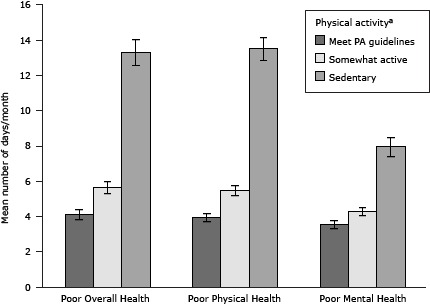
Cancer survivors and control subjects had similar rates of PA adherence. Of the survivors, 47% met the recommendations of 150 minutes of moderate-intensity PA or 120 minutes of vigorous-intensity PA per week, 41% were somewhat active, and 12% were sedentary. Compared with cancer survivors who were sedentary, survivors who were somewhat active were less likely to be obese (odds ratio [OR], 0.65; P < .007), and those who met PA recommendations were less likely to be overweight (OR, 0.61; P < .002) or obese (OR, 0.33, P < .001). Regression analysis indicated that PA adherence was positively correlated with HRQOL (P < .001).
Most cancer survivors did not meet PA recommendations, but those who are active seem to have improved HRQOL. Therefore, targeted interventions to improve adherence to PA among cancer survivors are needed.
有规律的身体活动(PA)可以改善癌症幸存者的健康结果,但中年幸存者对 PA 建议的依从率尚不清楚。我们检查了癌症幸存者和对照者对 PA 建议的依从性。我们试图确定对 PA 的依从性的相关因素,并确定 PA 的依从性是否与癌症幸存者的健康相关生活质量(HRQOL)相关。
我们检查了年龄在 45-64 岁的 8655 名癌症幸存者和 144213 名对照者对 2009 年行为风险因素监测系统调查的 PA 依从性。我们使用多项逻辑回归来评估 PA 依从性与人口统计学,心理社会和临床因素之间的关系,以及多变量线性回归来评估 PA 依从性与癌症幸存者 HRQOL 的关系。
癌症幸存者和对照者的 PA 依从率相似。在幸存者中,47%符合每周 150 分钟中等强度 PA 或 120 分钟剧烈强度 PA 的建议,41%有一定的活动量,12%是久坐不动的。与久坐不动的癌症幸存者相比,有一定活动量的幸存者不太可能肥胖(比值比[OR],0.65;P <.007),并且符合 PA 建议的幸存者不太可能超重(OR,0.61;P <.002)或肥胖(OR,0.33,P <.001)。回归分析表明,PA 依从性与 HRQOL 呈正相关(P <.001)。
大多数癌症幸存者没有达到 PA 建议,但那些活跃的人似乎有改善的 HRQOL。因此,需要针对癌症幸存者的 PA 依从性进行有针对性的干预。