Center for Clinical Epidemiology and Biostatistics, Perelman School of Medicine, University of Pennsylvania, Philadelphia, Pennsylvania, United States of America.
PLoS One. 2012;7(1):e30955. doi: 10.1371/journal.pone.0030955. Epub 2012 Jan 27.
The purpose of this meta-analysis was to examine the efficacy of exercise to reduce depressive symptoms among cancer survivors. In addition, we examined the extent to which exercise dose and clinical characteristics of cancer survivors influence the relationship between exercise and reductions in depressive symptoms.
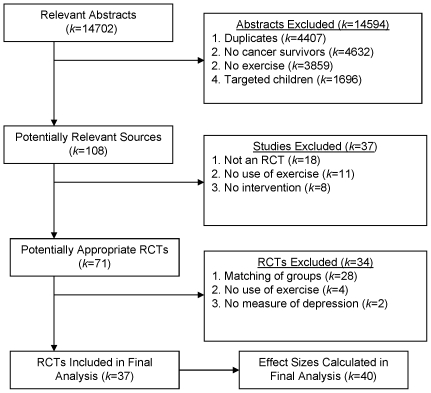
We conducted a systematic search identifying randomized controlled trials of exercise interventions among adult cancer survivors, examining depressive symptoms as an outcome. We calculated effect sizes for each study and performed weighted multiple regression moderator analysis.
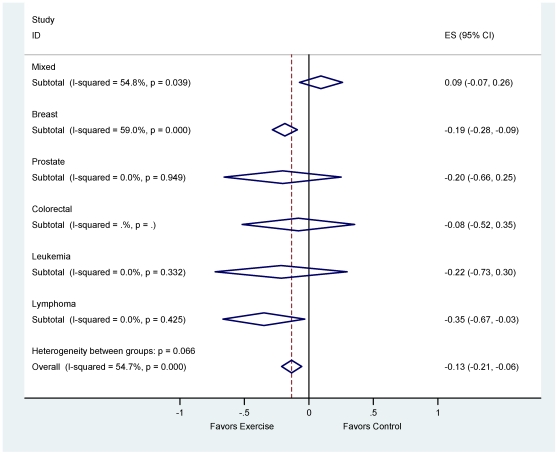
We identified 40 exercise interventions including 2,929 cancer survivors. Diverse groups of cancer survivors were examined in seven exercise interventions; breast cancer survivors were examined in 26; prostate cancer, leukemia, and lymphoma were examined in two; and colorectal cancer in one. Cancer survivors who completed an exercise intervention reduced depression more than controls, d(+) = -0.13 (95% CI: -0.26, -0.01). Increases in weekly volume of aerobic exercise reduced depressive symptoms in dose-response fashion (β = -0.24, p = 0.03), a pattern evident only in higher quality trials. Exercise reduced depressive symptoms most when exercise sessions were supervised (β = -0.26, p = 0.01) and when cancer survivors were between 47-62 yr (β = 0.27, p = 0.01).
Exercise training provides a small overall reduction in depressive symptoms among cancer survivors but one that increased in dose-response fashion with weekly volume of aerobic exercise in high quality trials. Depressive symptoms were reduced to the greatest degree among breast cancer survivors, among cancer survivors aged between 47-62 yr, or when exercise sessions were supervised.
本荟萃分析的目的是考察运动对减轻癌症幸存者抑郁症状的疗效。此外,我们还研究了运动剂量和癌症幸存者的临床特征在多大程度上影响运动与抑郁症状减轻之间的关系。
我们进行了系统搜索,确定了针对成年癌症幸存者的运动干预随机对照试验,将抑郁症状作为结果进行研究。我们计算了每项研究的效应大小,并进行了加权多元回归调节分析。
我们确定了 40 项运动干预措施,其中包括 2929 名癌症幸存者。在七个运动干预措施中检查了不同类型的癌症幸存者;26 个乳腺癌幸存者;2 个前列腺癌、白血病和淋巴瘤;1 个结直肠癌。完成运动干预的癌症幸存者比对照组的抑郁症状减轻更多,d(+) = -0.13(95%CI:-0.26,-0.01)。每周有氧运动量的增加呈剂量反应模式降低抑郁症状(β = -0.24,p = 0.03),这种模式仅在高质量试验中明显。当运动课程得到监督时(β = -0.26,p = 0.01),以及当癌症幸存者年龄在 47-62 岁之间时(β = 0.27,p = 0.01),运动对抑郁症状的缓解最大。
运动训练为癌症幸存者提供了抑郁症状的总体较小改善,但在高质量试验中,随着每周有氧运动量的增加呈剂量反应模式增加。乳腺癌幸存者、47-62 岁的癌症幸存者或当运动课程得到监督时,抑郁症状的减轻程度最大。