Social and Behavioral Health Sciences, FHI 360, Durham, NC, USA;
Research Utilization, FHI 360, Durham, NC, USA.
J Int AIDS Soc. 2014 Sep 8;17(3 Suppl 2):19159. doi: 10.7448/IAS.17.3.19159. eCollection 2014.
Constructively engaging male partners in women-centred health programs such as family planning and prevention of mother-to-child HIV transmission has resulted in both improved health outcomes and stronger relationships. Concerted efforts to engage men in microbicide use could make it easier for women to access and use microbicides in the future. This paper synthesizes findings from studies that investigated men's role in their partners' microbicide use during clinical trials to inform recommendations for male engagement in women's microbicide use.
We conducted primary and secondary analyses of data from six qualitative studies implemented in conjunction with microbicide clinical trials in South Africa, Kenya, and Tanzania. The analyses included data from 535 interviews and 107 focus groups with trial participants, male partners, and community members to answer research questions on partner communication about microbicides, men's role in women's microbicide use, and potential strategies for engaging men in future microbicide introduction. We synthesized the findings across the studies and developed recommendations.
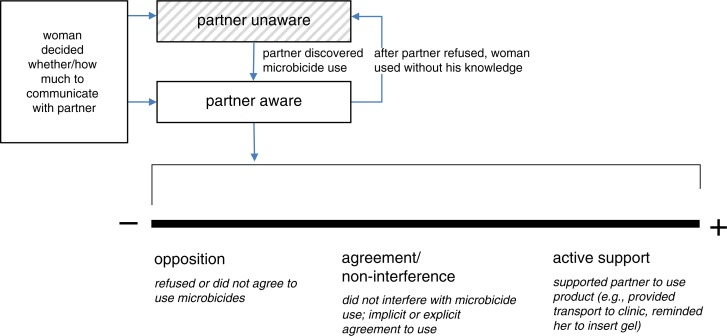
The majority of women in steady partnerships wanted agreement from their partners to use microbicides. Women used various strategies to obtain their agreement, including using the product for a while before telling their partners, giving men information gradually, and continuing to bring up microbicides until resistant partners acquiesced. Among men who were aware their partners were participating in a trial and using microbicides, involvement ranged from opposition to agreement/non-interference to active support. Both men and women expressed a desire for men to have access to information about microbicides and to be able to talk with a healthcare provider about microbicides.
We recommend counselling women on whether and how to involve their partners including strategies for gaining partner approval; providing couples' counselling on microbicides so men have the opportunity to talk with providers; and targeting men with community education and mass media to increase their awareness and acceptance of microbicides. These strategies should be tested in microbicide trials, open-label studies, and demonstration projects to identify effective male engagement approaches to include in eventual microbicide introduction. Efforts to engage men must take care not to diminish women's agency to decide whether to use the product and inform their partners.
在计划生育和预防母婴传播艾滋病毒等以妇女为中心的健康方案中,建设性地让男性伴侣参与其中,这不仅改善了健康结果,还加强了关系。共同努力让男性参与使用杀微生物剂,将来可能会使妇女更容易获得和使用杀微生物剂。本文综合了在南非、肯尼亚和坦桑尼亚进行的六项与杀微生物剂临床试验同时进行的研究结果,旨在为男性参与女性使用杀微生物剂提供建议。
我们对来自南非、肯尼亚和坦桑尼亚的六项杀微生物剂临床试验中实施的六项定性研究的数据进行了主要和次要分析。这些分析包括对 535 名试验参与者、男性伴侣和社区成员的访谈和 107 次焦点小组的数据分析,以回答关于伴侣之间关于杀微生物剂的沟通、男性在女性使用杀微生物剂中的作用以及未来引入杀微生物剂时吸引男性的潜在策略等问题。我们综合了研究结果并提出了建议。
大多数处于稳定伴侣关系的女性希望得到伴侣的同意才能使用杀微生物剂。女性使用各种策略来获得他们的同意,包括在告诉伴侣之前先使用一段时间产品,逐渐向男性提供信息,并且不断提出杀微生物剂,直到持反对意见的伴侣默认。在那些知道伴侣参加试验并使用杀微生物剂的男性中,参与程度从反对到同意/不干预到积极支持不等。男性和女性都表示希望男性能够获得有关杀微生物剂的信息,并能够与医疗保健提供者讨论杀微生物剂。
我们建议向女性提供咨询,包括获得伴侣批准的策略,以及是否和如何让伴侣参与进来;提供关于杀微生物剂的夫妻咨询,以便男性有机会与提供者交谈;并针对男性开展社区教育和大众媒体宣传,以提高他们对杀微生物剂的认识和接受度。这些策略应在杀微生物剂试验、开放标签研究和示范项目中进行测试,以确定最终引入杀微生物剂时纳入的有效男性参与方法。让男性参与的努力必须注意不削弱妇女决定是否使用该产品并告知其伴侣的自主权。