• 文献检索
  • 文档翻译
  • 深度研究
  • 学术资讯
  • Suppr Zotero 插件Zotero 插件
  • 邀请有礼
  • 套餐&价格
  • 历史记录
应用&插件
Suppr Zotero 插件Zotero 插件浏览器插件Mac 客户端Windows 客户端微信小程序
定价
高级版会员购买积分包购买API积分包
服务
文献检索文档翻译深度研究API 文档MCP 服务
关于我们
关于 Suppr公司介绍联系我们用户协议隐私条款
关注我们

Suppr 超能文献

核心技术专利:CN118964589B侵权必究
粤ICP备2023148730 号-1Suppr @ 2026

文献检索

告别复杂PubMed语法,用中文像聊天一样搜索,搜遍4000万医学文献。AI智能推荐,让科研检索更轻松。

立即免费搜索

文件翻译

保留排版,准确专业,支持PDF/Word/PPT等文件格式,支持 12+语言互译。

免费翻译文档

深度研究

AI帮你快速写综述,25分钟生成高质量综述,智能提取关键信息,辅助科研写作。

立即免费体验

同步衰老的大脑:通过食物调节生物钟能减缓阿尔茨海默病吗?

Synchronizing an aging brain: can entraining circadian clocks by food slow Alzheimer's disease?

机构信息

Department of Psychology, University of Cambridge Cambridge, UK.

出版信息

Front Aging Neurosci. 2014 Sep 1;6:234. doi: 10.3389/fnagi.2014.00234. eCollection 2014.

DOI:10.3389/fnagi.2014.00234
PMID:25225484
原文链接:https://pmc.ncbi.nlm.nih.gov/articles/PMC4150207/
Abstract

Alzheimer's disease (AD) is a global epidemic. Unfortunately, we are still without effective treatments or a cure for this disease, which is having devastating consequences for patients, their families, and societies around the world. Until effective treatments are developed, promoting overall health may hold potential for delaying the onset or preventing neurodegenerative diseases such as AD. In particular, chronobiological concepts may provide a useful framework for identifying the earliest signs of age-related disease as well as inexpensive and noninvasive methods for promoting health. It is well reported that AD is associated with disrupted circadian functioning to a greater extent than normal aging. However, it is unclear if the central circadian clock (i.e., the suprachiasmatic nucleus) is dysfunctioning, or whether the synchrony between the central and peripheral clocks that control behavior and metabolic processes are becoming uncoupled. Desynchrony of rhythms can negatively affect health, increasing morbidity and mortality in both animal models and humans. If the uncoupling of rhythms is contributing to AD progression or exacerbating symptoms, then it may be possible to draw from the food-entrainment literature to identify mechanisms for re-synchronizing rhythms to improve overall health and reduce the severity of symptoms. The following review will briefly summarize the circadian system, its potential role in AD, and propose using a feeding-related neuropeptide, such as ghrelin, to synchronize uncoupled rhythms. Synchronizing rhythms may be an inexpensive way to promote healthy aging and delay the onset of neurodegenerative disease such as AD.

摘要

阿尔茨海默病(AD)是一种全球性的流行病。不幸的是,我们仍然没有有效的治疗方法或治愈这种疾病,这对世界各地的患者、他们的家庭和社会造成了毁灭性的后果。在开发出有效的治疗方法之前,促进整体健康可能有助于延缓 AD 等神经退行性疾病的发病或预防。特别是,生物钟概念可能为识别与年龄相关的疾病的早期迹象以及促进健康的廉价、非侵入性方法提供有用的框架。据报道,AD 与昼夜节律功能紊乱的相关性大于正常衰老。然而,目前尚不清楚中央生物钟(即视交叉上核)是否出现功能障碍,或者控制行为和代谢过程的中央和外周时钟之间的同步性是否变得不同步。节律的不同步会对健康产生负面影响,增加动物模型和人类的发病率和死亡率。如果节律的失耦与 AD 的进展有关或加重症状,那么我们可以从与进食相关的神经肽文献中汲取知识,确定重新同步节律的机制,以改善整体健康状况并减轻症状的严重程度。以下综述将简要总结生物钟系统及其在 AD 中的潜在作用,并提出使用与进食相关的神经肽,如 ghrelin,来同步失耦的节律。同步节律可能是促进健康衰老和延缓 AD 等神经退行性疾病发病的一种廉价方法。
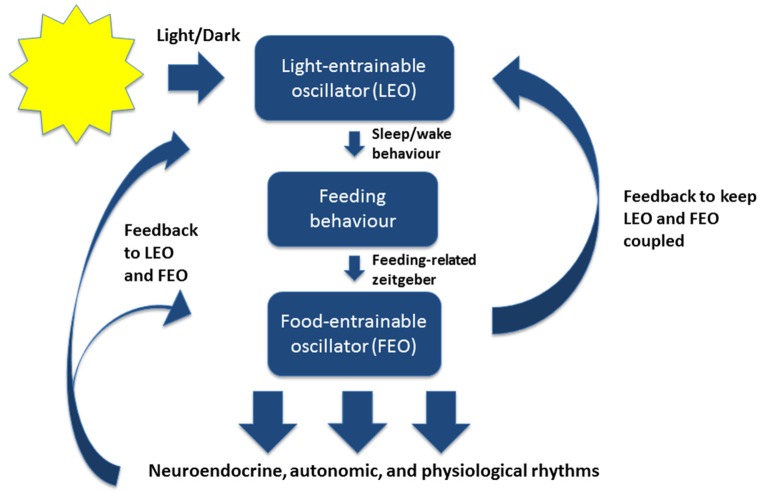
https://cdn.ncbi.nlm.nih.gov/pmc/blobs/82ce/4150207/ce75204424f8/fnagi-06-00234-g0002.jpg
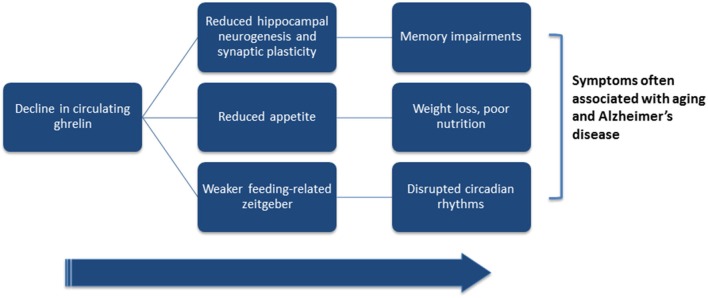
https://cdn.ncbi.nlm.nih.gov/pmc/blobs/82ce/4150207/c9f90acfb7fe/fnagi-06-00234-g0001.jpg
https://cdn.ncbi.nlm.nih.gov/pmc/blobs/82ce/4150207/ce75204424f8/fnagi-06-00234-g0002.jpg
https://cdn.ncbi.nlm.nih.gov/pmc/blobs/82ce/4150207/c9f90acfb7fe/fnagi-06-00234-g0001.jpg
https://cdn.ncbi.nlm.nih.gov/pmc/blobs/82ce/4150207/ce75204424f8/fnagi-06-00234-g0002.jpg

相似文献

1
Synchronizing an aging brain: can entraining circadian clocks by food slow Alzheimer's disease?同步衰老的大脑:通过食物调节生物钟能减缓阿尔茨海默病吗?
Front Aging Neurosci. 2014 Sep 1;6:234. doi: 10.3389/fnagi.2014.00234. eCollection 2014.
2
Interacting influences of aging and Alzheimer's disease on circadian rhythms.衰老与阿尔茨海默病对昼夜节律的交互影响。
Eur J Neurosci. 2020 Jan;51(1):310-325. doi: 10.1111/ejn.14358. Epub 2019 Feb 21.
3
Therapeutic implications of circadian clocks in neurodegenerative diseases.生物钟在神经退行性疾病中的治疗意义。
J Neurosci Res. 2020 Jun;98(6):1095-1113. doi: 10.1002/jnr.24572. Epub 2019 Dec 12.
4
Misalignment of Circadian Rhythms in Diet-Induced Obesity.饮食诱导肥胖中昼夜节律的失调。
Adv Exp Med Biol. 2024;1460:27-71. doi: 10.1007/978-3-031-63657-8_2.
5
Central and peripheral circadian clocks and their role in Alzheimer's disease.中枢和外周生物钟及其在阿尔茨海默病中的作用。
Dis Model Mech. 2017 Oct 1;10(10):1187-1199. doi: 10.1242/dmm.030627.
6
Food as circadian time cue for appetitive behavior.食物作为影响食欲行为的昼夜节律时间线索。
F1000Res. 2020 Jan 29;9. doi: 10.12688/f1000research.20829.1. eCollection 2020.
7
RCAN1 knockout and overexpression recapitulate an ensemble of rest-activity and circadian disruptions characteristic of Down syndrome, Alzheimer's disease, and normative aging.RCAN1 敲除和过表达重现了唐氏综合征、阿尔茨海默病和正常衰老的一系列静息-活动和昼夜节律紊乱特征。
J Neurodev Disord. 2022 May 24;14(1):33. doi: 10.1186/s11689-022-09444-y.
8
Relationships between the circadian system and Alzheimer's disease-like symptoms in Drosophila.果蝇昼夜节律系统与阿尔茨海默病样症状之间的关系。
PLoS One. 2014 Aug 29;9(8):e106068. doi: 10.1371/journal.pone.0106068. eCollection 2014.
9
Neurobiology of food anticipatory circadian rhythms.食物预期昼夜节律的神经生物学。
Physiol Behav. 2011 Sep 26;104(4):535-45. doi: 10.1016/j.physbeh.2011.04.015. Epub 2011 Apr 20.
10
Natural food intake patterns have little synchronizing effect on peripheral circadian clocks.天然食物的摄入模式对周围的生物钟几乎没有同步作用。
BMC Biol. 2020 Nov 6;18(1):160. doi: 10.1186/s12915-020-00872-7.

引用本文的文献

1
Time-restricted feeding alters isoflurane-induced memory deficits.限时进食可改变异氟烷引起的记忆缺陷。
Transl Neurosci. 2020 Sep 21;11(1):341-355. doi: 10.1515/tnsci-2020-0130. eCollection 2020.
2
Sleep and its regulation: An emerging pathogenic and treatment frontier in Alzheimer's disease.睡眠及其调节:阿尔茨海默病中新兴的发病机制和治疗靶点。
Prog Neurobiol. 2021 Feb;197:101902. doi: 10.1016/j.pneurobio.2020.101902. Epub 2020 Aug 30.
3
Microarray analysis of verbenalin-treated human amniotic epithelial cells reveals therapeutic potential for Alzheimer's Disease.

本文引用的文献

1
The central molecular clock is robust in the face of behavioural arrhythmia in a Drosophila model of Alzheimer's disease.中央分子钟在阿尔茨海默病果蝇模型中面对行为节律紊乱时具有稳健性。
Dis Model Mech. 2014 Apr;7(4):445-58. doi: 10.1242/dmm.014134. Epub 2014 Feb 26.
2
Circadian adaptations to meal timing: neuroendocrine mechanisms.昼夜节律对进餐时间的适应:神经内分泌机制。
Front Neurosci. 2013 Oct 14;7:185. doi: 10.3389/fnins.2013.00185.
3
Connecting cellular metabolism to circadian clocks.将细胞代谢与生物钟联系起来。
微阵列分析马鞭草宁处理的人羊膜上皮细胞揭示了治疗阿尔茨海默病的潜力。
Aging (Albany NY). 2020 Mar 29;12(6):5516-5538. doi: 10.18632/aging.102985.
4
Aging and the clock: Perspective from flies to humans.衰老与时钟:从果蝇到人类的视角
Eur J Neurosci. 2020 Jan;51(1):454-481. doi: 10.1111/ejn.14176. Epub 2018 Oct 30.
5
Circadian Rhythm and Alzheimer's Disease.昼夜节律与阿尔茨海默病
Med Sci (Basel). 2018 Jun 21;6(3):52. doi: 10.3390/medsci6030052.
6
Scheduled feeding restores memory and modulates c-Fos expression in the suprachiasmatic nucleus and septohippocampal complex.定时喂养可恢复记忆,并调节视交叉上核和隔海马复合体中的 c-Fos 表达。
Sci Rep. 2017 Jul 28;7(1):6755. doi: 10.1038/s41598-017-06963-w.
7
The Role of Ghrelin and Ghrelin Signaling in Aging.胃饥饿素及其信号通路在衰老过程中的作用
Int J Mol Sci. 2017 Jul 12;18(7):1511. doi: 10.3390/ijms18071511.
8
Ghrelin, Amylin, Gastric Inhibitory Peptide and Cognition in Middle-Aged HIV-Infected and Uninfected Women: The Women's Interagency HIV Study.胃饥饿素、胰淀素、胃抑制肽与中年感染和未感染艾滋病毒女性的认知:女性机构间艾滋病毒研究
J Neurol Neurophysiol. 2017 Feb;8(1). doi: 10.4172/2155-9562.1000413. Epub 2017 Feb 8.
9
Neurodegeneration and the Circadian Clock.神经退行性变与生物钟
Front Aging Neurosci. 2017 May 30;9:170. doi: 10.3389/fnagi.2017.00170. eCollection 2017.
10
The aging clock: circadian rhythms and later life.衰老时钟:昼夜节律与晚年生活
J Clin Invest. 2017 Feb 1;127(2):437-446. doi: 10.1172/JCI90328.
Trends Cell Biol. 2013 May;23(5):234-41. doi: 10.1016/j.tcb.2013.01.003. Epub 2013 Feb 5.
4
Tracking pathophysiological processes in Alzheimer's disease: an updated hypothetical model of dynamic biomarkers.阿尔茨海默病病理生理过程的追踪:动态生物标志物的更新假设模型。
Lancet Neurol. 2013 Feb;12(2):207-16. doi: 10.1016/S1474-4422(12)70291-0.
5
Toward the treatment and prevention of Alzheimer's disease: rational strategies and recent progress.针对阿尔茨海默病的治疗和预防:合理的策略和最新进展。
Annu Rev Med. 2013;64:367-83. doi: 10.1146/annurev-med-092611-084441.
6
The circadian system in Alzheimer's disease: disturbances, mechanisms, and opportunities.阿尔茨海默病中的生物钟系统:紊乱、机制和机遇。
Biol Psychiatry. 2013 Sep 1;74(5):333-9. doi: 10.1016/j.biopsych.2012.11.021. Epub 2012 Dec 28.
7
Increased skin temperature in Alzheimer's disease is associated with sleepiness.阿尔茨海默病患者皮肤温度升高与嗜睡有关。
J Neural Transm (Vienna). 2012 Oct;119(10):1185-94. doi: 10.1007/s00702-012-0864-1. Epub 2012 Jul 25.
8
Circadian system functionality, hippocampal oxidative stress, and spatial memory in the APPswe/PS1dE9 transgenic model of Alzheimer disease: effects of melatonin or ramelteon.生物钟系统功能、海马氧化应激与阿尔茨海默病 APPswe/PS1dE9 转基因模型的空间记忆:褪黑素或雷美尔酮的影响。
Chronobiol Int. 2012 Aug;29(7):822-34. doi: 10.3109/07420528.2012.699119.
9
Clinical and biomarker changes in dominantly inherited Alzheimer's disease.常染色体显性遗传阿尔茨海默病的临床和生物标志物变化。
N Engl J Med. 2012 Aug 30;367(9):795-804. doi: 10.1056/NEJMoa1202753. Epub 2012 Jul 11.
10
Ghrelin and leptin secretion in patients with moderate Alzheimer's disease.中重度阿尔茨海默病患者的胃饥饿素和瘦素分泌。
J Nutr Health Aging. 2012 May;16(5):472-7. doi: 10.1007/s12603-012-0058-4.