Felix Ashley S, Gaudet Mia M, La Vecchia Carlo, Nagle Christina M, Shu Xiao Ou, Weiderpass Elisabete, Adami Hans Olov, Beresford Shirley, Bernstein Leslie, Chen Chu, Cook Linda S, De Vivo Immaculata, Doherty Jennifer A, Friedenreich Christine M, Gapstur Susan M, Hill Dierdre, Horn-Ross Pamela L, Lacey James V, Levi Fabio, Liang Xiaolin, Lu Lingeng, Magliocco Anthony, McCann Susan E, Negri Eva, Olson Sara H, Palmer Julie R, Patel Alpa V, Petruzella Stacey, Prescott Jennifer, Risch Harvey A, Rosenberg Lynn, Sherman Mark E, Spurdle Amanda B, Webb Penelope M, Wise Lauren A, Xiang Yong-Bing, Xu Wanghong, Yang Hannah P, Yu Herbert, Zeleniuch-Jacquotte Anne, Brinton Louise A
Hormonal and Reproductive Epidemiology Branch, Division of Cancer Epidemiology and Genetics, National Cancer Institute, Bethesda, MD; Cancer Prevention Fellowship Program, Division of Cancer Prevention, National Cancer Institute, Bethesda, MD.
Int J Cancer. 2015 Mar 1;136(5):E410-22. doi: 10.1002/ijc.29229. Epub 2014 Sep 30.
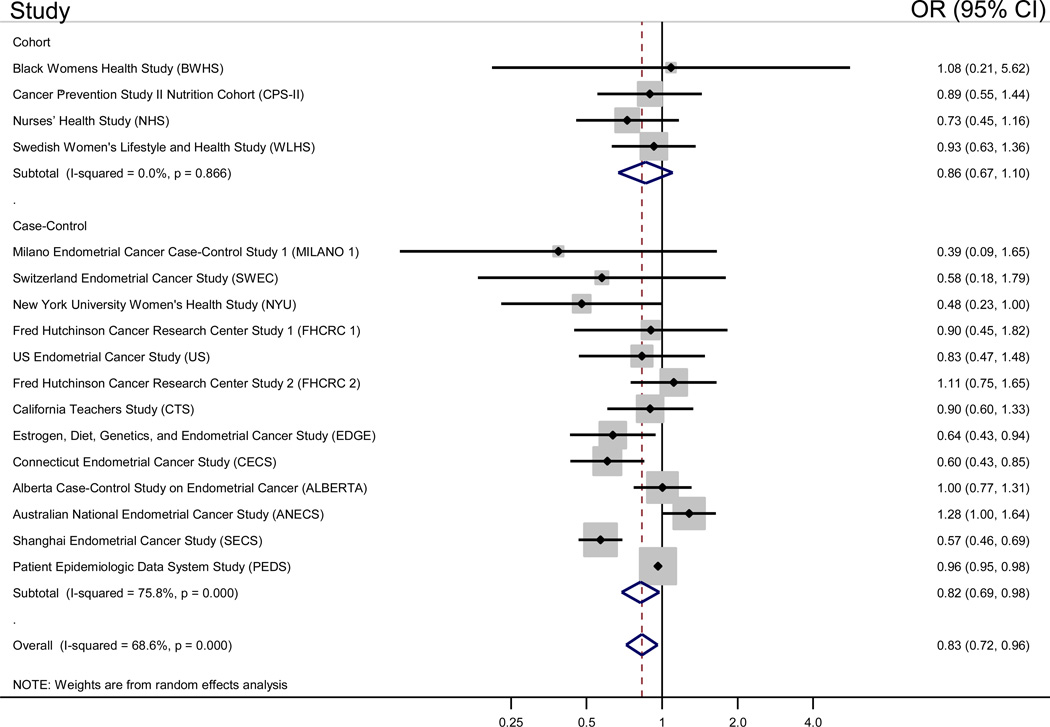
Intrauterine devices (IUDs), long-acting and reversible contraceptives, induce a number of immunological and biochemical changes in the uterine environment that could affect endometrial cancer (EC) risk. We addressed this relationship through a pooled analysis of data collected in the Epidemiology of Endometrial Cancer Consortium. We combined individual-level data from 4 cohort and 14 case-control studies, in total 8,801 EC cases and 15,357 controls. Using multivariable logistic regression, we estimated pooled odds ratios (pooled-ORs) and 95% confidence intervals (CIs) for EC risk associated with ever use, type of device, ages at first and last use, duration of use and time since last use, stratified by study and adjusted for confounders. Ever use of IUDs was inversely related to EC risk (pooled-OR = 0.81, 95% CI = 0.74-0.90). Compared with never use, reduced risk of EC was observed for inert IUDs (pooled-OR = 0.69, 95% CI = 0.58-0.82), older age at first use (≥ 35 years pooled-OR = 0.53, 95% CI = 0.43-0.67), older age at last use (≥ 45 years pooled-OR = 0.60, 95% CI = 0.50-0.72), longer duration of use (≥ 10 years pooled-OR = 0.61, 95% CI = 0.52-0.71) and recent use (within 1 year of study entry pooled-OR = 0.39, 95% CI = 0.30-0.49). Future studies are needed to assess the respective roles of detection biases and biologic effects related to foreign body responses in the endometrium, heavier bleeding (and increased clearance of carcinogenic cells) and localized hormonal changes.
宫内节育器(IUD)是长效可逆的避孕方法,它会在子宫环境中引发一系列免疫和生化变化,这些变化可能会影响子宫内膜癌(EC)的发病风险。我们通过对子宫内膜癌流行病学联盟收集的数据进行汇总分析来研究这种关系。我们整合了来自4项队列研究和14项病例对照研究的个体水平数据,共计8801例子宫内膜癌病例和15357例对照。使用多变量逻辑回归分析,我们按研究分层并对混杂因素进行调整后,估计了与曾经使用、节育器类型、首次和末次使用年龄、使用时长以及末次使用后时间相关的子宫内膜癌风险的汇总比值比(pooled-OR)和95%置信区间(CI)。曾经使用宫内节育器与子宫内膜癌风险呈负相关(pooled-OR = 0.81,95%CI = 0.74 - 0.90)。与从未使用相比,惰性宫内节育器使用者的子宫内膜癌风险降低(pooled-OR = 0.69,95%CI = 0.58 - 0.82),首次使用年龄较大(≥35岁,pooled-OR = 0.53,95%CI = 0.43 - 0.67),末次使用年龄较大(≥45岁,pooled-OR = 0.60,95%CI = 0.50 - 0.72),使用时长较长(≥10年,pooled-OR = 0.61,95%CI = 0.52 - 0.71)以及近期使用(研究入组前1年内,pooled-OR = 0.39,95%CI = 0.30 - 0.49)。未来需要开展研究,以评估检测偏倚以及与子宫内膜异物反应、出血量增加(以及致癌细胞清除增加)和局部激素变化相关的生物学效应各自所起的作用。