Wan Ching S, Ward Leigh C, Halim Jocelyn, Gow Megan L, Ho Mandy, Briody Julie N, Leung Kelvin, Cowell Chris T, Garnett Sarah P
Institute of Endocrinology & Diabetes, The Children's Hospital at Westmead, Locked Bag 4001, Westmead NSW2145, Australia.
BMC Pediatr. 2014 Oct 3;14:249. doi: 10.1186/1471-2431-14-249.
There is a need for a practical, inexpensive method to assess body composition in obese adolescents. This study aimed to 1) compare body composition parameters estimated by a stand-on, multi-frequency bioelectrical impendence (BIA) device, using a) the manufacturers' equations, and b) published and derived equations with body composition measured by dual-energy x-ray absorptiometry (DXA) and 2) assess percentage body fat (%BF) change after a weight loss intervention.
Participants were 66 obese adolescents, mean age (SD) 12.9 (2.0) years. Body composition was measured by Tanita BIA MC-180MA (Tanita BIA8) and DXA (GE-Lunar Prodigy). BIA resistance and reactance data at frequencies of 5, 50, 250 and 500 kHz, were used in published equations, and to generate a new prediction equation for fat-free mass (FFM) using a split-sample method. Approximately half (n = 34) of the adolescents had their body composition measured by DXA and BIA on two occasions, three to nine months apart.
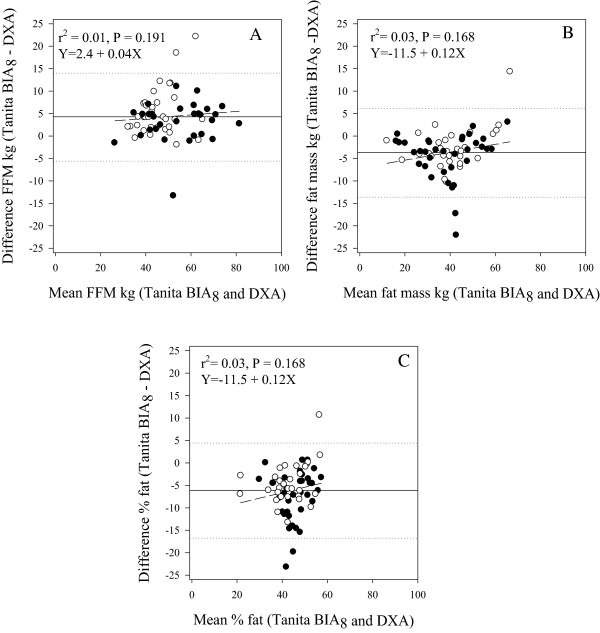
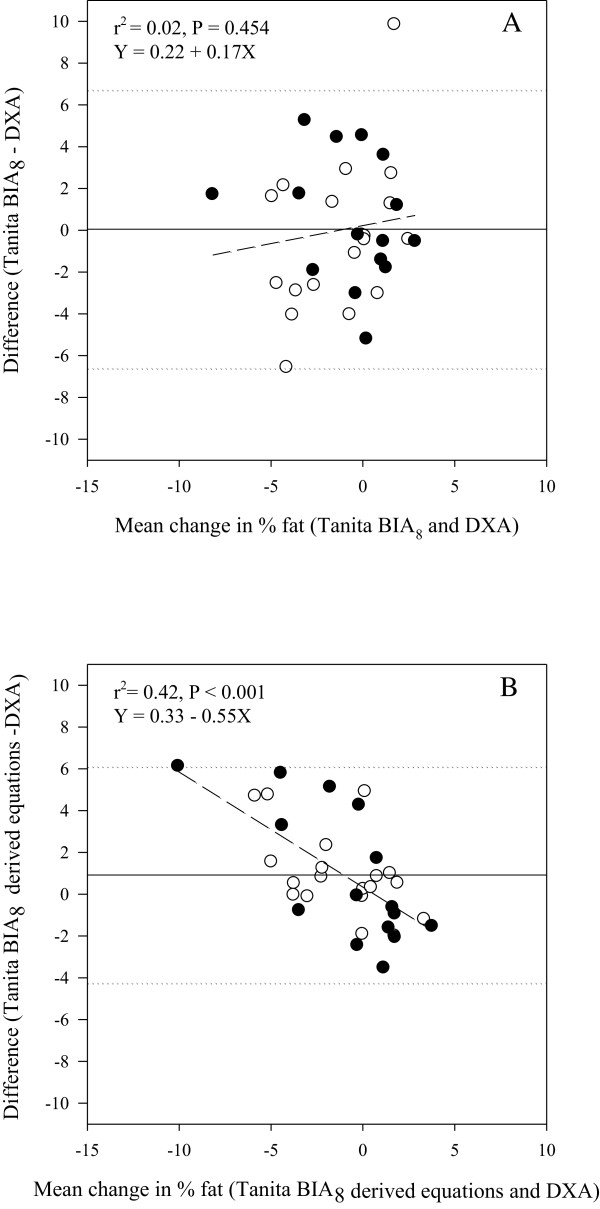
The correlations between FFM (kg), fat mass (kg) and %BF measured by BIA and DXA were 0.92, 0.93 and 0.78, respectively. The Tanita BIA8 manufacturers equations significantly (P < 0.001) overestimated FFM (4.3 kg [-5.3 to 13.9]) and underestimated %BF (-5.0% [-15 to 5.0]) compared to DXA. The mean differences between BIA derived equations and DXA measured body composition parameters were small (0.4 to 2.1%), not significant, but had large limits of agreements (~ ±15% for FFM). After the intervention mean %BF loss was similar by both methods (~1.5%), but with wide limits of agreement.
The Tanita BIA8 could be a valuable clinical tool to measure body composition at the group level, but is inaccurate for the individual obese adolescent.
需要一种实用且经济的方法来评估肥胖青少年的身体成分。本研究旨在:1)比较通过站立式多频生物电阻抗(BIA)设备使用以下两种方法估算的身体成分参数:a)制造商的公式,以及b)已发表和推导的公式与通过双能X线吸收法(DXA)测量的身体成分;2)评估体重减轻干预后体脂百分比(%BF)的变化。
参与者为66名肥胖青少年,平均年龄(标准差)12.9(2.0)岁。使用Tanita BIA MC - 180MA(Tanita BIA8)和DXA(GE - Lunar Prodigy)测量身体成分。在已发表的公式中使用了5、50、250和500 kHz频率下的BIA电阻和电抗数据,并使用拆分样本法生成了无脂肪质量(FFM)的新预测方程。大约一半(n = 34)的青少年在相隔三到九个月的时间里通过DXA和BIA进行了两次身体成分测量。
通过BIA和DXA测量的FFM(kg)、脂肪量(kg)和%BF之间的相关性分别为0.92、0.93和0.78。与DXA相比,Tanita BIA8制造商的公式显著(P < 0.001)高估了FFM(4.3 kg [-5.3至13.9])并低估了%BF(-5.0% [-15至5.0])。BIA推导公式与DXA测量的身体成分参数之间的平均差异较小(0.4至2.1%),无统计学意义,但一致性界限较大(FFM约为±15%)。干预后,两种方法的平均%BF损失相似(约1.5%),但一致性界限较宽。
Tanita BIA8在群体水平上可能是测量身体成分的有价值的临床工具,但对于个体肥胖青少年不准确。