Iwasaki Koji, Sudo Hideki, Yamada Katsuhisa, Higashi Hideaki, Ohnishi Takashi, Tsujimoto Takeru, Iwasaki Norimasa
Department of Orthopaedic Surgery, Hokkaido University Graduate School of Medicine, Sapporo, Japan.
Department of Advanced Medicine for Spine and Spinal Cord Disorders, Hokkaido University Graduate School of Medicine, Sapporo, Japan.
PLoS One. 2014 Oct 6;9(10):e109851. doi: 10.1371/journal.pone.0109851. eCollection 2014.
Analgesic discography (discoblock) can be used to diagnose or treat discogenic low back pain by injecting a small amount of local anesthetics. However, recent in vitro studies have revealed cytotoxic effects of local anesthetics on intervertebral disc (IVD) cells. Here we aimed to investigate the deteriorative effects of lidocaine and bupivacaine on rabbit IVDs using an organotypic culture model and an in vivo long-term follow-up model.
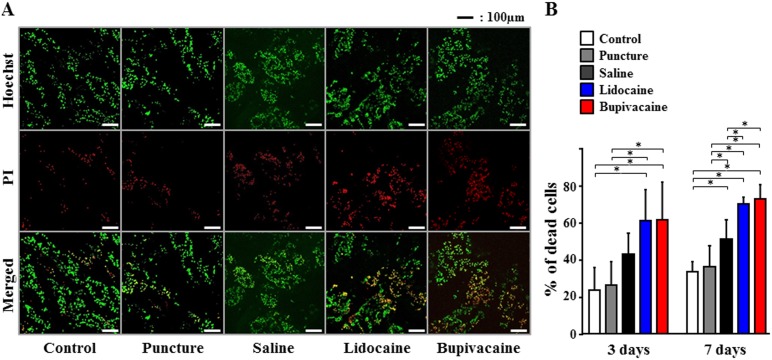
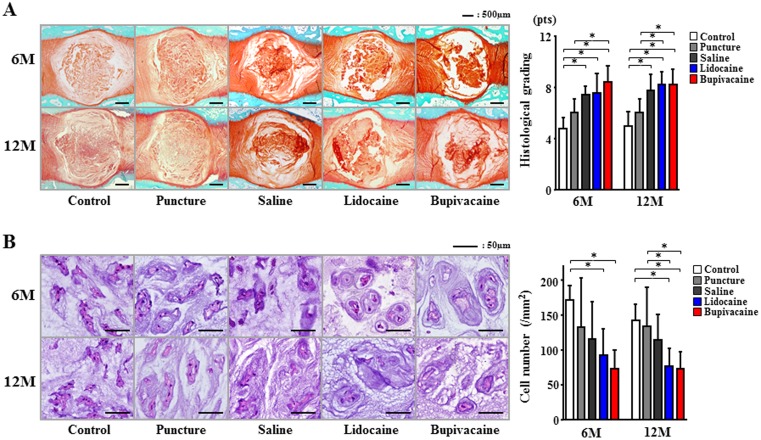
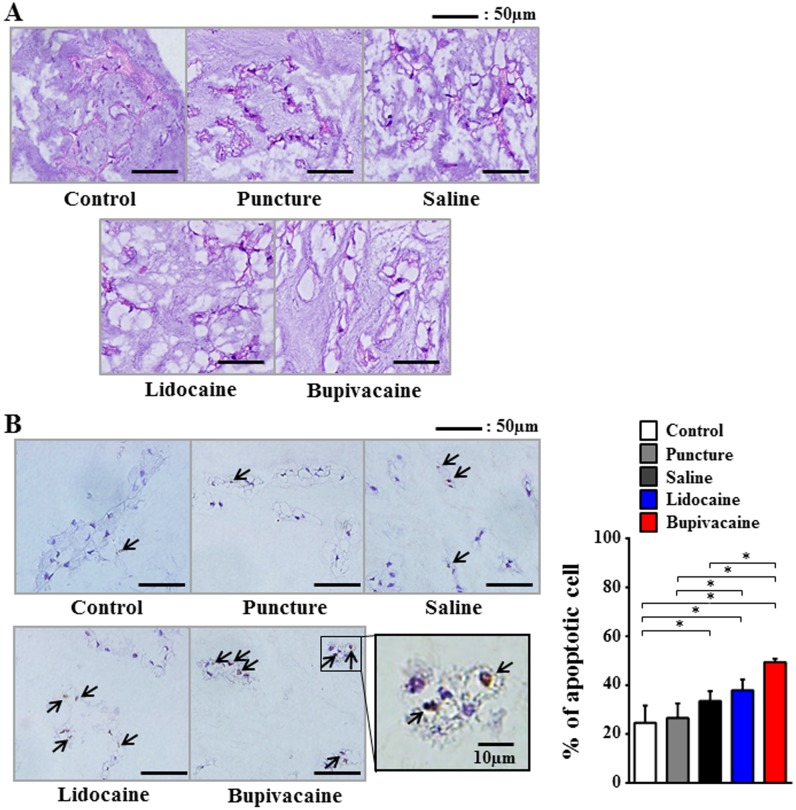
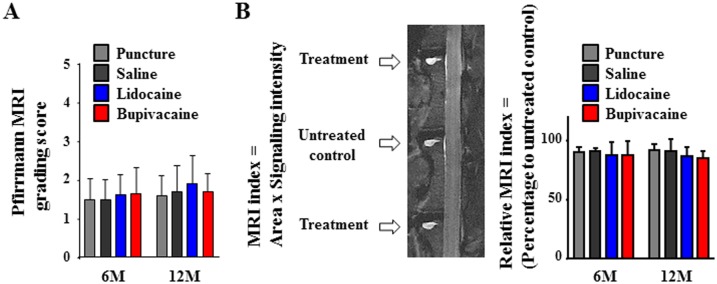
For the organotypic culture model, rabbit IVDs were harvested and cultured for 3 or 7 days after intradiscal injection of local anesthetics (1% lidocaine or 0.5% bupivacaine). Nucleus pulposus (NP) cell death was measured using confocal microscopy. Histological and TUNEL assays were performed. For in vivo study, each local anesthetic was injected into rabbit lumbar IVDs under a fluoroscope. Six or 12 months after the injection, each IVD was prepared for magnetic resonance imaging (MRI) and histological analysis.
In the organotypic culture model, both anesthetic agents induced time-dependent NP cell death; when compared with injected saline solution, significant effects were detected within 7 days. Compared with the saline group, TUNEL-positive NP cells were significantly increased in the bupivacaine group. In the in vivo study, MRI analysis did not show any significant difference. Histological analysis revealed that IVD degeneration occurred to a significantly level in the saline- and local anesthetics-injected groups compared with the untreated control or puncture-only groups. However, there was no significant difference between the saline and anesthetic agents groups.
CONCLUSIONS/SIGNIFICANCE: In the in vivo model using healthy IVDs, there was no strong evidence to suggest that discoblock with local anesthetics has the potential of inducing IVD degeneration other than the initial mechanical damage of the pressurized injection. Further studies should be performed to investigate the deteriorative effects of the local injection of analgesic agents on degenerated IVDs.
镇痛性椎间盘造影术(椎间盘阻滞)可通过注射少量局部麻醉剂来诊断或治疗椎间盘源性下腰痛。然而,最近的体外研究显示局部麻醉剂对椎间盘(IVD)细胞具有细胞毒性作用。在此,我们旨在使用器官型培养模型和体内长期随访模型,研究利多卡因和布比卡因对兔椎间盘的恶化作用。
对于器官型培养模型,在椎间盘内注射局部麻醉剂(1%利多卡因或0.5%布比卡因)后,采集兔椎间盘并培养3天或7天。使用共聚焦显微镜测量髓核(NP)细胞死亡情况。进行组织学和TUNEL分析。对于体内研究,在荧光镜下将每种局部麻醉剂注射到兔腰椎间盘内。注射后6个月或12个月,对每个椎间盘进行磁共振成像(MRI)和组织学分析。
在器官型培养模型中,两种麻醉剂均诱导了时间依赖性的NP细胞死亡;与注射生理盐水相比,7天内检测到显著影响。与生理盐水组相比,布比卡因组TUNEL阳性NP细胞显著增加。在体内研究中,MRI分析未显示任何显著差异。组织学分析显示,与未治疗的对照组或仅穿刺组相比,注射生理盐水和局部麻醉剂的组中椎间盘退变程度显著。然而,生理盐水组和麻醉剂组之间没有显著差异。
结论/意义:在使用健康椎间盘的体内模型中,没有有力证据表明局部麻醉剂进行椎间盘阻滞除了加压注射的初始机械损伤外,有诱导椎间盘退变的可能性。应进行进一步研究以调查局部注射镇痛剂对退变椎间盘的恶化作用。