Kant A K, Whitley M I, Graubard B I
Department of Family, Nutrition, and Exercise Sciences, Queens College of the City University of New York, Flushing, NY, USA.
Division of Cancer Epidemiology and Genetics, Biostatistics Branch, National Cancer Institute, National Institutes of Health, Bethesda, MD, USA.
Int J Obes (Lond). 2015 May;39(5):820-7. doi: 10.1038/ijo.2014.183. Epub 2014 Oct 16.
Away from home (AFH) meals are known to be energy-dense and of poor diet quality. Both direct and indirect exposure (for example, neighborhood restaurant density) to AFH meals have been implicated as contributors to higher body weight and adverse health outcomes.
To examine the association of frequency of eating AFH and fast-food meals with biomarkers of chronic disease and dietary intake.
This cross-sectional study used frequency of AFH and fast-food meal and biomarker data from the NHANES 2005-2010. Information on weekly frequency of AFH and fast-food meals was collected via questionnaire during the household interview. The metabolic biomarkers examined included body mass index (BMI), serum cholesterol (total, high-density lipoprotein (HDL) and low-density lipoprotein (LDL)), triglycerides, glycohemoglobin and fasting glucose (n=8314, age⩾20, National Health and Nutrition Examination Surveys (NHANES) 2007-2010). Biomarkers of dietary exposure included serum concentrations of vitamins A, D, E, C, B-6, B-12, folate and carotenoids (n=4162; 2005-2006). Multiple linear and logistic regression methods adjusted for complex survey methodology and covariates.
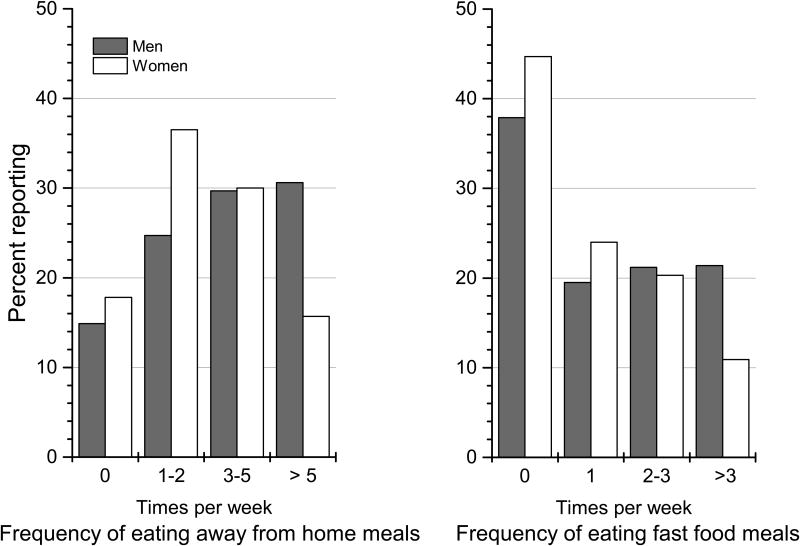
American adults reported a mean of 3.9 (95% confidence interval 3.7, 4.0) AFH and 1.8 (1.6, 1.9) fast-food meals/week. Over 50% of adults reported ⩾3 AFH and >35% reported ⩾2 fast-food meals/week. The mean BMI of more frequent AFH or fast-food meal reporters was higher (Ptrend⩽0.0004). Serum concentrations of total, LDL and HDL-cholesterol were related inversely with frequency of AFH meals (P<0.05). Frequencies of fast-food meals and serum HDL-cholesterol were also related inversely (P=0.0001). Serum concentrations of all examined micronutrients (except vitamin A and lycopene) declined with increasing frequency of AFH meals (P<0.05); women and ⩾50-year olds were at higher risk.
Reporters of frequent AFH and fast-food meals had higher BMI and lower concentrations of HDL-cholesterol; however, profiles of other biomarkers did not indicate higher metabolic risk. However, the serum concentrations of nutrients with mostly plant foods as sources declined with increasing AFH meal frequency.
外出就餐的膳食能量密度高且饮食质量差。直接和间接接触外出就餐膳食(例如,邻里餐厅密度)都被认为是导致体重增加和不良健康后果的因素。
研究外出就餐和快餐膳食的频率与慢性病生物标志物及膳食摄入量之间的关联。
这项横断面研究使用了2005 - 2010年美国国家健康与营养检查调查(NHANES)中外出就餐和快餐膳食的频率以及生物标志物数据。通过家庭访谈期间的问卷调查收集每周外出就餐和快餐膳食频率的信息。检测的代谢生物标志物包括体重指数(BMI)、血清胆固醇(总胆固醇、高密度脂蛋白(HDL)和低密度脂蛋白(LDL))、甘油三酯、糖化血红蛋白和空腹血糖(n = 8314,年龄≥20岁,2007 - 2010年国家健康与营养检查调查)。膳食暴露生物标志物包括血清中维生素A、D、E、C、B - 6、B - 12、叶酸和类胡萝卜素的浓度(n = 4162;2005 - 2006年)。采用多元线性和逻辑回归方法,并对复杂的调查方法和协变量进行了调整。
美国成年人报告平均每周外出就餐3.9次(95%置信区间3.7,4.0),快餐膳食1.8次(1.6,1.9)。超过一半的成年人报告每周外出就餐≥3次,超过35%的人报告每周快餐膳食≥2次。外出就餐或快餐膳食频率较高的人的平均BMI更高(趋势P≤0.0004)。血清总胆固醇、低密度脂蛋白和高密度脂蛋白胆固醇浓度与外出就餐膳食频率呈负相关(P < 0.05)。快餐膳食频率与血清高密度脂蛋白胆固醇也呈负相关(P = 0.0001)。随着外出就餐膳食频率增加,所有检测的微量营养素(维生素A和番茄红素除外)的血清浓度均下降(P < 0.05);女性和≥50岁的人风险更高。
频繁外出就餐和食用快餐膳食的人BMI较高,高密度脂蛋白胆固醇浓度较低;然而,其他生物标志物特征并未表明代谢风险更高。然而,以植物性食物为主来源的营养素血清浓度随着外出就餐膳食频率增加而下降。