School of Medicine, Department of Public Health and Preventive Medicine, St. George's University (SGU), West Indies, Grenada.
African Medical and Research Foundation (AMREF), Nairobi, Kenya.
Infect Dis Poverty. 2014 Oct 1;3(1):37. doi: 10.1186/2049-9957-3-37. eCollection 2014.
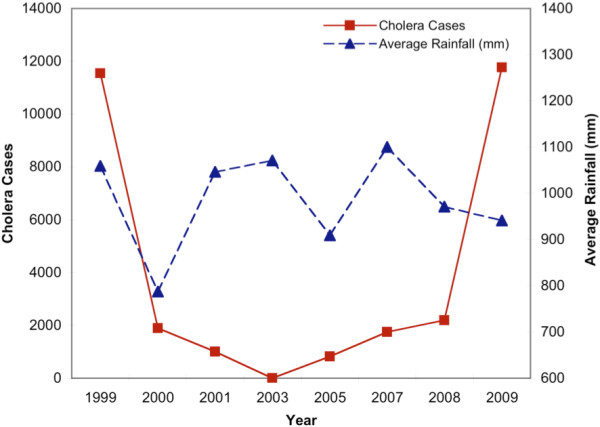
Cholera remains an important public health concern in developing countries including Kenya where 11,769 cases and 274 deaths were reported in 2009 according to the World Health Organization (WHO). This ecological study investigates the impact of various climatic, environmental, and demographic variables on the spatial distribution of cholera cases in Kenya.
District-level data was gathered from Kenya's Division of Disease Surveillance and Response, the Meteorological Department, and the National Bureau of Statistics. The data included the entire population of Kenya from 1999 to 2009.
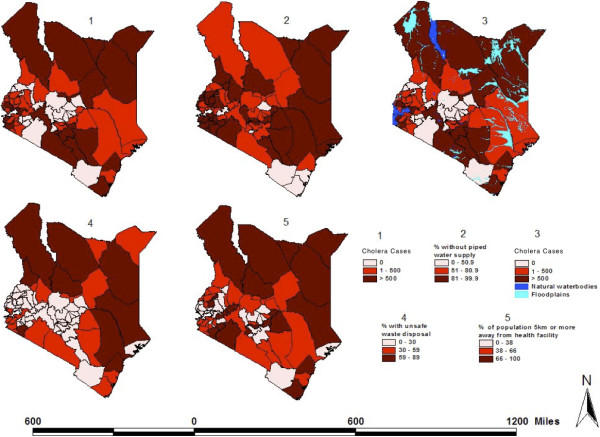
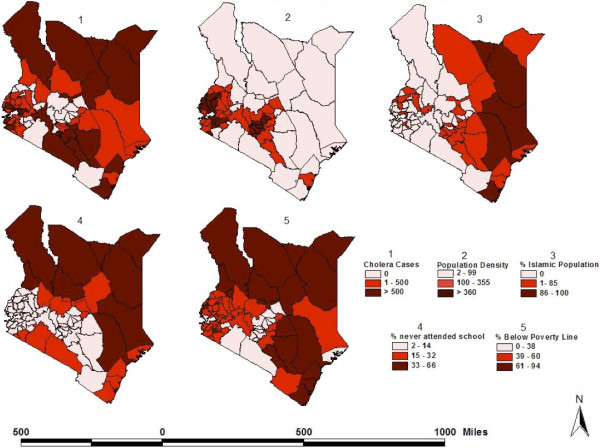
Multivariate analyses showed that districts had an increased risk of cholera outbreaks when a greater proportion of the population lived more than five kilometers from a health facility (RR: 1.025 per 1% increase; 95% CI: 1.010, 1.039), bordered a body of water (RR: 5.5; 95% CI: 2.472, 12.404), experienced increased rainfall from October to December (RR: 1.003 per 1 mm increase; 95% CI: 1.001, 1.005), and experienced decreased rainfall from April to June (RR: 0.996 per 1 mm increase; 95% CI: 0.992, 0.999). There was no detectable association between cholera and population density, poverty, availability of piped water, waste disposal methods, rainfall from January to March, or rainfall from July to September.
Bordering a large body of water, lack of health facilities nearby, and changes in rainfall were significantly associated with an increased risk of cholera in Kenya.
霍乱仍然是发展中国家的一个重要公共卫生问题,包括肯尼亚。根据世界卫生组织(WHO)的数据,2009 年肯尼亚报告了 11769 例病例和 274 例死亡。本生态研究调查了各种气候、环境和人口变量对肯尼亚霍乱病例空间分布的影响。
从肯尼亚疾病监测和应对司、气象部门和国家统计局收集了地区一级的数据。数据包括 1999 年至 2009 年肯尼亚的全部人口。
多变量分析表明,当更多的人口距离卫生设施超过五公里时,地区爆发霍乱的风险增加(RR:1.025/增加 1%;95%CI:1.010,1.039),与水体接壤(RR:5.5;95%CI:2.472,12.404),10 月至 12 月降雨量增加(RR:每增加 1 毫米增加 1.003;95%CI:1.001,1.005),4 月至 6 月降雨量减少(RR:每增加 1 毫米减少 0.996;95%CI:0.992,0.999)。霍乱与人口密度、贫困、管道供水的可用性、废物处理方法、1 月至 3 月的降雨量或 7 月至 9 月的降雨量之间没有明显的关联。
与大水体接壤、附近缺乏卫生设施以及降雨量的变化与肯尼亚霍乱风险增加显著相关。