Adagbada Ajoke Olutola, Adesida Solayide Abosede, Nwaokorie Francisca Obiageri, Niemogha Mary-Theresa, Coker Akitoye Olusegun
Molecular Biology and Biotechnology Division, Nigerian Institute of Medical Research, Yaba, Lagos, Nigeria.
Pan Afr Med J. 2012;12:59. Epub 2012 Jul 2.
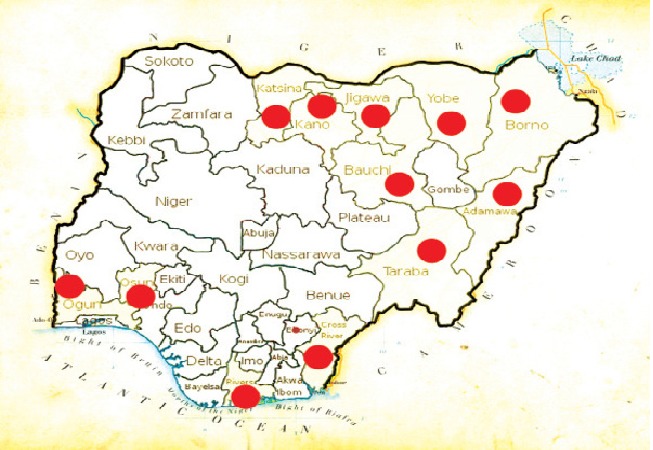
Cholera is an acute diarrhoeal infection caused by ingestion of food or water contaminated with the bacterium, Vibrio cholera. Choleragenic V. cholera O1 and O139 are the only causative agents of the disease. The two most distinguishing epidemiologic features of the disease are its tendency to appear in explosive outbreaks and its predisposition to causing pandemics that may progressively affect many countries and spread into continents. Despite efforts to control cholera, the disease continues to occur as a major public health problem in many developing countries. Numerous studies over more than a century have made advances in the understanding of the disease and ways of treating patients, but the mechanism of emergence of new epidemic strains, and the ecosystem supporting regular epidemics, remain challenging to epidemiologists. In Nigeria, since the first appearance of epidemic cholera in 1972, intermittent outbreaks have been occurring. The later part of 2010 was marked with severe outbreak which started from the northern part of Nigeria, spreading to the other parts and involving approximately 3,000 cases and 781 deaths. Sporadic cases have also been reported. Although epidemiologic surveillance constitutes an important component of the public health response, publicly available surveillance data from Nigeria have been relatively limited to date. Based on existing relevant scientific literature on features of cholera, this paper presents a synopsis of cholera epidemiology emphasising the situation in Nigeria.
霍乱是一种急性腹泻感染病,由摄入被霍乱弧菌污染的食物或水引起。产毒株霍乱弧菌O1群和O139群是该疾病的唯一病原体。该疾病两个最显著的流行病学特征是易爆发性和引发可能逐渐影响许多国家并蔓延至各大洲的大流行的倾向。尽管一直在努力控制霍乱,但在许多发展中国家,霍乱仍是一个主要的公共卫生问题。一个多世纪以来的大量研究在了解该疾病和治疗患者的方法方面取得了进展,但新流行菌株的出现机制以及支持定期流行的生态系统,对流行病学家来说仍然具有挑战性。在尼日利亚,自1972年首次出现霍乱疫情以来,间歇性疫情不断发生。2010年下半年,尼日利亚北部爆发了严重疫情,并蔓延至其他地区,报告病例约3000例,死亡781人。也有散发病例的报告。尽管流行病学监测是公共卫生应对措施的重要组成部分,但尼日利亚目前公开的监测数据相对有限。基于现有的关于霍乱特征的相关科学文献,本文概述了霍乱流行病学,重点介绍了尼日利亚的情况。