Chen Huize, Gong Yan, Han Rong
Higher Education Key Laboratory of Plant Molecular and Environmental Stress Response (Shanxi Normal University) in Shanxi Province, Linfen, China; School of Life Science, Shanxi Normal University, Linfen, China.
Higher Education Key Laboratory of Plant Molecular and Environmental Stress Response (Shanxi Normal University) in Shanxi Province, Linfen, China; School of Chemistry and Material Science, Shanxi Normal University, Linfen, China.
PLoS One. 2014 Oct 20;9(10):e110400. doi: 10.1371/journal.pone.0110400. eCollection 2014.
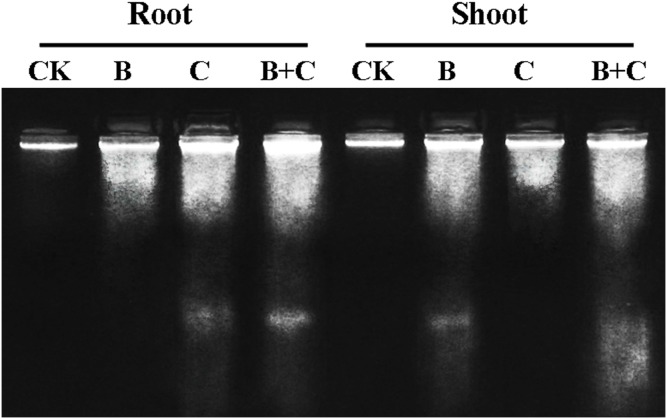
Nanoparticles (NPs) are becoming increasingly widespread in the environment. Free cadmium ions released from commonly used NPs under ultraviolet-B (UV-B) radiation are potentially toxic to living organisms. With increasing levels of UV-B radiation at the Earth's surface due to the depletion of the ozone layer, the potential additive effect of NPs and UV-B radiation on plants is of concern. In this study, we investigated the synergistic effect of CdTe quantum dots (CdTe-QDs), a common form of NP, and UV-B radiation on wheat seedlings. Graded doses of CdTe-QDs and UV-B radiation were tested, either alone or in combination, based on physical characteristics of 5-day-old seedlings. Treatments of wheat seedlings with either CdTe-QDs (200 mg/L) or UV-B radiation (10 KJ/m(2)/d) induced the activation of wheat antioxidant enzymes. CdTe-QDs accumulation in plant root cells resulted in programmed cell death as detected by DNA laddering. CdTe-QDs and UV-B radiation inhibited root and shoot growth, respectively. Additive inhibitory effects were observed in the combined treatment group. This research described the effects of UV-B and CdTe-QDs on plant growth. Furthermore, the finding that CdTe-QDs accumulate during the life cycle of plants highlights the need for sustained assessments of these interactions.
纳米颗粒(NPs)在环境中越来越普遍。常用纳米颗粒在紫外线B(UV-B)辐射下释放的游离镉离子可能对生物体有毒。由于臭氧层损耗,地球表面UV-B辐射水平不断上升,纳米颗粒和UV-B辐射对植物的潜在叠加效应令人担忧。在本研究中,我们调查了常见纳米颗粒形式的碲化镉量子点(CdTe-QDs)与UV-B辐射对小麦幼苗的协同效应。根据5日龄幼苗的物理特性,对不同剂量的CdTe-QDs和UV-B辐射进行了单独或组合测试。用CdTe-QDs(200 mg/L)或UV-B辐射(10 KJ/m(2)/d)处理小麦幼苗均可诱导小麦抗氧化酶的激活。通过DNA梯状条带检测发现,植物根细胞中CdTe-QDs的积累导致了程序性细胞死亡。CdTe-QDs和UV-B辐射分别抑制根和地上部分的生长。在联合处理组中观察到了叠加抑制效应。本研究描述了UV-B和CdTe-QDs对植物生长的影响。此外,CdTe-QDs在植物生命周期中积累这一发现凸显了持续评估这些相互作用的必要性。