Tran Ulrich S, Cebolla Ausiàs, Glück Tobias M, Soler Joaquim, Garcia-Campayo Javier, von Moy Theresa
University of Vienna, Vienna, Austria.
University Jaume I, Castelló de la Plana, Spain; Ciber Fisiopatologia de la obesidad y la nutrición (CIBEROBN), Santiago de Compostela, Spain.
PLoS One. 2014 Oct 16;9(10):e110192. doi: 10.1371/journal.pone.0110192. eCollection 2014.
To investigate the psychometric and structural properties of the Five Facets Mindfulness Questionnaire (FFMQ) among meditators, to develop a short form, and to examine associations of mindfulness with mental health and the mechanisms of mindfulness.
Two independent samples were used, a German (n = 891) and a Spanish (n = 393) meditator sample, practicing various meditation styles. Structural and psychometric properties of the FFMQ were investigated with multigroup confirmatory factor analysis and exploratory structural equation modeling. Associations with mental health and mechanisms of mindfulness were examined with path analysis.
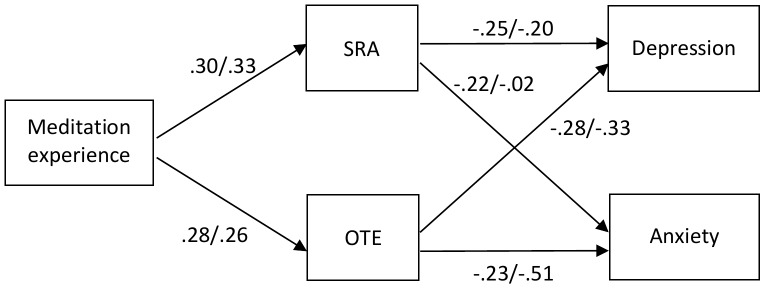
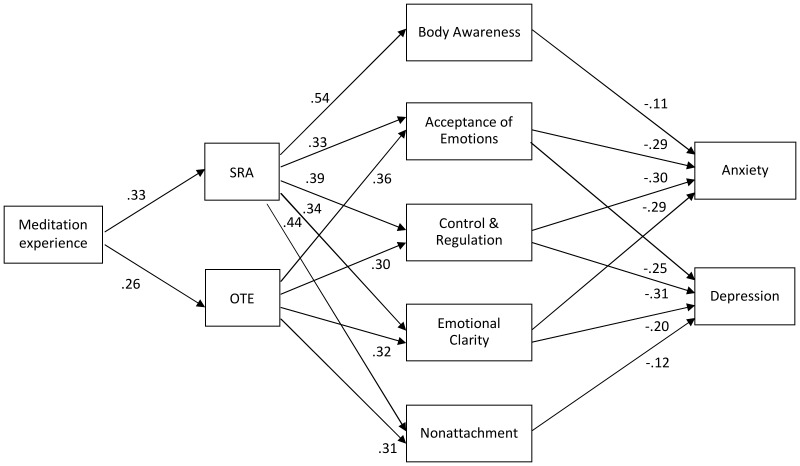
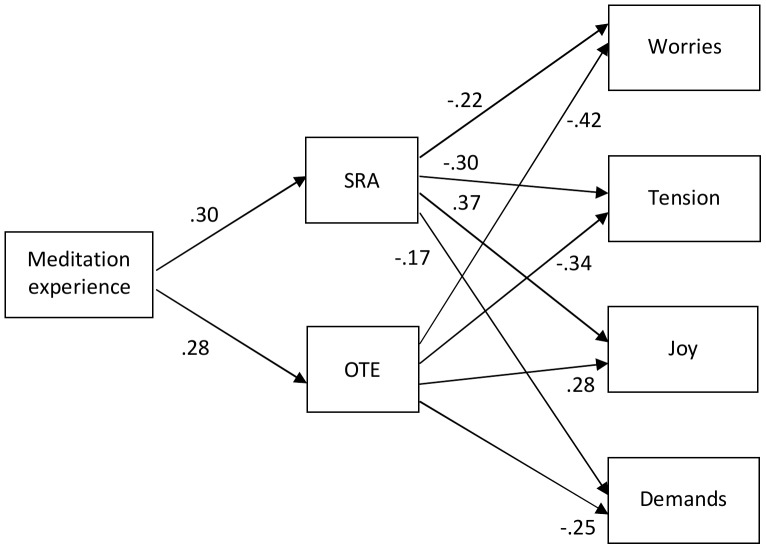
The derived short form broadly matched a previous item selection in samples of non-meditators. Self-regulated Attention and Orientation to Experience governed the facets of mindfulness on a higher-order level. Higher-order factors of mindfulness and meditation experience were negatively associated with symptoms of depression and anxiety, and perceived stress. Decentering and nonattachment were the most salient mechanisms of mindfulness. Aspects of emotion regulation, bodily awareness, and nonattachment explained the effects of mindfulness on depression and anxiety.
A two-component conceptualization for the FFMQ, and for the study of mindfulness as a psychological construct, is recommended for future research. Mechanisms of mindfulness need to be examined in intervention studies.
探讨五因素正念问卷(FFMQ)在冥想者中的心理测量和结构特性,编制一个简版,并研究正念与心理健康的关联以及正念的作用机制。
使用了两个独立样本,一个德国冥想者样本(n = 891)和一个西班牙冥想者样本(n = 393),他们练习各种冥想方式。采用多组验证性因素分析和探索性结构方程模型研究FFMQ的结构和心理测量特性。通过路径分析研究与心理健康和正念作用机制的关联。
得出的简版在很大程度上与之前在非冥想者样本中的项目选择相匹配。自我调节注意力和对体验的关注在高阶层面上主导着正念的各个方面。正念和冥想体验的高阶因素与抑郁、焦虑症状以及感知到的压力呈负相关。去中心化和不执着是正念最显著的作用机制。情绪调节、身体觉察和不执着的方面解释了正念对抑郁和焦虑的影响。
建议在未来研究中对FFMQ以及将正念作为一种心理结构进行研究时采用双成分概念化。正念的作用机制需要在干预研究中进行检验。