Cho Han Jin, Park Jung Han Yoon
Department of Food and Nutrition, Hallym University, Chuncheon, Korea.
J Cancer Prev. 2013 Sep;18(3):257-63. doi: 10.15430/jcp.2013.18.3.257.
A greater intake of vegetables and fruits has been linked to a reduced incidence of colon cancer. Flavonoids are polyphenolic compounds which are broadly distributed in fruits and vegetables and display a remarkable spectrum of physiological activities, including anti-carcinogenic effects. The objective of this study was to determine the mechanisms by which kaempferol, a flavonol present in tea, apples, strawberries, and beans, inhibits the growth of HT-29 human colon cancer cells.
To examine the effects of kaempferol on cell cycle progression in HT-29 cells, cells were treated with various concentrations (0-60 μmol/L) of kaempferol. Cell proliferation and DNA synthesis were evaluated by MTT assay and [(3)H]thymidine incorporation assay, respectively. Fluorescence-activated cell sorting analyses were conducted to calculate cell cycle phase distribution. Western blot analyses and in vitro kinase assays were used to estimate the expression of proteins involved in the regulation of cell cycle progression and the activity of cyclin-dependent kinase (CDK)s, respectively.
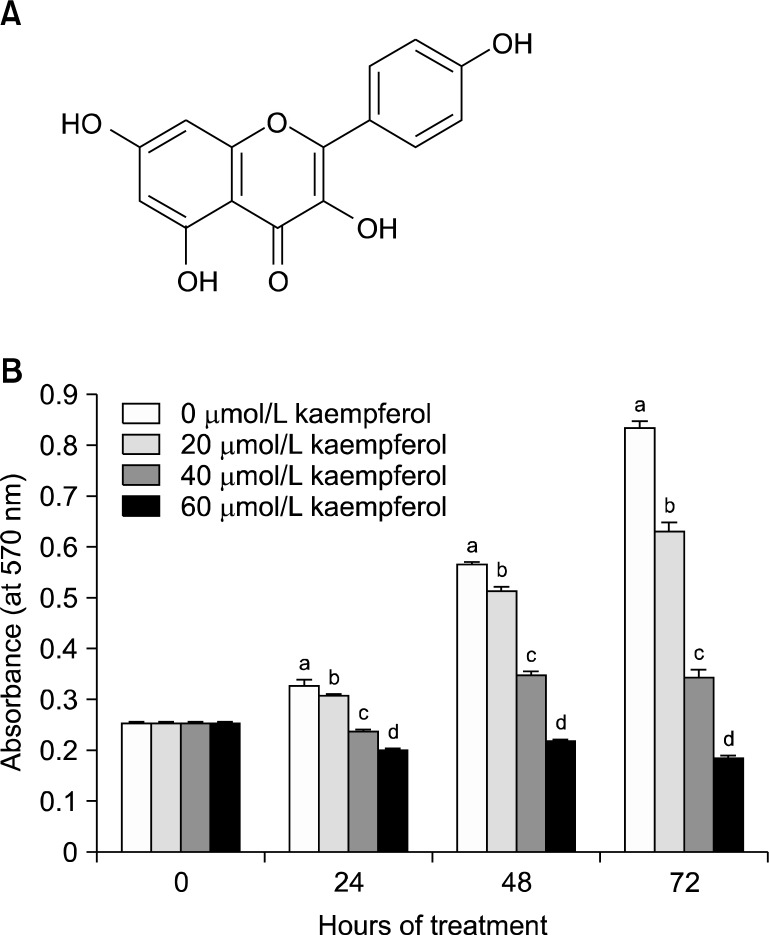
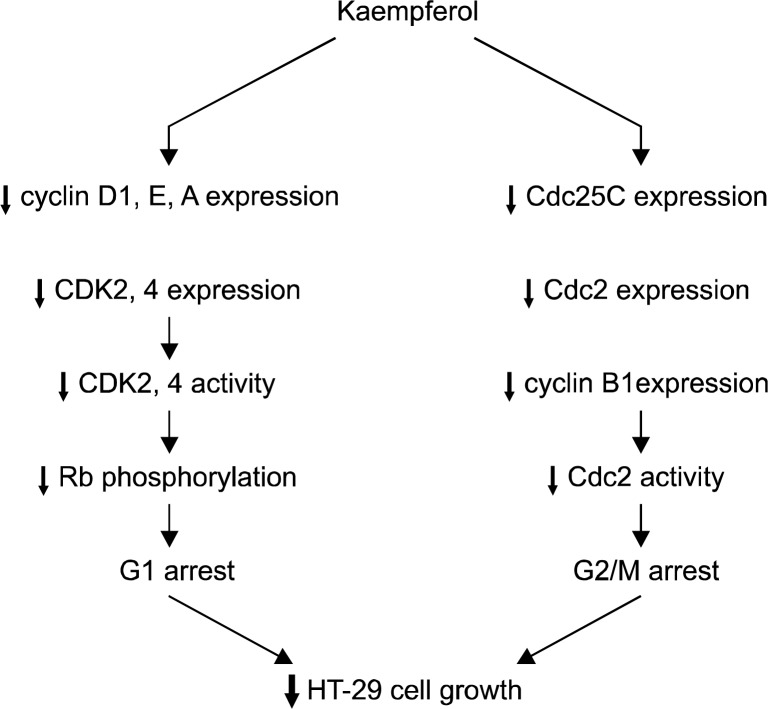
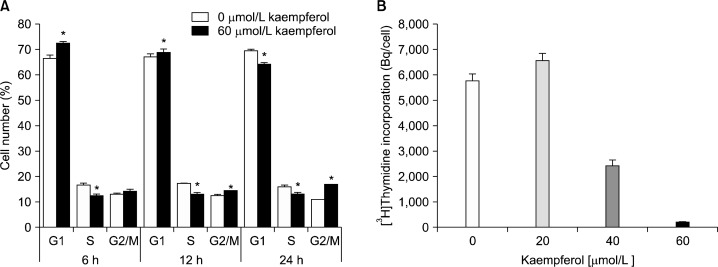
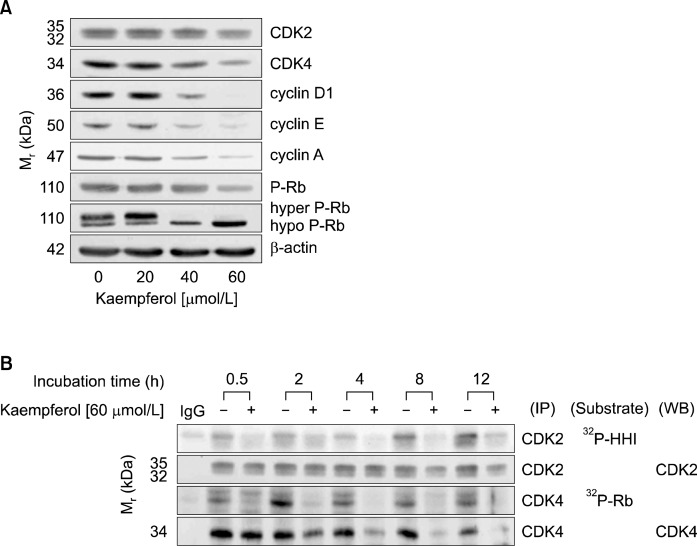
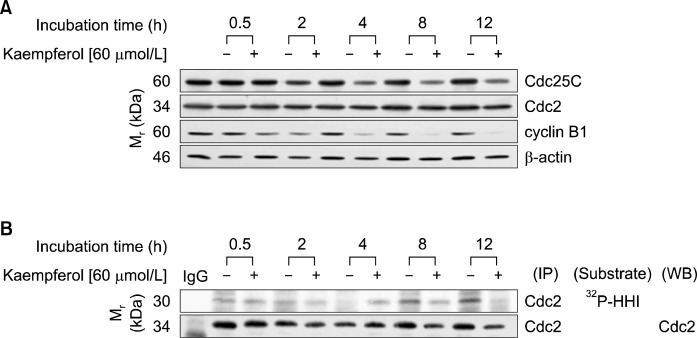
Kaempferol decreased viable cell numbers and [(3)H]thymidine incorporation into DNA of HT-29 cells in a dose-dependent manner. Kaempferol induced G1 cell cycle arrest within 6 h and G2/M arrest at 12 h. Kaempferol inhibited the activity of CDK2 and CDK4 as well as the protein expression of CDK2, CDK4, cyclins D1, cyclin E, and cyclin A, and suppressed the phosphorylation of retinoblastoma protein. Additionally, kaempferol decreased the levels of Cdc25C, Cdc2, and cyclin B1 proteins, as well as the activity of Cdc2.
The present results indicate that kaempferol induces G1 and G2/M cell cycle arrest by inhibiting the activity of CDK2, CDK4, and Cdc2. The induction of cell cycle arrest may be one of the mechanisms by which kaempferol exerts anti-carcinogenic effects in colon cancer cells.
摄入更多的蔬菜和水果与降低结肠癌发病率有关。黄酮类化合物是多酚类化合物,广泛分布于水果和蔬菜中,并具有显著的一系列生理活性,包括抗癌作用。本研究的目的是确定山奈酚(一种存在于茶、苹果、草莓和豆类中的黄酮醇)抑制HT - 29人结肠癌细胞生长的机制。
为了研究山奈酚对HT - 29细胞周期进程的影响,用不同浓度(0 - 60 μmol/L)的山奈酚处理细胞。分别通过MTT法和[³H]胸腺嘧啶核苷掺入法评估细胞增殖和DNA合成。进行荧光激活细胞分选分析以计算细胞周期阶段分布。分别使用蛋白质免疫印迹分析和体外激酶测定来估计参与细胞周期进程调节的蛋白质表达和细胞周期蛋白依赖性激酶(CDK)的活性。
山奈酚以剂量依赖性方式降低HT - 29细胞的活细胞数量和[³H]胸腺嘧啶核苷掺入DNA的量。山奈酚在6小时内诱导G1期细胞周期停滞,在12小时诱导G2/M期停滞。山奈酚抑制CDK2和CDK4的活性以及CDK2、CDK4、细胞周期蛋白D1、细胞周期蛋白E和细胞周期蛋白A的蛋白质表达,并抑制视网膜母细胞瘤蛋白的磷酸化。此外,山奈酚降低了Cdc25C、Cdc2和细胞周期蛋白B1的蛋白质水平以及Cdc2的活性。
目前的结果表明,山奈酚通过抑制CDK2、CDK4和Cdc2的活性诱导G1和G2/M期细胞周期停滞。细胞周期停滞的诱导可能是山奈酚在结肠癌细胞中发挥抗癌作用的机制之一。