Juras Anna, Dabert Miroslawa, Kushniarevich Alena, Malmström Helena, Raghavan Maanasa, Kosicki Jakub Z, Metspalu Ene, Willerslev Eske, Piontek Janusz
Department of Human Evolutionary Biology, Faculty of Biology, Adam Mickiewicz University in Poznan, Poznan, Poland.
Molecular Biology Techniques Laboratory, Faculty of Biology, Adam Mickiewicz University in Poznan, Poznan, Poland.
PLoS One. 2014 Oct 22;9(10):e110839. doi: 10.1371/journal.pone.0110839. eCollection 2014.
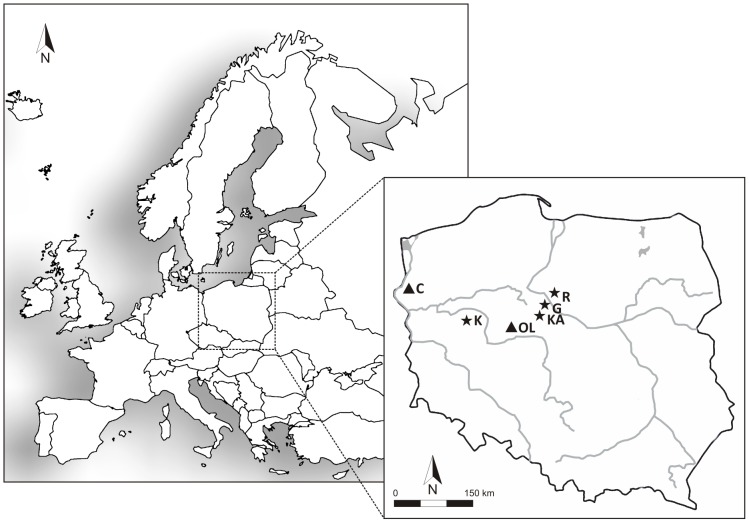
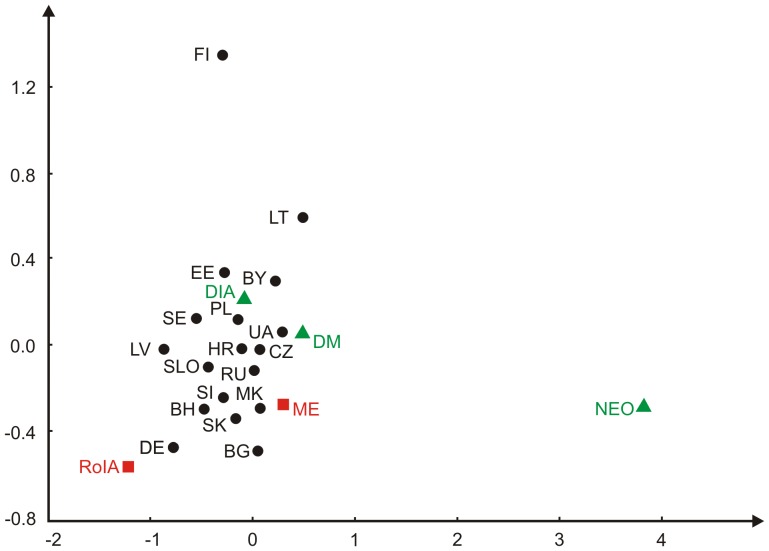
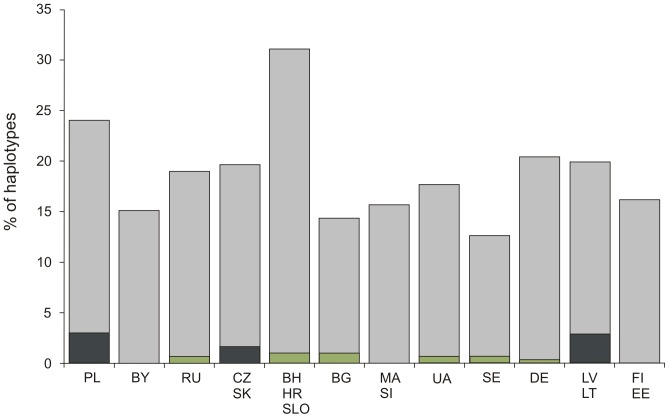
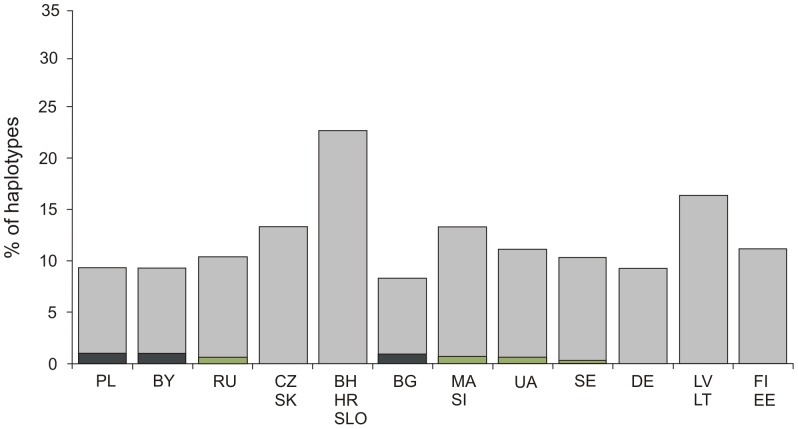
While numerous ancient human DNA datasets from across Europe have been published till date, modern-day Poland in particular, remains uninvestigated. Besides application in the reconstruction of continent-wide human history, data from this region would also contribute towards our understanding of the history of the Slavs, whose origin is hypothesized to be in East or Central Europe. Here, we present the first population-scale ancient human DNA study from the region of modern-day Poland by establishing mitochondrial DNA profiles for 23 samples dated to 200 BC - 500 AD (Roman Iron Age) and for 20 samples dated to 1000-1400 AD (Medieval Age). Our results show that mitochondrial DNA sequences from both periods belong to haplogroups that are characteristic of contemporary West Eurasia. Haplotype sharing analysis indicates that majority of the ancient haplotypes are widespread in some modern Europeans, including Poles. Notably, the Roman Iron Age samples share more rare haplotypes with Central and Northeast Europeans, whereas the Medieval Age samples share more rare haplotypes with East-Central and South-East Europeans, primarily Slavic populations. Our data demonstrates genetic continuity of certain matrilineages (H5a1 and N1a1a2) in the area of present-day Poland from at least the Roman Iron Age until present. As such, the maternal gene pool of present-day Poles, Czechs and Slovaks, categorized as Western Slavs, is likely to have descended from inhabitants of East-Central Europe during the Roman Iron Age.
尽管迄今为止已经公布了许多来自欧洲各地的古代人类DNA数据集,但现代波兰尤其尚未得到研究。除了应用于重建整个欧洲大陆的人类历史外,该地区的数据也将有助于我们了解斯拉夫人的历史,据推测斯拉夫人起源于东欧或中欧。在这里,我们通过建立23个可追溯到公元前200年至公元500年(罗马铁器时代)的样本以及20个可追溯到公元1000年至1400年(中世纪)的样本的线粒体DNA图谱,展示了来自现代波兰地区的第一项大规模古代人类DNA研究。我们的结果表明,两个时期的线粒体DNA序列都属于当代西亚西部特有的单倍群。单倍型共享分析表明,大多数古代单倍型在一些现代欧洲人中广泛存在,包括波兰人。值得注意的是,罗马铁器时代的样本与中欧和东北欧人共享更多罕见单倍型,而中世纪的样本与中东欧和东南欧人,主要是斯拉夫人群体共享更多罕见单倍型。我们的数据证明了当今波兰地区某些母系血统(H5a1和N1a1a2)从至少罗马铁器时代到现在的遗传连续性。因此,被归类为西斯拉夫人的当今波兰人、捷克人和斯洛伐克人的母系基因库可能源自罗马铁器时代中欧东部的居民。