Wu Jie, Zou Lirong, Ni Hanzhong, Pei Lei, Zeng Xianqiao, Liang Lijun, Zhong Haojie, He Jianfeng, Song Yingchao, Kang Min, Zhang Xin, Lin Jinyan, Ke Changwen
Center for Disease Control and Prevention of Guangdong Province, Guangzhou 511430, China.
Virol J. 2014 Oct 23;11:184. doi: 10.1186/1743-422X-11-184.
The aim of this study was to assess the prevalence of the novel avian influenza A virus (H7N9) in three high risk groups. The groups were divided into those exposed through infected individuals, those exposed through poultry and those individuals exposed through the external environment, in the early stage of the epidemic in Guangdong Province, which is located in the southern region of China.
Serologic studies were conducted among samples collected from individuals who had close contact with the first H7N9 infected patient reported in Guangdong Province, those who were most likely exposed to the first group of H7N9 infected poultry, and those who might have been exposed to H7N9 in the environmental settings, namely hemagglutinin inhibition (HI) and microneutralizaiton(MN) assays using three viruses as antigens.
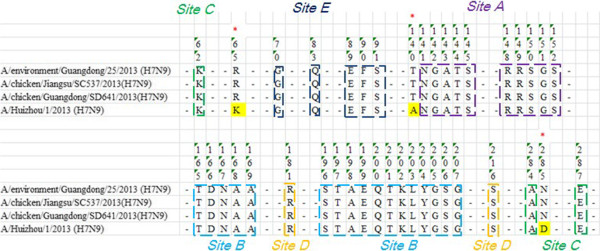
The alignment results of the viral sequences indicated the similarity of the HA gene sequence among viruses from exposure to infected poultry, infected humans and contaminated environments were highly conserved. Seven samples of individuals exposed to contaminated environments were positive in the HI assay and one sample among them was positive in the MN assay using poultry H7N9 virus as the antigen. One sample was positive against human H7N9 virus and 3 samples were positive against environmental H7N9 among those that were in contact with infected patients in HI assay. None of these were positive in MN assay. All HI titers of the 240 samples from those individuals in contact with infected poultry were less than 40 aganist the antigens from three viruses.
The results suggest that when the H7N9 virus was in the early stages of circulation in Guangdong Province, the antigenic sites of the HA proteins of the H7N9 strain isolated from different hosts were highly conserved. The risk of new infection is low in individuals who have contact with the infected patients, poultry or a contaminated environment in the early stages of the circulation of the H7N9 virus.
本研究旨在评估新型甲型禽流感病毒(H7N9)在三个高危群体中的流行情况。这些群体分为在广东省疫情早期通过感染个体暴露的人群、通过家禽暴露的人群以及通过外部环境暴露的人群,广东省位于中国南部地区。
对从与广东省报告的首例H7N9感染患者密切接触的个体、最有可能接触首批H7N9感染家禽的个体以及可能在环境中接触过H7N9的个体采集的样本进行血清学研究,即使用三种病毒作为抗原进行血凝抑制(HI)和微量中和(MN)试验。
病毒序列比对结果表明,来自暴露于感染家禽、感染人类和受污染环境的病毒之间的HA基因序列相似性高度保守。在HI试验中,7份暴露于受污染环境个体的样本呈阳性,其中1份样本使用家禽H7N9病毒作为抗原在MN试验中呈阳性。在HI试验中,与感染患者接触的个体中,1份样本对人H7N9病毒呈阳性,3份样本对环境H7N9呈阳性。这些样本在MN试验中均未呈阳性。来自接触感染家禽个体的240份样本对三种病毒抗原的所有HI效价均低于40。
结果表明,当H7N9病毒在广东省处于早期传播阶段时,从不同宿主分离的H7N9毒株HA蛋白的抗原位点高度保守。在H7N9病毒传播早期与感染患者、家禽或受污染环境接触的个体中,新感染的风险较低。