Kleefman Marijke, Jansen Daniëlle E M C, Stewart Roy E, Reijneveld Sijmen A
BMC Med. 2014 Oct 28;12:191. doi: 10.1186/s12916-014-0191-5.
Children with borderline to mild intellectual disability (BMID) have been shown to be at increased risk for psychosocial problems. The presence of these psychosocial problems leads to parenting stress. Stepping Stones Triple P (SSTP) is a parenting support program to support parents with children with BMID and psychosocial problems. The aim of this study was to evaluate the effectiveness of SSTP compared to Care as Usual (CAU) in reducing psychosocial problems in children with BMID.
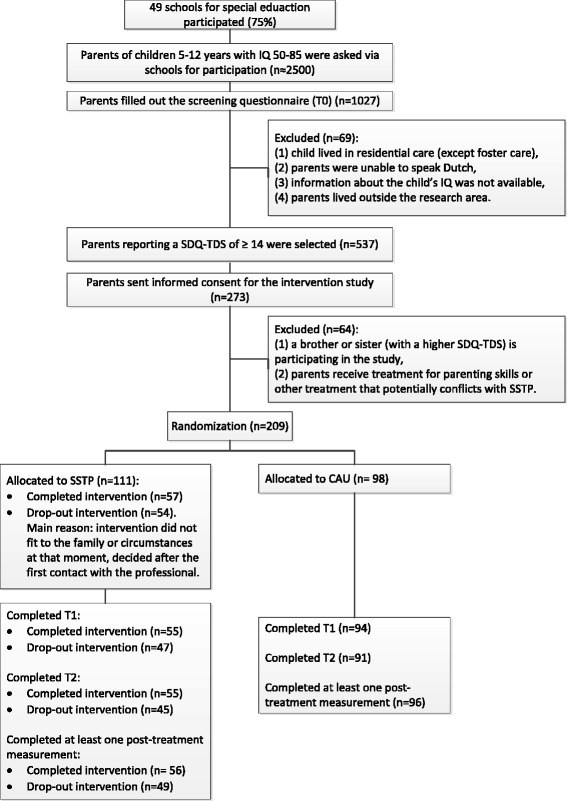
We conducted a randomized controlled trial in the Northern provinces of the Netherlands. Parents of children aged 5 to 12 with borderline (IQ 70 to 85) or mild (IQ 70 to 50) ID and psychosocial problems were invited. Psychosocial problems were identified using the Strengths and Difficulties Questionnaire (SDQ) parent report (≥14). Measurements were assessed before the intervention (T0), immediately after the intervention (T1) and after a follow-up of six months (T2). SSTP takes 8 to 10 individual sessions of 40-90 minutes, provided over 10 to 12 weeks. CAU concerned any service, except SSTP. Primary outcomes were the child's psychosocial problems (SDQ parent and teacher forms and the Eyberg Child Behavior Inventory, ECBI). Secondary outcomes were parenting stress (Parenting Stress Index, PSI) and parenting skills (Alabama Parenting Questionnaire, APQ).
In total 209 parents of children aged 5 to 12 with BMID were allocated blindly to either SSTP (n =111) or CAU (n =98). In the intention to treat analyses, SSTP achieved no significantly better effect than CAU for the SDQ parent report, the ECBI and the APQ on the short- and long- term. In the short term, SSTP was significantly more effective than CAU for the SDQ teacher report (B = -2.25, 95% CI -3.79 to -0.71) and the PSI (B = -7.06, 95% CI -12.11 to -2.01). For both SDQ teacher report and PSI, there was no statistically significant effect in the long term. Dropout from SSTP was considerable (49%), with the effects being solely found in the adherent SSTP subgroup.
SSTP had some short-term advantages over CAU, but not in the longer term.
Dutch Trial Register NTR2624. Registered 26 November 2010.
边缘至轻度智力残疾(BMID)儿童出现心理社会问题的风险更高。这些心理社会问题的存在会导致育儿压力。步步递进积极育儿方案(SSTP)是一项育儿支持项目,旨在帮助有BMID及心理社会问题儿童的家长。本研究旨在评估SSTP与常规护理(CAU)相比,在减少BMID儿童心理社会问题方面的有效性。
我们在荷兰北部省份进行了一项随机对照试验。邀请了5至12岁患有边缘型(智商70至85)或轻度(智商70至50)智力残疾及心理社会问题儿童的家长。使用优势与困难问卷(SDQ)家长报告(≥14)来识别心理社会问题。在干预前(T0)、干预后立即(T1)以及随访6个月后(T2)进行测量评估。SSTP包括8至10次时长40 - 90分钟的个体辅导课程,在10至12周内完成。CAU包括除SSTP之外的任何服务。主要结局指标为儿童的心理社会问题(SDQ家长版和教师版以及埃伯格儿童行为量表,ECBI)。次要结局指标为育儿压力(育儿压力指数,PSI)和育儿技能(阿拉巴马育儿问卷,APQ)。
共有209名5至12岁患有BMID儿童的家长被随机分配至SSTP组(n = 111)或CAU组(n = 98)。在意向性分析中,对于SDQ家长报告、ECBI和APQ,SSTP在短期和长期内均未显示出比CAU有显著更好的效果。短期内,对于SDQ教师报告(B = -2.25,95%置信区间 -3.79至 -0.71)和PSI(B = -7.06,95%置信区间 -12.11至 -2.01),SSTP比CAU显著更有效。对于SDQ教师报告和PSI,长期来看均无统计学显著效果。SSTP的退出率相当高(49%),效果仅在坚持参与SSTP的亚组中发现。
SSTP在短期内比CAU有一些优势,但长期来看并非如此。
荷兰试验注册库NTR2624。2010年11月26日注册。