Yazdizadeh Bahareh, Majdzadeh Reza, Alami Ali, Amrolalaei Sima
Knowledge Utilization Research Center, Tehran University of Medical Science, No 1547, North Karegar St, Enghelab Ave, Tehran, Iran.
Health Res Policy Syst. 2014 Oct 29;12:63. doi: 10.1186/1478-4505-12-63.
Formal knowledge networks are considered among the solutions for strengthening knowledge translation and one of the elements of innovative systems in developing and developed countries. In the year 2000, knowledge networks were established in Iran's health system to organize, lead, empower, and coordinate efforts made by health-related research centers in the country. Since the assessment of a knowledge network is one of the main requirements for its success, the current study was designed in two qualitative and quantitative sections to identify the strengths and weaknesses of the established knowledge networks and to assess their efficiency.
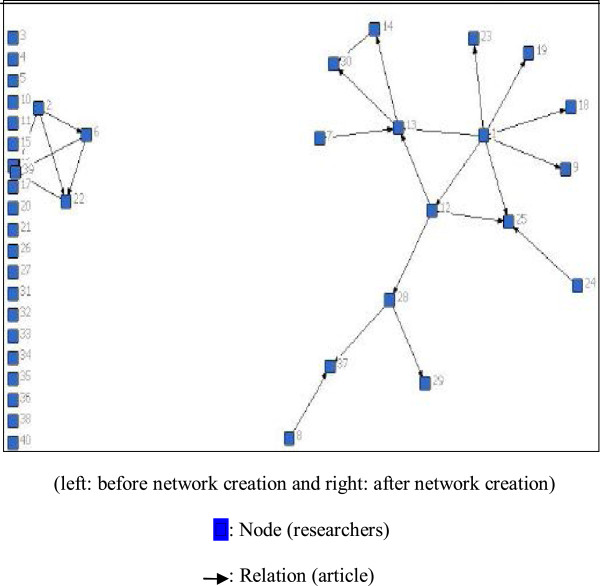
In the qualitative section, semi-structured, in-depth interviews were held with network directors and secretaries. The interviews were analyzed through the framework approach. To analyze effectiveness, social network analysis approach was used. That is, by considering the networks' research council members as 'nodes', and the numbers of their joint articles--before and after the network establishments--as 'relations or ties', indices of density, clique, and centrality were calculated for each network. In the qualitative section, non-transparency of management, lack of goals, administrative problems were among the most prevalent issues observed.
Currently, the most important challenges are the policies related to them and their management. In the quantitative section, we observed that density and clique indices had risen for some networks; however, the centrality index for the same networks was not as high. Consequently the attribution of density and clique indices to these networks was not possible.
Therefore, consolidating and revising policies relevant to the networks and preparing a guide for establishing managing networks could prove helpful. To develop knowledge and technology in a country, networks need to solve the problems they face in management and governance. That is, the first step towards the realization of true knowledge networks in health system.
正式知识网络被视为加强知识转化的解决方案之一,也是发展中国家和发达国家创新体系的要素之一。2000年,伊朗卫生系统建立了知识网络,以组织、领导、赋能并协调该国卫生相关研究中心所做的工作。由于对知识网络的评估是其成功的主要要求之一,本研究设计了定性和定量两个部分,以确定已建立的知识网络的优势和劣势,并评估其效率。
在定性部分,对网络主任和秘书进行了半结构化的深入访谈。通过框架方法对访谈进行分析。为了分析有效性,使用了社会网络分析方法。也就是说,将网络研究委员会成员视为“节点”,将他们在网络建立前后的联合文章数量视为“关系或联系”,为每个网络计算密度、团块和中心性指数。在定性部分,管理不透明、缺乏目标、行政问题是观察到的最普遍问题。
目前,最重要的挑战是与之相关的政策及其管理。在定量部分,我们观察到一些网络的密度和团块指数有所上升;然而,同一网络的中心性指数并不高。因此,无法将密度和团块指数归因于这些网络。
因此,巩固和修订与网络相关的政策,并编写建立管理网络的指南可能会有所帮助。为了在一个国家发展知识和技术,网络需要解决它们在管理和治理方面面临的问题。也就是说,这是在卫生系统中实现真正知识网络的第一步。