Departamento de Inteligencia Artificial, Universidad Politecnica de Madrid Madrid, Spain.
Front Comput Neurosci. 2014 Oct 16;8:131. doi: 10.3389/fncom.2014.00131. eCollection 2014.
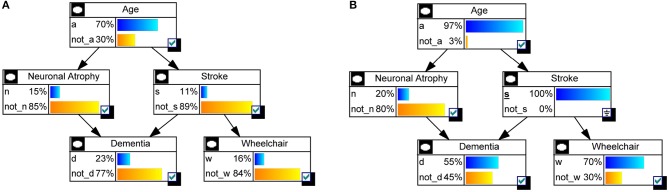
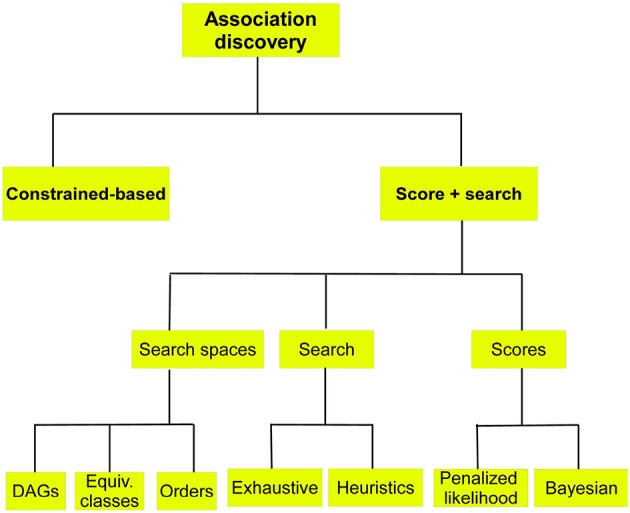
Bayesian networks are a type of probabilistic graphical models lie at the intersection between statistics and machine learning. They have been shown to be powerful tools to encode dependence relationships among the variables of a domain under uncertainty. Thanks to their generality, Bayesian networks can accommodate continuous and discrete variables, as well as temporal processes. In this paper we review Bayesian networks and how they can be learned automatically from data by means of structure learning algorithms. Also, we examine how a user can take advantage of these networks for reasoning by exact or approximate inference algorithms that propagate the given evidence through the graphical structure. Despite their applicability in many fields, they have been little used in neuroscience, where they have focused on specific problems, like functional connectivity analysis from neuroimaging data. Here we survey key research in neuroscience where Bayesian networks have been used with different aims: discover associations between variables, perform probabilistic reasoning over the model, and classify new observations with and without supervision. The networks are learned from data of any kind-morphological, electrophysiological, -omics and neuroimaging-, thereby broadening the scope-molecular, cellular, structural, functional, cognitive and medical- of the brain aspects to be studied.
贝叶斯网络是一种概率图形模型,位于统计学和机器学习的交叉点。它们已被证明是在不确定情况下对领域变量之间的依赖关系进行编码的强大工具。由于其通用性,贝叶斯网络可以容纳连续和离散变量以及时间过程。在本文中,我们回顾了贝叶斯网络以及如何通过结构学习算法从数据中自动学习这些网络。此外,我们还研究了用户如何利用这些网络通过精确或近似推理算法进行推理,这些算法通过图形结构传播给定的证据。尽管它们在许多领域都有应用,但在神经科学中使用得很少,神经科学主要关注特定问题,如从神经影像学数据中进行功能连接分析。在这里,我们调查了神经科学中使用贝叶斯网络的关键研究,这些研究具有不同的目的:发现变量之间的关联、在模型上进行概率推理以及在有监督和无监督的情况下对新观测值进行分类。这些网络可以从任何类型的数据中学习 - 形态学、电生理学、组学和神经影像学 - 从而拓宽了研究的大脑方面的范围 - 分子、细胞、结构、功能、认知和医学。