Hamblion Esther L, Salter Mark, Jones Jane
Centre for Infectious Disease Surveillance and Control, Public Health England, 61 Colindale Avenue, London, NW9 5EQ, England .
Global Health, Public Health England, London, England .
Bull World Health Organ. 2014 Nov 1;92(11):836-43. doi: 10.2471/BLT.14.137828. Epub 2014 Sep 9.
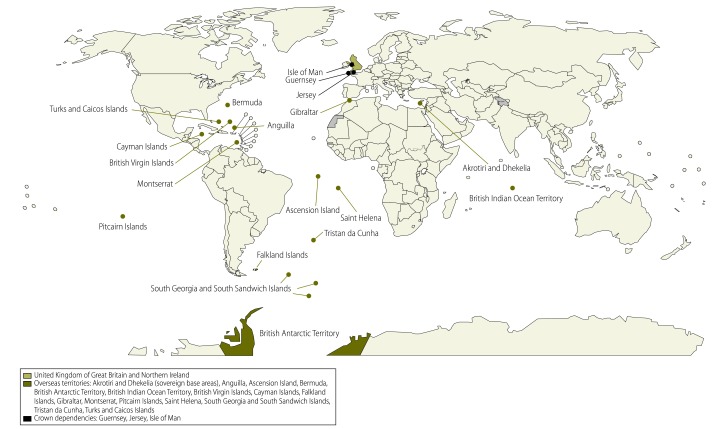
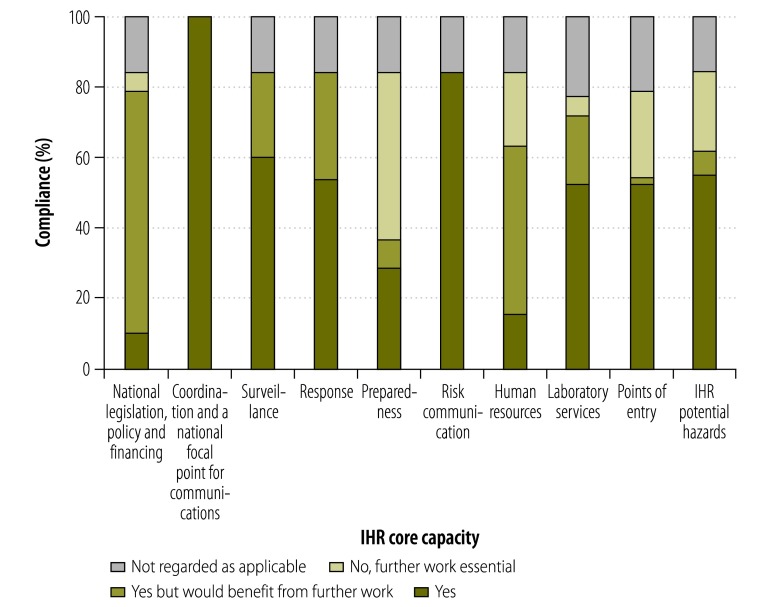
The 2005 International Health Regulations (IHR) came into force for all Member States of the World Health Organization (WHO) in June 2007 and the deadline for achieving compliance was June 2012. The purpose of the IHR is to prevent, protect against, control - and provide a public health response to - international spread of disease. The territory of the United Kingdom of Great Britain and Northern Ireland and that of several other Member States, such as China, Denmark, France, the Netherlands and the United States of America, include overseas territories, which cover a total population of approximately 15 million people. Member States have a responsibility to ensure that all parts of their territory comply with the IHR. Since WHO has not provided specific guidance on compliance in the special circumstances of the overseas territories of Member States, compliance by these territories is an issue for self-assessment by Member States themselves. To date, no reports have been published on the assessment of IHR compliance in countries with overseas territories. We describe a gap analysis done in the United Kingdom to assess IHR compliance of its overseas territories. The findings and conclusions are broadly applicable to other countries with overseas territories which may have yet to assess their compliance with the IHR. Such assessments are needed to ensure compliance across all parts of a Member States' territory and to increase global health security.
《2005年国际卫生条例》(《国际卫生条例》)于2007年6月对世界卫生组织(世卫组织)所有成员国生效,达到合规的截止日期为2012年6月。《国际卫生条例》的目的是预防、防范、控制疾病的国际传播,并对此做出公共卫生应对。大不列颠及北爱尔兰联合王国以及中国、丹麦、法国、荷兰和美利坚合众国等其他几个成员国的领土包括海外领土,这些海外领土的总人口约为1500万。成员国负有确保其领土所有部分遵守《国际卫生条例》的责任。由于世卫组织尚未就成员国海外领土的特殊情况提供关于合规的具体指导,这些领土的合规情况是成员国自行评估的问题。迄今为止,尚未发表关于有海外领土国家《国际卫生条例》合规情况评估的报告。我们描述了联合王国为评估其海外领土的《国际卫生条例》合规情况所做的差距分析。研究结果和结论广泛适用于其他有海外领土且可能尚未评估其《国际卫生条例》合规情况的国家。需要进行此类评估,以确保成员国领土所有部分的合规,并加强全球卫生安全。