Xu X, Su S, Wang X, Barnes V, De Miguel C, Ownby D, Pollock J, Snieder H, Chen W, Wang X
Department of Pediatrics, Georgia Prevention Center, Institute of Public and Preventive Health, Georgia Regents University, Augusta, GA, USA.
Cardio-Rental Physiology and Medicine, Division of Nephrology, Department of Medicine, University of Alabama at Birmingham, Birmingham, AL, USA.
Int J Obes (Lond). 2015 Jan;39(1):26-32. doi: 10.1038/ijo.2014.194. Epub 2014 Nov 12.
There is emerging evidence suggesting the role of peripheral blood leukocytes in the pathogenesis of obesity and related diseases. However, few studies have taken a genome-wide approach to investigating gene expression profiles in peripheral leukocytes between obese and lean individuals with the consideration of obesity-related shifts in leukocyte types.
We conducted this study in 95 African Americans (AAs) of both genders (age 14-20 years, 46 lean and 49 obese). Complete blood count with differential test (CBC) was performed in whole blood. Genome-wide gene expression analysis was obtained using the Illumina HumanHT-12 V4 Beadchip with RNA extracted from peripheral leukocytes. Out of the 95 participants, 64 had neutrophils stored. The validation study was based on real-time PCR with RNA extracted from purified neutrophils.
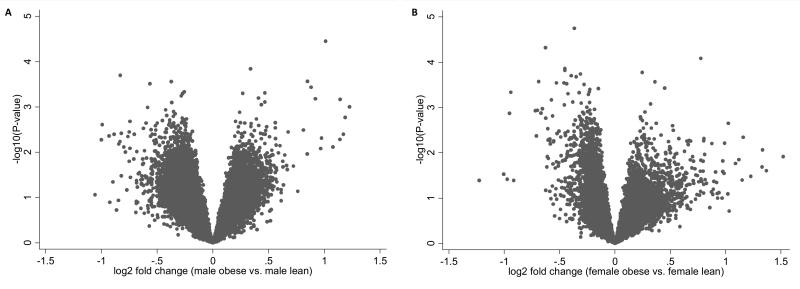
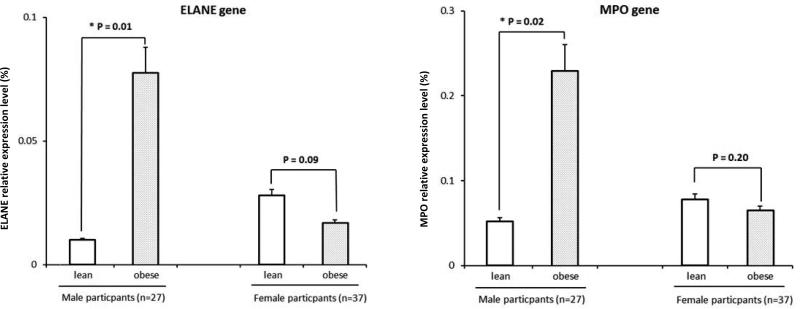
CBC test suggested that, in males, obesity was associated with increased neutrophil percentage (P=0.03). Genome-wide gene expression analysis showed that, in males, the majority of the most differentially expressed genes were related to neutrophil activation. Validation of the gene expression levels of ELANE (neutrophil elastase) and MPO (myeloperoxidase) in purified neutrophils demonstrated that the expression of these two genes--important biomarkers of neutrophils activation--were significantly elevated in obese males (P=0.01 and P=0.02, respectively).
The identification of increased neutrophil percentage and activation in obese AA males suggests that neutrophils have an essential role in the pathogenesis of obesity-related disease. Further functional and mechanistic studies on neutrophils may contribute to the development of novel intervention strategies reducing the burden associated with obesity-related health problems.
越来越多的证据表明外周血白细胞在肥胖及相关疾病的发病机制中发挥作用。然而,很少有研究采用全基因组方法,在考虑肥胖相关白细胞类型变化的情况下,研究肥胖个体与瘦个体外周白细胞中的基因表达谱。
我们对95名非裔美国人(AAs)(年龄14 - 20岁,46名瘦者和49名肥胖者)进行了这项研究。对全血进行全血细胞计数及分类检测(CBC)。使用Illumina HumanHT - 12 V4 Beadchip对从外周白细胞中提取的RNA进行全基因组基因表达分析。在95名参与者中,64人储存了中性粒细胞。验证研究基于从纯化的中性粒细胞中提取RNA进行的实时PCR。
CBC检测表明,在男性中,肥胖与中性粒细胞百分比增加有关(P = 0.03)。全基因组基因表达分析显示,在男性中,大多数差异表达最大的基因与中性粒细胞活化有关。对纯化中性粒细胞中ELANE(中性粒细胞弹性蛋白酶)和MPO(髓过氧化物酶)基因表达水平的验证表明,这两个作为中性粒细胞活化重要生物标志物的基因在肥胖男性中的表达显著升高(分别为P = 0.01和P = 0.02)。
肥胖非裔美国男性中性粒细胞百分比增加和活化的发现表明,中性粒细胞在肥胖相关疾病的发病机制中起重要作用。对中性粒细胞进行进一步的功能和机制研究可能有助于开发新的干预策略,减轻与肥胖相关健康问题相关的负担。