Izadi Saeed, Anandakrishnan Ramu, Onufriev Alexey V
Department of Biomedical Engineering and Mechanics, Department of Computer Science, and Departments of Computer Science and Physics, Virginia Tech , Blacksburg, Virginia 24060, United States.
J Phys Chem Lett. 2014 Nov 6;5(21):3863-3871. doi: 10.1021/jz501780a. Epub 2014 Oct 16.
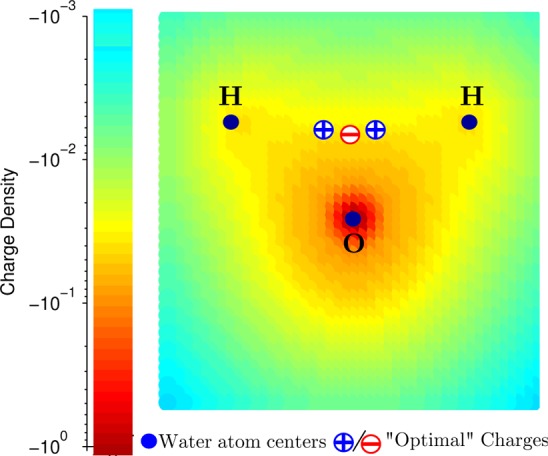
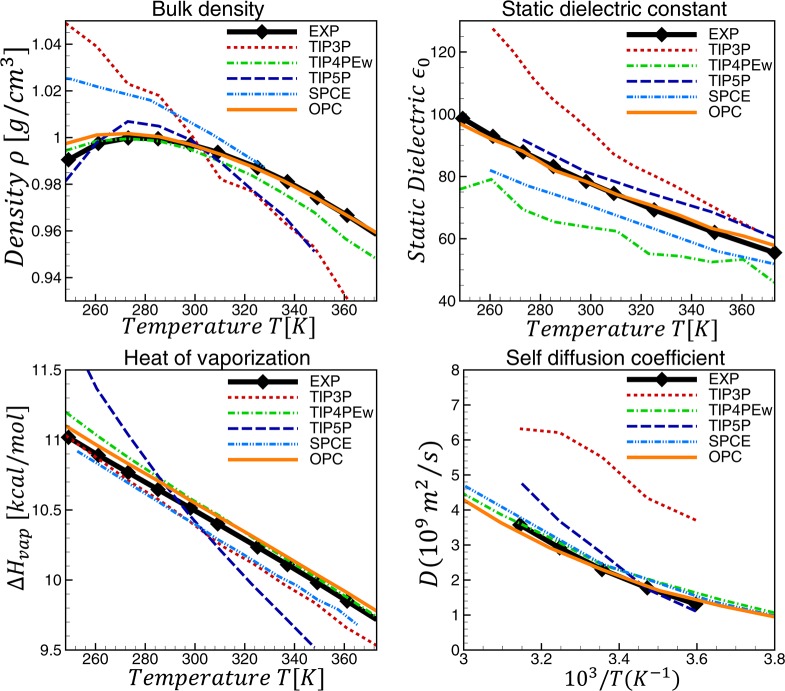
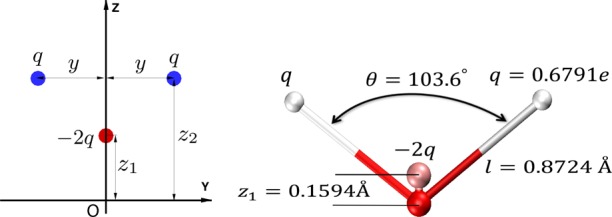
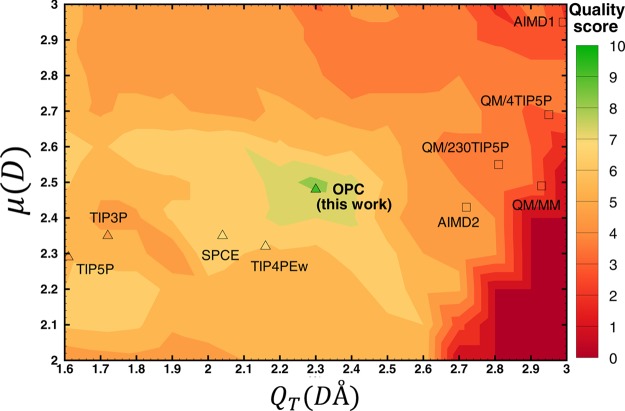
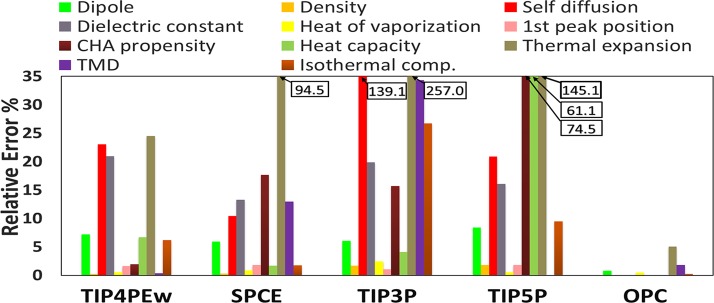
Simplified classical water models are currently an indispensable component in practical atomistic simulations. Yet, despite several decades of intense research, these models are still far from perfect. Presented here is an alternative approach to constructing widely used point charge water models. In contrast to the conventional approach, we do not impose any geometry constraints on the model other than the symmetry. Instead, we optimize the distribution of point charges to best describe the "electrostatics" of the water molecule. The resulting "optimal" 3-charge, 4-point rigid water model (OPC) reproduces a comprehensive set of bulk properties significantly more accurately than commonly used rigid models: average error relative to experiment is 0.76%. Close agreement with experiment holds over a wide range of temperatures. The improvements in the proposed model extend beyond bulk properties: compared to common rigid models, predicted hydration free energies of small molecules using OPC are uniformly closer to experiment, with root-mean-square error <1 kcal/mol.
简化的经典水模型目前是实际原子模拟中不可或缺的组成部分。然而,尽管经过了几十年的深入研究,这些模型仍远非完美。本文提出了一种构建广泛使用的点电荷水模型的替代方法。与传统方法不同,除了对称性外,我们不对模型施加任何几何约束。相反,我们优化点电荷的分布以最好地描述水分子的“静电学”。由此产生的“最优”三电荷、四点刚性水模型(OPC)比常用的刚性模型更准确地再现了一系列丰富的体相性质:相对于实验的平均误差为0.76%。在很宽的温度范围内都与实验结果高度吻合。所提出模型的改进不仅体现在体相性质方面:与常见的刚性模型相比,使用OPC预测的小分子水合自由能总体上更接近实验值,均方根误差<1千卡/摩尔。