Perkins Arden, Poole Leslie B, Karplus P Andrew
Department of Biochemistry and Biophysics, Oregon State University , Corvallis, Oregon 97331, United States.
Biochemistry. 2014 Dec 16;53(49):7693-705. doi: 10.1021/bi5013222. Epub 2014 Dec 1.
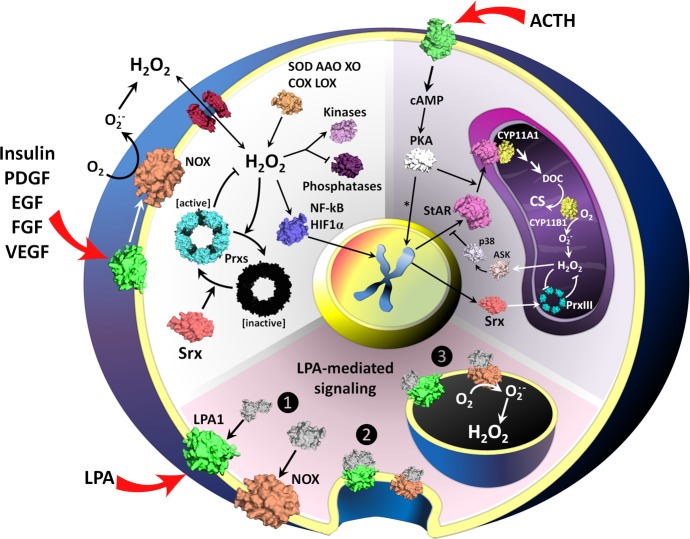
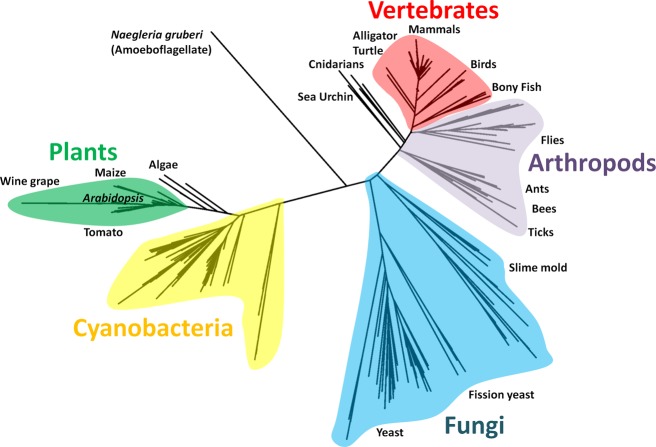
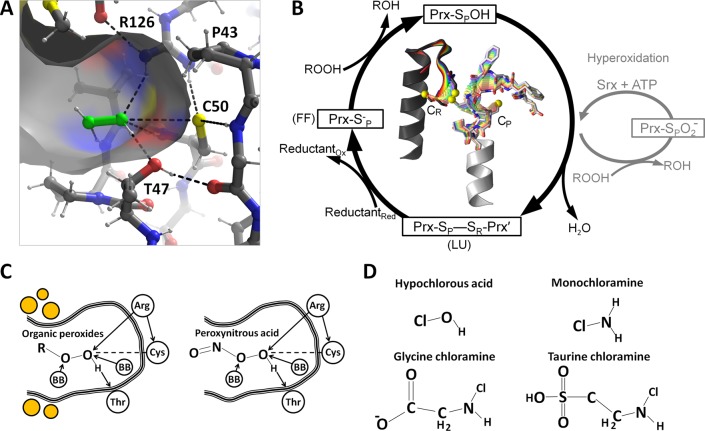
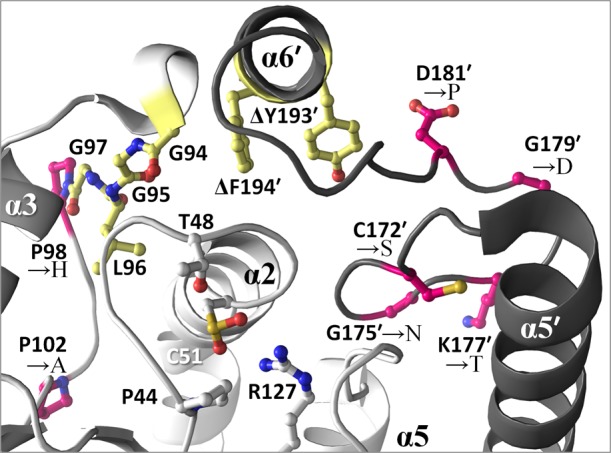
Peroxiredoxins (Prxs) make up an ancient family of enzymes that are the predominant peroxidases for nearly all organisms and play essential roles in reducing hydrogen peroxide, organic hydroperoxides, and peroxynitrite. Even between distantly related organisms, the core protein fold and key catalytic residues related to its cysteine-based catalytic mechanism have been retained. Given that these enzymes appeared early in biology, Prxs have experienced more than 1 billion years of optimization for specific ecological niches. Although their basic enzymatic function remains the same, Prxs have diversified and are involved in roles such as protecting DNA against mutation, defending pathogens against host immune responses, suppressing tumor formation, and--for eukaryotes--helping regulate peroxide signaling via hyperoxidation of their catalytic Cys residues. Here, we review the current understanding of the physiological roles of Prxs by analyzing knockout and knockdown studies from ∼25 different species. We also review what is known about the structural basis for the sensitivity of some eukaryotic Prxs to inactivation by hyperoxidation. In considering the physiological relevance of hyperoxidation, we explore the distribution across species of sulfiredoxin (Srx), the enzyme responsible for rescuing hyperoxidized Prxs. We unexpectedly find that among eukaryotes appearing to have a "sensitive" Prx isoform, some do not contain Srx. Also, as Prxs are suggested to be promising targets for drug design, we discuss the rationale behind recently proposed strategies for their selective inhibition.
过氧化物酶体增殖物激活受体(Prxs)构成了一个古老的酶家族,它们是几乎所有生物体中主要的过氧化物酶,在还原过氧化氢、有机过氧化物和过氧亚硝酸盐方面发挥着重要作用。即使在亲缘关系较远的生物体之间,与基于半胱氨酸的催化机制相关的核心蛋白折叠和关键催化残基也得以保留。鉴于这些酶在生物学早期就已出现,Prxs经历了超过10亿年的时间来适应特定的生态位。尽管它们的基本酶功能保持不变,但Prxs已经多样化,并参与了多种作用,如保护DNA免受突变、帮助病原体抵御宿主免疫反应、抑制肿瘤形成,以及对于真核生物而言,通过其催化性半胱氨酸残基的超氧化来帮助调节过氧化物信号传导。在这里,我们通过分析来自约25个不同物种的基因敲除和基因敲低研究,综述了目前对Prxs生理作用的理解。我们还综述了关于一些真核生物Prxs对超氧化失活敏感性的结构基础的已知信息。在考虑超氧化的生理相关性时,我们探讨了硫氧还蛋白(Srx)在物种间的分布,Srx是负责拯救超氧化Prxs的酶。我们意外地发现,在似乎具有“敏感”Prx亚型的真核生物中,有些并不含有Srx。此外,由于Prxs被认为是药物设计的有前景的靶点,我们讨论了最近提出的针对它们的选择性抑制策略背后的基本原理。