
恶性疟原虫在新生儿血液中的体外生长
In vitro growth of Plasmodium falciparum in neonatal blood.
作者信息
Sauerzopf Ulrich, Honkpehedji Yabo J, Adgenika Ayôla A, Feugap Elianne N, Ngoma Ghyslain Mombo, Mackanga Jean-Rodolphe, Lötsch Felix, Loembe Marguerite M, Kremsner Peter G, Mordmüller Benjamin, Ramharter Michael
机构信息
Department of Medicine I, Division of Infectious Diseases and Tropical Medicine, Medical University of Vienna, Vienna, Austria.
出版信息
Malar J. 2014 Nov 18;13:436. doi: 10.1186/1475-2875-13-436.
BACKGROUND
Children below the age of six months suffer less often from malaria than older children in sub-Saharan Africa. This observation is commonly attributed to the persistence of foetal haemoglobin (HbF), which is considered not to permit growth of Plasmodium falciparum and therefore providing protection against malaria. Since this concept has recently been challenged, this study evaluated the effect of HbF erythrocytes and maternal plasma on in vitro parasite growth of P. falciparum in Central African Gabon.
METHODS
Umbilical cord blood and peripheral maternal blood were collected at delivery at the Albert Schweitzer Hospital in Gabon. Respective erythrocyte suspension and plasma were used in parallel for in vitro culture. In vitro growth rates were compared between cultures supplemented with either maternal or cord erythrocytes. Plasma of maternal blood and cord blood was evaluated. Parasite growth rates were assessed by the standard HRP2-assay evaluating the increase of HRP2 concentration in Plasmodium culture.
RESULTS
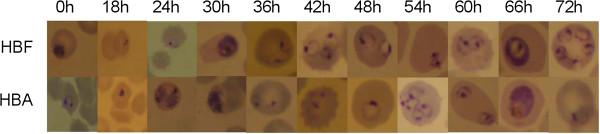
Culture of P. falciparum using foetal erythrocytes led to comparable growth rates (mean growth rate = 4.2, 95% CI: 3.5 - 5.0) as cultures with maternal red blood cells (mean growth rate =4.2, 95% CI: 3.4 - 5.0) and those from non-malaria exposed individuals (mean growth rate = 4.6, 95% CI: 3.8 - 5.5). Standard in vitro culture of P. falciparum supplemented with either maternal or foetal plasma showed both significantly lower growth rates than a positive control using non-malaria exposed donor plasma.
CONCLUSIONS
These data challenge the concept of HbF serving as intrinsic inhibitor of P. falciparum growth in the first months of life. Erythrocytes containing HbF are equally permissive to P. falciparum growth in vitro. However, addition of maternal and cord plasma led to reduced in vitro growth which may translate to protection against clinical disease or show synergistic effects with HbF in vivo. Further studies are needed to elucidate the pathophysiology of innate and acquired protection against neonatal malaria.
背景
在撒哈拉以南非洲地区,六个月以下儿童患疟疾的频率低于大龄儿童。这一观察结果通常归因于胎儿血红蛋白(HbF)的持续存在,人们认为它不允许恶性疟原虫生长,因此能提供疟疾防护。由于这一概念最近受到了挑战,本研究评估了加蓬中部地区含HbF的红细胞和母体血浆对恶性疟原虫体外寄生虫生长的影响。
方法
在加蓬阿尔贝特·施韦泽医院分娩时采集脐带血和母体外周血。分别使用各自的红细胞悬液和血浆进行平行体外培养。比较添加母体或脐带红细胞的培养物之间的体外生长率。对母体血液和脐带血的血浆进行评估。通过评估疟原虫培养物中HRP2浓度增加的标准HRP2测定法来评估寄生虫生长率。
结果
使用胎儿红细胞进行恶性疟原虫培养,其生长率(平均生长率 = 4.2,95%置信区间:3.5 - 5.0)与使用母体红细胞的培养物(平均生长率 = 4.2,95%置信区间:3.4 - 5.0)以及未接触疟疾个体的培养物(平均生长率 = 4.6,95%置信区间:3.8 - 5.5)相当。添加母体或胎儿血浆的恶性疟原虫标准体外培养显示,其生长率均显著低于使用未接触疟疾供体血浆的阳性对照。
结论
这些数据对HbF在生命最初几个月作为恶性疟原虫生长的内在抑制剂这一概念提出了挑战。含HbF的红细胞在体外对恶性疟原虫生长同样具有容许性。然而,添加母体和脐带血浆会导致体外生长减少,这可能转化为对临床疾病的防护,或在体内与HbF显示协同作用。需要进一步研究以阐明针对新生儿疟疾的先天和后天防护的病理生理学。


 Zotero 插件