Department of Psychology, Texas A&M University, 4235 TAMU, College Station, TX 77843-4235 USA.
MentorCONNECT, www.mentorconnect-ed.org, Houston, Texas USA.
J Eat Disord. 2014 Aug 22;2(1):24. doi: 10.1186/s40337-014-0024-0. eCollection 2014.
There is a current and pressing need for recovery resources for individuals suffering from eating disorders. Mentoring programs have been useful with other psychiatric disorders such as addictions, and may be useful for individuals recovering from an eating disorder. The present study sought to examine a mentoring program for individuals working towards recovery from an eating disorder.
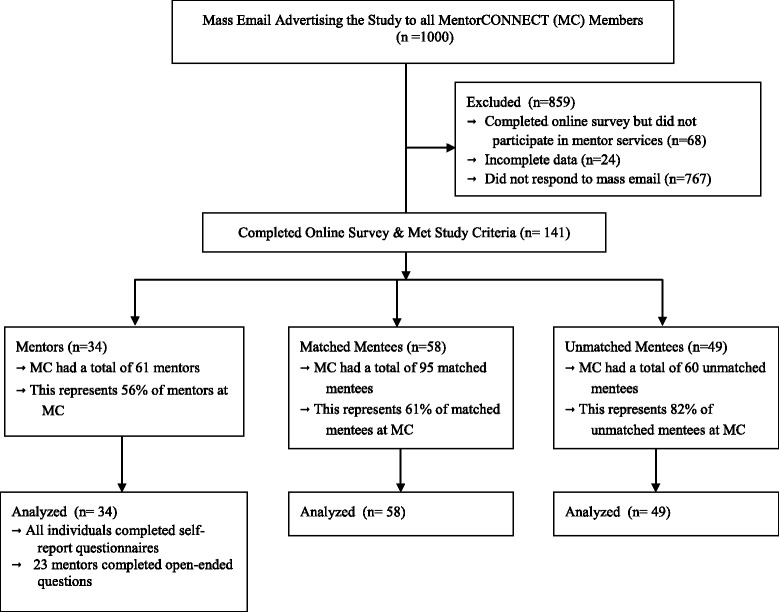
The study included mentors (i.e., individuals who have recovered from an eating disorder for an extended period of time), and mentees (i.e., individuals who were in the process of recovering from an eating disorder and wanting additional support aside from their treatment team). Participants included 141 participants, consisting of 34 mentors, 58 mentees who matched with a mentor, and 49 mentees searching for a mentor. Participants completed questions assessing eating disorder symptoms, quality of life, motivation towards recovery, and treatment compliance.
Matched mentees reported higher levels of quality of life on 7 out of 12 domains, and missed fewer appointments with treatment providers when compared to unmatched mentees. There were no differences between matched and unmatched mentees on motivation, energy or confidence towards recovery.
Findings suggest a mentor model is beneficial for individuals engaged in the process of recovering from an eating disorder in the areas of quality of life and treatment compliance. Specifically, mentees in a mentoring relationship reported better family and close relationships, future outlook, and psychological, emotional, and physical well-being than unmatched mentees. Mentors reported being positively impacted by the mentoring relationship by strengthening the skills they learned while in recovery, and reminding them of how far they had come in their own recovery. The findings in this study suggest that mentor programs warrant further investigation as ancillary support services for individuals recovering from an eating disorder.
目前迫切需要为饮食障碍患者提供康复资源。指导计划在治疗其他精神疾病(如成瘾)方面非常有效,可能对从饮食障碍中康复的患者也有帮助。本研究旨在检验针对饮食障碍患者康复的指导计划。
本研究纳入了指导者(即已经从饮食障碍中康复了很长时间的人)和被指导者(即正在从饮食障碍中康复并希望除治疗团队外获得额外支持的人)。参与者包括 141 名参与者,其中有 34 名指导者、58 名与指导者匹配的被指导者和 49 名正在寻找指导者的被指导者。参与者完成了评估饮食障碍症状、生活质量、康复动机和治疗依从性的问题。
与指导者匹配的被指导者在 12 个领域中的 7 个领域报告了更高的生活质量得分,与未匹配的被指导者相比,他们错过治疗提供者预约的次数更少。在康复动机、精力和信心方面,匹配的被指导者和未匹配的被指导者之间没有差异。
研究结果表明,指导者模式对正在从饮食障碍中康复的患者在生活质量和治疗依从性方面是有益的。具体而言,处于指导关系中的被指导者在家庭和亲密关系、未来展望以及心理、情感和身体健康方面的报告优于未匹配的被指导者。指导者报告说,他们从指导关系中受益,因为这加强了他们在康复过程中学到的技能,并提醒他们自己在康复过程中走了多远。本研究的结果表明,指导计划作为饮食障碍患者康复的辅助支持服务值得进一步研究。