Kong Xiangli, Yang Xiaoqin, Zhou Jinglin, Chen Sixiu, Li Xiaoyu, Jian Fan, Deng Pengchi, Li Wei
State Key Laboratory of Oral Diseases, West China Hospital of Stomatology, Sichuan University, Chengdu, Sichuan 610041, P.R. China.
Department of Oral and Maxillofacial Surgery, Guangdong Provincial Stomatological Hospital, Southern Medical University, Guangzhou, Guangdong 510515, P.R. China.
Oncol Lett. 2015 Jan;9(1):283-289. doi: 10.3892/ol.2014.2619. Epub 2014 Oct 15.
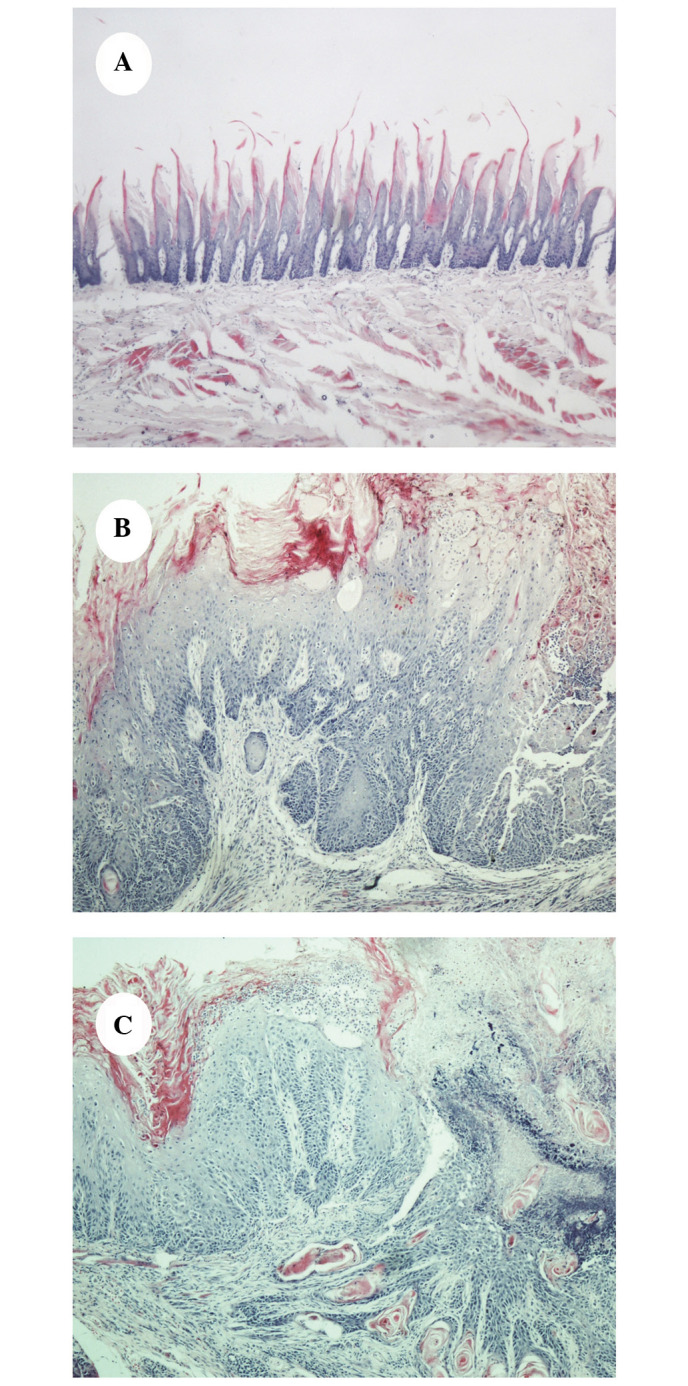
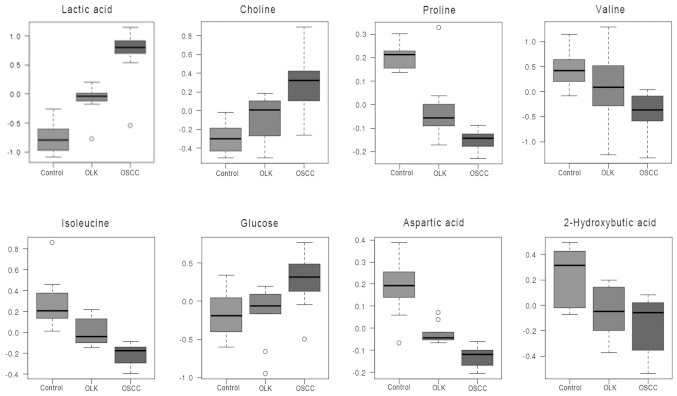
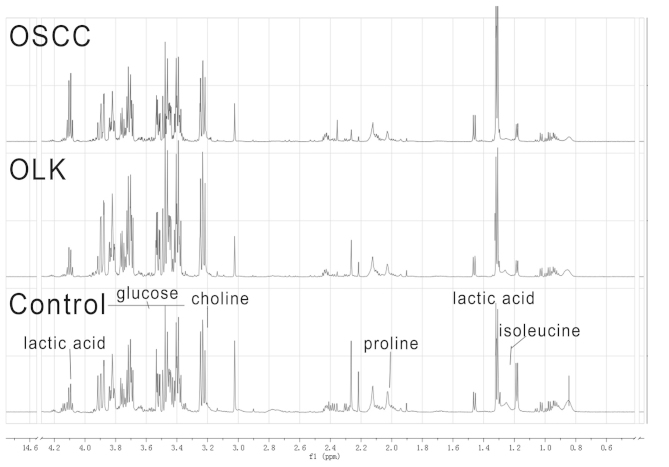
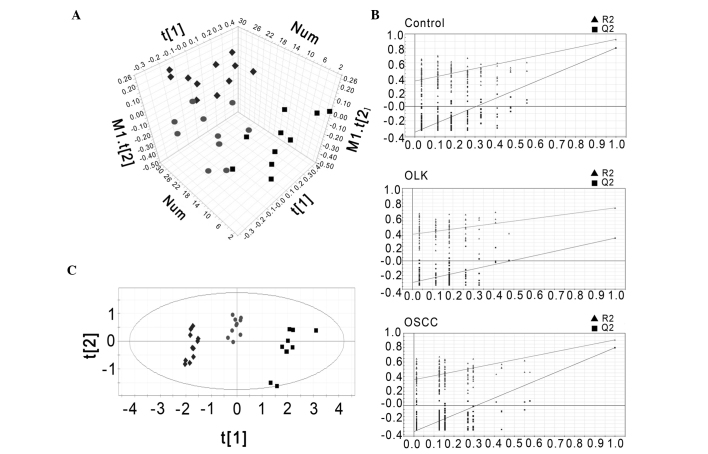
The aim of the present study was to identify time-dependent changes in the expression of metabolic biomarkers during the various stages of oral carcinogenesis to provide an insight into the sequential mechanism of oral cancer development. An H nuclear magnetic resonance (NMR)-based metabolomics approach was used to analyze the blood plasma samples of Sprague-Dawley rats exhibiting various oral lesions induced by the administration of 4-nitroquinoline-1-oxide (4NQO) in drinking water. The H NMR spectra were processed by principal component analysis (PCA) and partial least-squares discriminant analysis (PLS-DA) to determine the metabolic differences between the three developmental stages of oral mucosa cancer (health, oral leukoplakia [OLK] and oral squamous cell carcinoma [OSCC]). The variable importance in projection (VIP) score derived from the PLS-DA model was used to screen for important metabolites, whose significance was further verified through analysis of variance (ANOVA). Data from the present study indicated that 4NQO-induced rat oral carcinogenesis produced oral pre-neoplastic and neoplastic lesions and provided an effective model for analyzing sequential changes in the H NMR spectra of rat blood plasma. The H NMR-based metabolomics approach clearly differentiates between healthy, OLK and OSSC rats in the PCA and PLS-DA models. Furthermore, lactic acid, choline, glucose, proline, valine, isoleucine, aspartic acid and 2-hydroxybutyric acid demonstrated VIP>1 in the PLS-D model and P<0.05 with ANOVA. It was also identified that increases in lactic acid, choline and glucose, and decreases in proline, valine, isoleucine, aspartic acid and 2-hydroxybutyric acid may be relative to the characteristic mechanisms of oral carcinogenesis. Therefore, these plasma metabolites may serve as metabolic biomarkers in oral carcinogenesis and assist in the early diagnosis and preventive treatment of oral cancer.
本研究的目的是确定口腔癌发生各阶段代谢生物标志物表达随时间的变化,以深入了解口腔癌发展的连续机制。采用基于氢核磁共振(NMR)的代谢组学方法,分析饮用含4-硝基喹啉-1-氧化物(4NQO)的水诱导产生各种口腔病变的Sprague-Dawley大鼠的血浆样本。通过主成分分析(PCA)和偏最小二乘判别分析(PLS-DA)对氢核磁共振谱进行处理,以确定口腔黏膜癌三个发展阶段(健康、口腔白斑[OLK]和口腔鳞状细胞癌[OSCC])之间的代谢差异。利用PLS-DA模型得出的投影变量重要性(VIP)得分筛选重要代谢物,并通过方差分析(ANOVA)进一步验证其显著性。本研究数据表明,4NQO诱导的大鼠口腔癌发生产生了口腔癌前病变和肿瘤病变,并为分析大鼠血浆氢核磁共振谱的连续变化提供了有效模型。基于氢核磁共振的代谢组学方法在PCA和PLS-DA模型中能清晰区分健康、OLK和OSCC大鼠。此外,乳酸、胆碱、葡萄糖、脯氨酸、缬氨酸、异亮氨酸、天冬氨酸和2-羟基丁酸在PLS-D模型中的VIP>1,且经ANOVA分析P<0.05。还发现乳酸、胆碱和葡萄糖增加,脯氨酸、缬氨酸、异亮氨酸、天冬氨酸和2-羟基丁酸减少可能与口腔癌发生的特征机制有关。因此,这些血浆代谢物可作为口腔癌发生中的代谢生物标志物,有助于口腔癌的早期诊断和预防性治疗。