Thomas Milton, Wang Zhao, Sreenivasan Chithra C, Hause Ben M, Li Feng, Francis David H, Kaushik Radhey S, Khatri Mahesh
Department of Biology and Microbiology, South Dakota State University, Brookings, SD, USA.
Department of Diagnostic Medicine and Pathobiology, Kansas State University, Manhattan, KS, USA.
Vaccine. 2015 Jan 15;33(4):542-8. doi: 10.1016/j.vaccine.2014.11.034. Epub 2014 Nov 28.
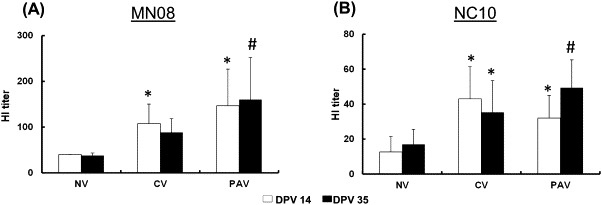
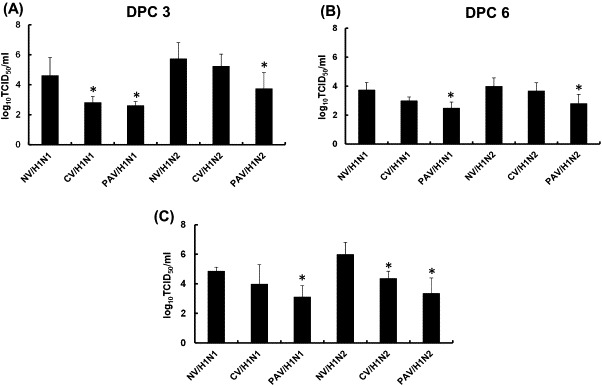
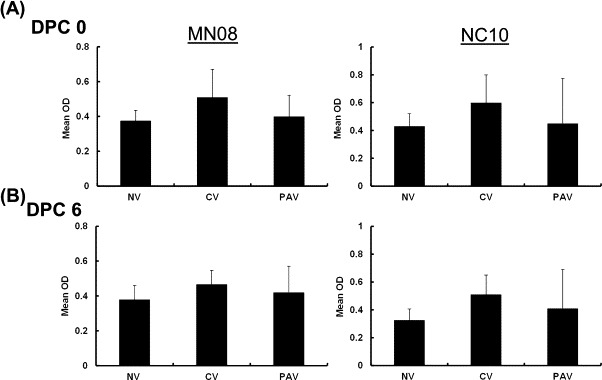
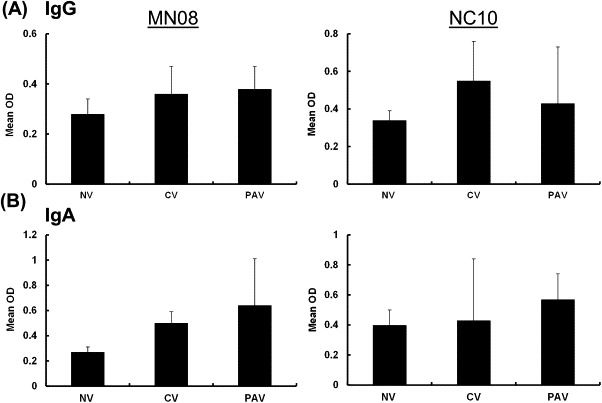
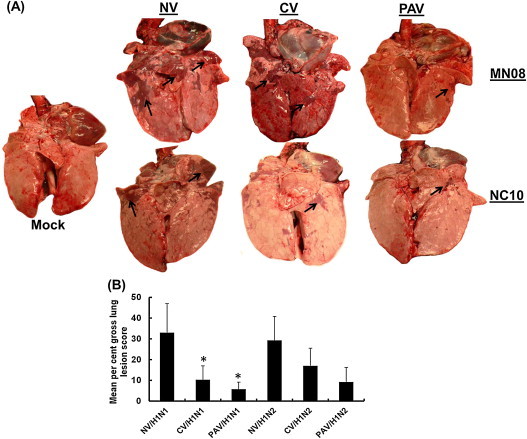
Swine influenza is widely prevalent in swine herds in North America and Europe causing enormous economic losses and a public health threat. Pigs can be infected by both avian and mammalian influenza viruses and are sources of generation of reassortant influenza viruses capable of causing pandemics in humans. Current commercial vaccines provide satisfactory immunity against homologous viruses; however, protection against heterologous viruses is not adequate. In this study, we evaluated the protective efficacy of an intranasal Poly I:C adjuvanted UV inactivated bivalent swine influenza vaccine consisting of Swine/OH/24366/07 H1N1 and Swine/CO/99 H3N2, referred as PAV, in maternal antibody positive pigs against an antigenic variant and a heterologous swine influenza virus challenge. Groups of three-week-old commercial-grade pigs were immunized intranasally with PAV or a commercial vaccine (CV) twice at 2 weeks intervals. Three weeks after the second immunization, pigs were challenged with the antigenic variant Swine/MN/08 H1N1 (MN08) and the heterologous Swine/NC/10 H1N2 (NC10) influenza virus. Antibodies in serum and respiratory tract, lung lesions, virus shedding in nasal secretions and virus load in lungs were assessed. Intranasal administration of PAV induced challenge viruses specific-hemagglutination inhibition- and IgG antibodies in the serum and IgA and IgG antibodies in the respiratory tract. Importantly, intranasal administration of PAV provided protection against the antigenic variant MN08 and the heterologous NC10 swine influenza viruses as evidenced by significant reductions in lung virus load, gross lung lesions and significantly reduced shedding of challenge viruses in nasal secretions. These results indicate that Poly I:C or its homologues may be effective as vaccine adjuvants capable of generating cross-protective immunity against antigenic variants/heterologous swine influenza viruses in pigs.
猪流感在北美和欧洲的猪群中广泛流行,造成巨大的经济损失和公共卫生威胁。猪可感染禽流感病毒和哺乳动物流感病毒,是能够导致人类大流行的重配流感病毒的来源。目前的商业疫苗对同源病毒提供了令人满意的免疫力;然而,对异源病毒的保护并不充分。在本研究中,我们评估了一种鼻内接种的聚肌胞苷酸(Poly I:C)佐剂紫外线灭活二价猪流感疫苗(由猪/俄亥俄/24366/07 H1N1和猪/科罗拉多/99 H3N2组成,简称PAV)在母源抗体阳性猪中对抗抗原变异株和异源猪流感病毒攻击的保护效力。将三周龄的商业级猪分组,每隔2周鼻内接种PAV或商业疫苗(CV)两次。第二次免疫后三周,用抗原变异株猪/明尼苏达/08 H1N1(MN08)和异源猪/北卡罗来纳/10 H1N2(NC10)流感病毒对猪进行攻击。评估血清和呼吸道中的抗体、肺部病变、鼻分泌物中的病毒脱落以及肺中的病毒载量。鼻内接种PAV可诱导血清中针对攻击病毒的特异性血凝抑制抗体和IgG抗体以及呼吸道中的IgA和IgG抗体。重要的是,鼻内接种PAV可提供针对抗原变异株MN08和异源NC10猪流感病毒的保护,这表现为肺病毒载量显著降低、肺部大体病变明显减轻以及鼻分泌物中攻击病毒的脱落显著减少。这些结果表明,聚肌胞苷酸或其同源物可能作为疫苗佐剂有效,能够在猪中产生针对抗原变异株/异源猪流感病毒的交叉保护性免疫。