Colombini S, Arya S K, Reitz M S, Jagodzinski L, Beaver B, Wong-Staal F
Laboratory of Tumor Cell Biology, National Cancer Institute, Bethesda, MD 20892.
Proc Natl Acad Sci U S A. 1989 Jul;86(13):4813-7. doi: 10.1073/pnas.86.13.4813.
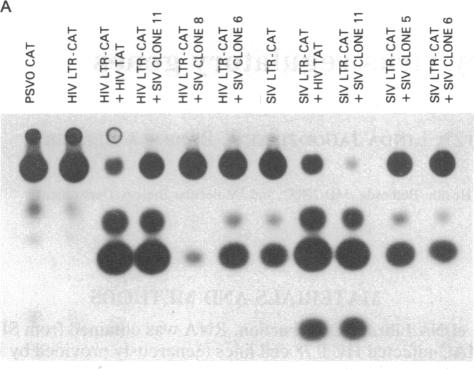
Three full-length cDNA clones were obtained from cells infected with the simian immunodeficiency virus (SIV) isolated from captive macaques (SIVMAC). Nucleotide sequence analyses suggested that these represented mRNA for the SIV MAC genes tat, rev (formerly, art/trs), and nef (formerly, 3'orf). The putative tat-specific clone was active in trans-activation of the SIV MAC long terminal repeat in COS-1 and Jurkat cells. In contrast, the human immunodeficiency virus 1 long terminal repeat was significantly trans-activated only in the COS-1 cells. This suggests that trans-activation by the SIV tat gene is modulated by cell-specific factors. The structure of all of the clones suggested an mRNA splicing pattern more complex than that described for human immunodeficiency virus 1.
从感染了从圈养猕猴分离出的猴免疫缺陷病毒(SIVMAC)的细胞中获得了三个全长cDNA克隆。核苷酸序列分析表明,这些代表了SIV MAC基因tat、rev(以前称为art/trs)和nef(以前称为3'orf)的mRNA。推定的tat特异性克隆在COS-1和Jurkat细胞中对SIV MAC长末端重复序列具有反式激活活性。相比之下,人类免疫缺陷病毒1长末端重复序列仅在COS-1细胞中被显著反式激活。这表明SIV tat基因的反式激活受到细胞特异性因子的调节。所有克隆的结构表明其mRNA剪接模式比人类免疫缺陷病毒1所描述的更为复杂。