Tabynov Kairat, Sansyzbay Abylay, Sandybayev Nurlan, Mambetaliyev Muratbay
The Research Institute for Biological Safety Problems, Zhambylskaya oblast, Kordayskiy rayon, Gvardeiskiy, 080409, Republic of Kazakhstan.
Virol J. 2014 Nov 29;11:207. doi: 10.1186/s12985-014-0207-y.
Highly pathogenic avian influenza (HPAI) H5N1 viruses continue to circulate in poultry and can infect and cause mortality in birds and mammals; the genetic determinants of their increased virulence are largely unknown. The main purpose of this work was to determine the correlation between known molecular determinants of virulence in different avian influenza virus (AIV) genes and the results of experimental infection of birds and mammals with AIV strain A/swan/Mangistau/3/06 (H5N1; SW/3/06).
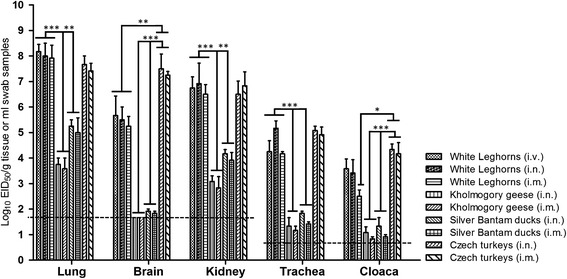
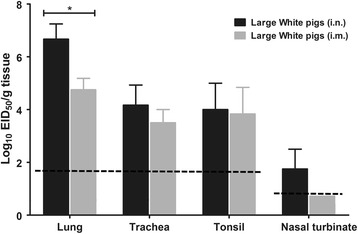
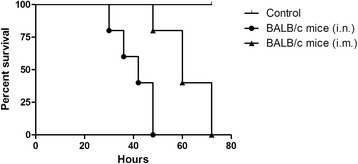
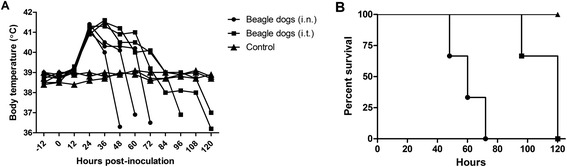
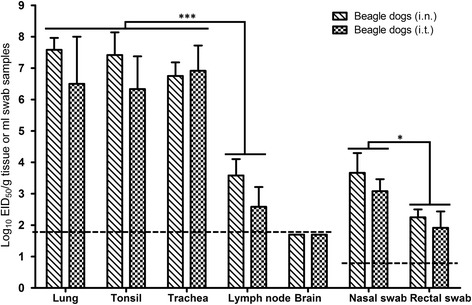
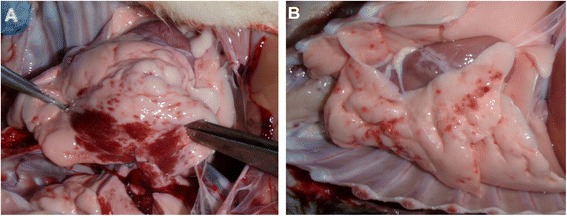
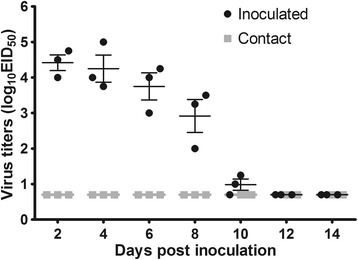
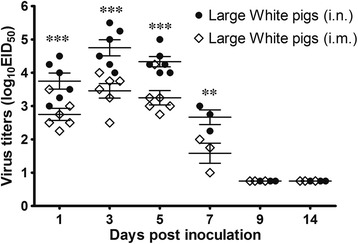
We examined the virulence of SW/3/06 in four species of birds (chickens, ducks, turkeys, geese) and five species of mammals (mice, guinea pigs, cats, dogs, pigs), and identified the molecular determinants of virulence in 11 genes (HA, NA, PB1, PB1-F2, PB2, PA, NS1, NS2, M1, M2 and NP). SW/3/06 does not possess the prime virulence determinant of HPAIV - a polybasic HA cleavage site - and is highly pathogenic in chickens. SW/3/06 replicated efficiently in chickens, ducks, turkeys, mice and dogs, causing 100% mortality within 1.6-5.2 days. In addition, no mortalities were observed in geese, guinea pigs, cats and pigs. The HI assay demonstrated all not diseased animals infected with the SW/3/06 virus had undergone seroconversion by 14, 21 and 28 dpi. Eleven mutations in the seven genes were present in SW/3/06. These mutations may play a role in the pathogenicity of this strain in chickens, ducks, turkeys, mice and dogs. Together or separately, mutations 228S-103S-318I in HA may play a role in the efficient replication of SW/3/06 in mammals (mice, dogs, pigs).
This study provides new information on the pathogenicity of the newly-isolated swan derived H5N1 virus in birds and mammals, and explored the role of molecular determinants of virulence in different genes; such studies may help to identify key virulence or adaptation markers that can be used for global surveillance of viruses threatening to emerge into the human population.
高致病性禽流感(HPAI)H5N1病毒继续在家禽中传播,可感染鸟类和哺乳动物并导致其死亡;其毒力增强的遗传决定因素大多未知。这项工作的主要目的是确定不同禽流感病毒(AIV)基因中已知的毒力分子决定因素与AIV毒株A/天鹅/曼格斯套/3/06(H5N1;SW/3/06)对鸟类和哺乳动物进行实验性感染的结果之间的相关性。
我们检测了SW/3/06在四种鸟类(鸡、鸭、火鸡、鹅)和五种哺乳动物(小鼠、豚鼠、猫、狗、猪)中的毒力,并确定了11个基因(HA、NA、PB1、PB1-F2、PB2、PA、NS1、NS2、M1、M2和NP)中的毒力分子决定因素。SW/3/06不具备高致病性禽流感病毒的主要毒力决定因素——多碱性HA裂解位点——但对鸡具有高致病性。SW/3/06在鸡、鸭、火鸡、小鼠和狗中高效复制,在1.6 - 5.2天内导致100%死亡。此外,在鹅、豚鼠、猫和猪中未观察到死亡。血凝抑制试验表明,所有感染SW/3/06病毒的未患病动物在感染后第14、21和28天均发生了血清转化。SW/3/06在七个基因中存在11个突变。这些突变可能在该毒株对鸡、鸭、火鸡、小鼠和狗的致病性中起作用。HA基因中的228S - 103S - 318I突变一起或分别可能在SW/3/06在哺乳动物(小鼠、狗、猪)中的高效复制中起作用。
本研究提供了关于新分离的源自天鹅的H5N1病毒在鸟类和哺乳动物中的致病性的新信息,并探讨了不同基因中毒力分子决定因素的作用;此类研究可能有助于识别可用于全球监测有可能传播给人类的病毒的关键毒力或适应性标志物。