Smith Emma M, Sakakibara Brodie M, Miller William C
a Graduate Program in Rehabilitation Sciences, University of British Columbia , Vancouver , BC , Canada .
b Faculty of Health Sciences , Simon Fraser University , Vancouver , BC , Canada and.
Disabil Rehabil Assist Technol. 2016;11(5):361-74. doi: 10.3109/17483107.2014.989420. Epub 2014 Dec 4.
To systematically identify factors associated with participation in social and community activities for adult wheelchair users (WCUs).
PubMed/MEDLINE, CINAHL, PsycINFO and EMBASE.
Quantitative and qualitative peer-reviewed publications were included, which were written in English, reported original research and investigated factors associated with social and community participation in adult WCUs.
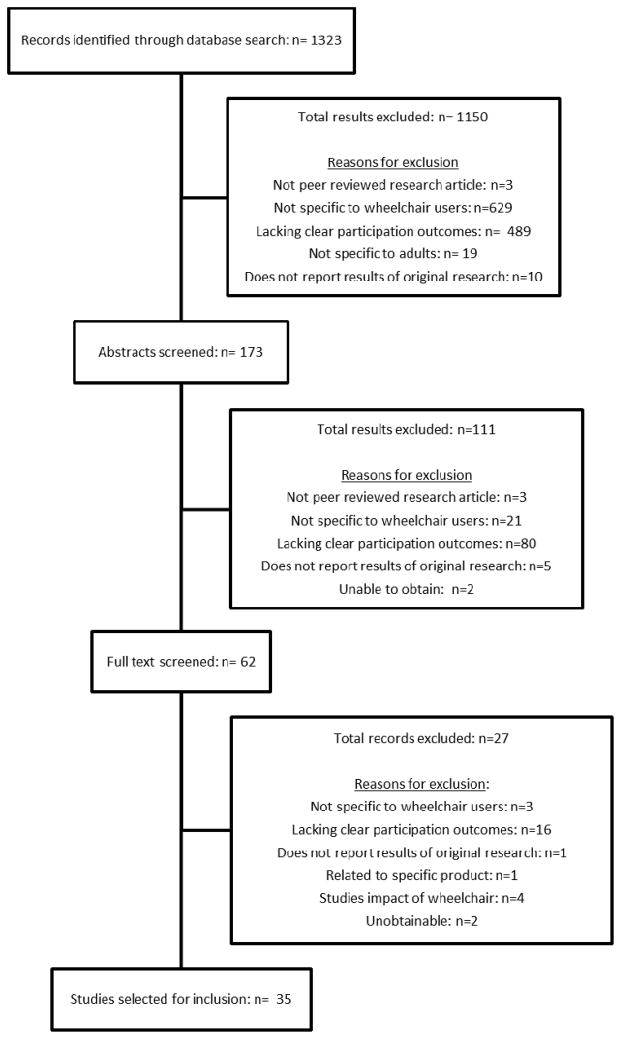
The Preferred Reporting Items for Systematic Reviews and Meta-Analyses guidelines were used. Factors were organized using the International Classification of Functioning, Disability and Health (ICF).
Thirty-five studies were selected: two of power WCUs, 10 of manual WCUs and 23 of both. Six qualitative studies, ranging in quality from 8/10 to 9/10 and 29 quantitative studies were included, ranging in quality from 4/15 to 11/15. Fifteen body function, 4 activity, 5 participation, 15 environmental and 14 personal factors were found to be associated with social and community participation.
Social and community participation of WCUs is associated with factors from all ICF domains. Wheelchair factors, accessibility, skills with wheelchair use, pain, finances and education are modifiable factors frequently reported to be associated with participation. Experimental research focusing on modifiable factors is needed to further our understanding of factors influencing participation among WCUs. Implications for Rehabilitation Wheelchair factors, including comfort and durability, are associated with participation and may be targeted in clinical intervention. Wheelchair skills are clinically modifiable and have been shown to improve participation in manual wheelchair users. Body functions (e.g. confidence, depression and fatigue) and personal factors (e.g. finances and level of education) may be considered for clinical intervention.
系统识别与成年轮椅使用者参与社会和社区活动相关的因素。
PubMed/MEDLINE、CINAHL、PsycINFO和EMBASE。
纳入经过同行评审的定量和定性出版物,这些出版物用英文撰写,报告了原创研究,并调查了与成年轮椅使用者社会和社区参与相关的因素。
使用系统评价和Meta分析的首选报告项目指南。因素按照国际功能、残疾和健康分类(ICF)进行组织。
选择了35项研究:2项关于电动轮椅使用者,10项关于手动轮椅使用者,23项关于两者。纳入了6项定性研究,质量从8/10到9/10,以及29项定量研究,质量从4/15到11/15。发现15个身体功能、4个活动、5个参与、15个环境和14个个人因素与社会和社区参与相关。
轮椅使用者的社会和社区参与与ICF所有领域的因素相关。轮椅因素、可达性、轮椅使用技能、疼痛、财务状况和教育是经常报告的与参与相关的可改变因素。需要开展关注可改变因素的实验研究,以加深我们对影响轮椅使用者参与因素的理解。对康复的启示 轮椅因素,包括舒适性和耐用性,与参与相关,可能是临床干预的目标。轮椅技能在临床上是可改变的,并且已证明可改善手动轮椅使用者的参与度。身体功能(如信心、抑郁和疲劳)和个人因素(如财务状况和教育水平)可考虑用于临床干预。