Hill Keith D, Day Lesley, Haines Terry P
School of Physiotherapy and Exercise Science, Faculty of Health Sciences, Curtin University, Perth, WA, Australia ; National Ageing Research Institute, Royal Melbourne Hospital, Parkville, VIC, Australia.
Falls Prevention Research Unit, Monash Injury Research Institute, Monash University, VIC, Australia.
Clin Interv Aging. 2014 Nov 26;9:2045-53. doi: 10.2147/CIA.S72679. eCollection 2014.
To investigate previous, current, or planned participation in, and perceptions toward, multifactorial fall prevention programs such as those delivered through a falls clinic in the community setting, and to identify factors influencing older people's intent to undertake these interventions.
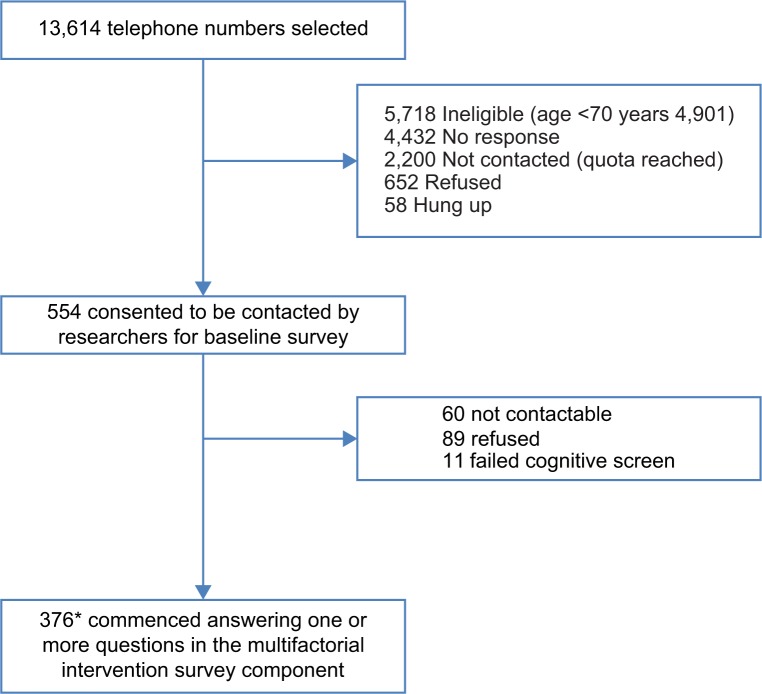
Community-dwelling people aged >70 years completed a telephone survey. Participants were randomly selected from an electronic residential telephone listing, but purposeful sampling was used to include equal numbers with and without common chronic health conditions associated with fall-related hospitalization. The survey included scenarios for fall prevention interventions, including assessment/multifactorial interventions, such as those delivered through a falls clinic. Participants were asked about previous exposure to, or intent to participate in, the interventions. A path model analysis was used to identify factors associated with intent to participate in assessment/multifactorial interventions.
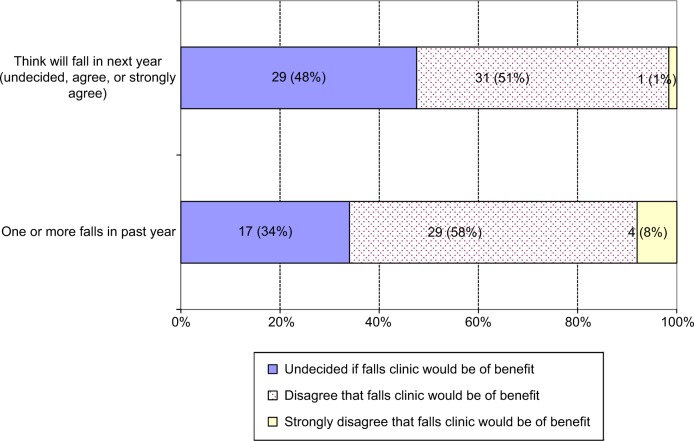
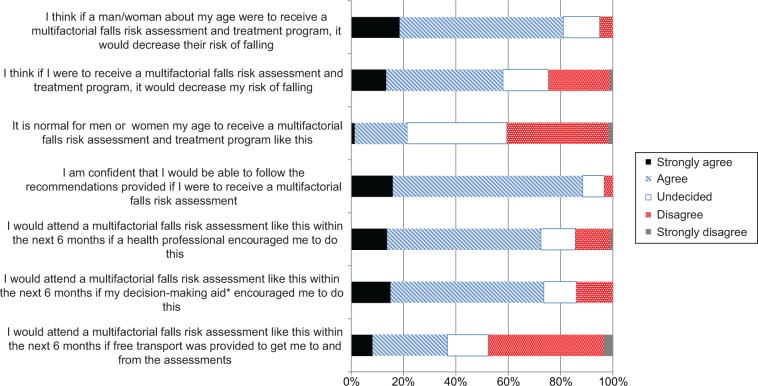
Thirty of 376 participants (8.0%) reported exposure to a multifactorial falls clinic-type intervention in the past 5 years, and 16.0% expressed intention to undertake this intervention. Of the 132 participants who reported one or more falls in the past 12 months, over one-third were undecided or disagreed that a falls clinic type of intervention would be of benefit to them. Four elements from the theoretical model positively influenced intention to participate in the intervention: personal perception of intervention effectiveness, self-perceived risk of falls, self-perceived risk of injury, and inability to walk up/down steps without a handrail (P<0.05).
Multifactorial falls clinic-type interventions are not commonly accessed or considered as intended fall prevention approaches among community-dwelling older people, even among those with falls in the past 12 months. Factors identified as influencing intention to undertake these interventions may be useful in promoting or targeting these interventions.
调查老年人过去、当前或计划参与社区环境中通过跌倒诊所开展的多因素跌倒预防项目的情况以及对这些项目的看法,并确定影响老年人参与这些干预措施意愿的因素。
对年龄超过70岁的社区居民进行电话调查。参与者从电子住宅电话清单中随机选取,但采用了目的抽样法,以纳入数量相等的有和没有与跌倒相关住院的常见慢性健康状况的人群。调查包括跌倒预防干预措施的情景,包括评估/多因素干预措施,如通过跌倒诊所提供的干预措施。询问参与者过去是否接触过或是否打算参与这些干预措施。采用路径模型分析来确定与参与评估/多因素干预措施意愿相关的因素。
376名参与者中有30名(8.0%)报告在过去5年中接触过多因素跌倒诊所类型的干预措施,16.0%表示打算接受这种干预。在过去12个月内报告有一次或多次跌倒的132名参与者中,超过三分之一的人不确定或不同意跌倒诊所类型的干预措施对他们有益。理论模型中的四个因素对参与干预的意愿有积极影响:对干预效果的个人认知、自我感知的跌倒风险、自我感知的受伤风险以及没有扶手时无法上下楼梯(P<0.05)。
多因素跌倒诊所类型的干预措施在社区居住的老年人中并不常见,也未被视为预期的跌倒预防方法,即使在过去12个月内有跌倒经历的人群中也是如此。确定的影响参与这些干预措施意愿的因素可能有助于推广或针对性地实施这些干预措施。