Shankar Kalpana N, Liu Shan W, Ganz David A
Boston Medical Center, Department of Emergency Medicine, Boston, Massachusetts.
Massachusetts General Hospital, Department of Emergency Medicine, Boston, Massachusetts.
West J Emerg Med. 2017 Aug;18(5):785-793. doi: 10.5811/westjem.2017.5.33615. Epub 2017 Jul 14.
One third of older adults fall each year, and falls are costly to both the patient in terms of morbidity and mortality and to the health system. Given that falls are a preventable cause of injury, our objective was to understand the characteristics and trends of emergency department (ED) fall-related visits among older adults. We hypothesize that falls among older adults are increasing and examine potential factors associated with this rise, such as race, ethnicity, gender, insurance and geography.
We conducted a secondary analysis of data from the National Hospital Ambulatory Medical Care Survey (NHAMCS) to determine fall trends over time by examining changes in ED visit rates for falls in the United States between 2003 and 2010, detailing differences by gender, sociodemographic characteristics and geographic region.
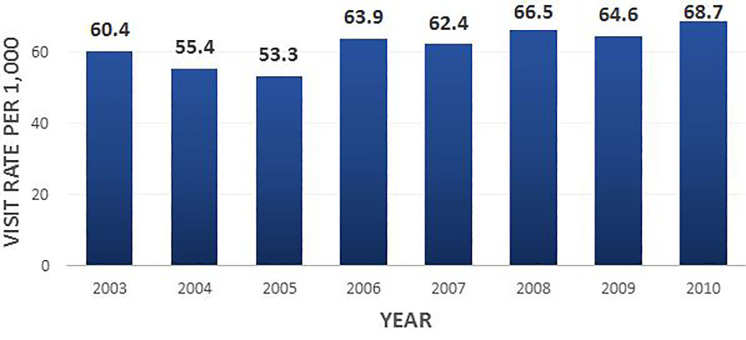
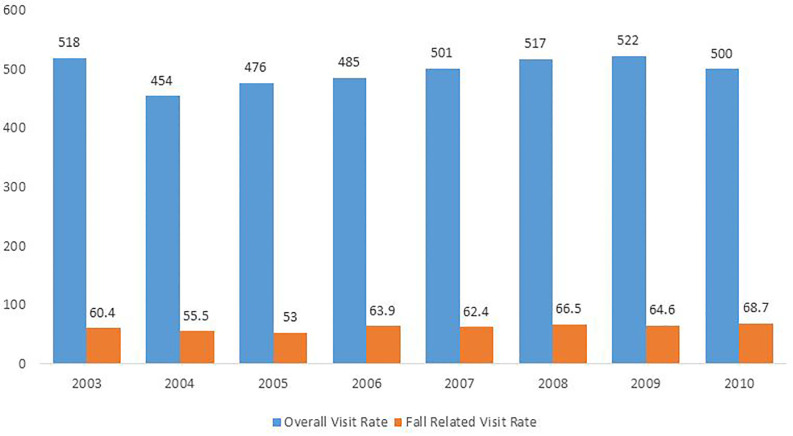
Between 2003 and 2010, the visit rate for falls and fall-related injuries among people age ≥ 65 increased from 60.4 (95% confidence interval [CI][51.9-68.8]) to 68.8 (95% CI [57.8-79.8]) per 1,000 population (p=0.03 for annual trend). Among subgroups, visits by patients aged 75-84 years increased from 56.2 to 82.1 per 1,000 (P <.01), visits by women increased from 67.4 to 81.3 (p = 0.04), visits by non-Hispanic Whites increased from 63.1 to 73.4 (p < 0.01), and visits in the South increased from 54.4 to 71.1 (p=0.03).
ED visit rates for falls are increasing over time. There is a national movement to increase falls awareness and prevention. EDs are in a unique position to engage patients on future fall prevention and should consider ways they can also partake in such initiatives in a manner that is feasible and appropriate for the ED setting.
每年有三分之一的老年人跌倒,跌倒对患者的发病率和死亡率以及卫生系统而言成本高昂。鉴于跌倒是一种可预防的伤害原因,我们的目标是了解老年人急诊科(ED)跌倒相关就诊的特征和趋势。我们假设老年人跌倒情况正在增加,并研究与此上升相关的潜在因素,如种族、族裔、性别、保险和地理位置。
我们对来自国家医院门诊医疗调查(NHAMCS)的数据进行了二次分析,通过研究2003年至2010年美国急诊科跌倒就诊率的变化来确定跌倒趋势随时间的变化情况,并详细分析性别、社会人口学特征和地理区域的差异。
2003年至2010年期间,年龄≥65岁人群的跌倒及跌倒相关损伤就诊率从每1000人60.4(95%置信区间[CI][51.9 - 68.8])增至68.8(95% CI [57.8 - 79.8])(年度趋势p = 0.03)。在亚组中,75 - 84岁患者的就诊率从每1000人56.2增至82.1(P <.01),女性就诊率从67.4增至81.3(p = 0.04),非西班牙裔白人就诊率从63.1增至73.4(p < 0.01),南部地区的就诊率从54.4增至71.1(p = 0.03)。
跌倒的急诊科就诊率随时间增加。全国正在开展提高对跌倒的认识和预防的行动。急诊科在促使患者预防未来跌倒方面具有独特地位,应考虑以适合急诊科环境且可行的方式参与此类举措的途径。