Hao Xinyuan, Horvath David P, Chao Wun S, Yang Yajun, Wang Xinchao, Xiao Bin
College of Horticulture, Northwest A&F University, Yangling 712100, Shaanxi, China.
USDA-Agricultural Research Service, Biosciences Research Lab, Sunflower and Plant Biology Research Unit, 1605 Albrecht Blvd N, Fargo, ND 58102, USA.
Int J Mol Sci. 2014 Dec 2;15(12):22155-72. doi: 10.3390/ijms151222155.
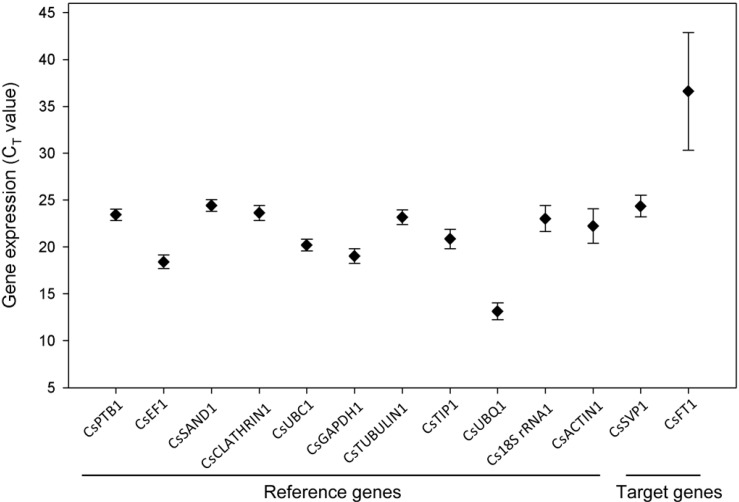
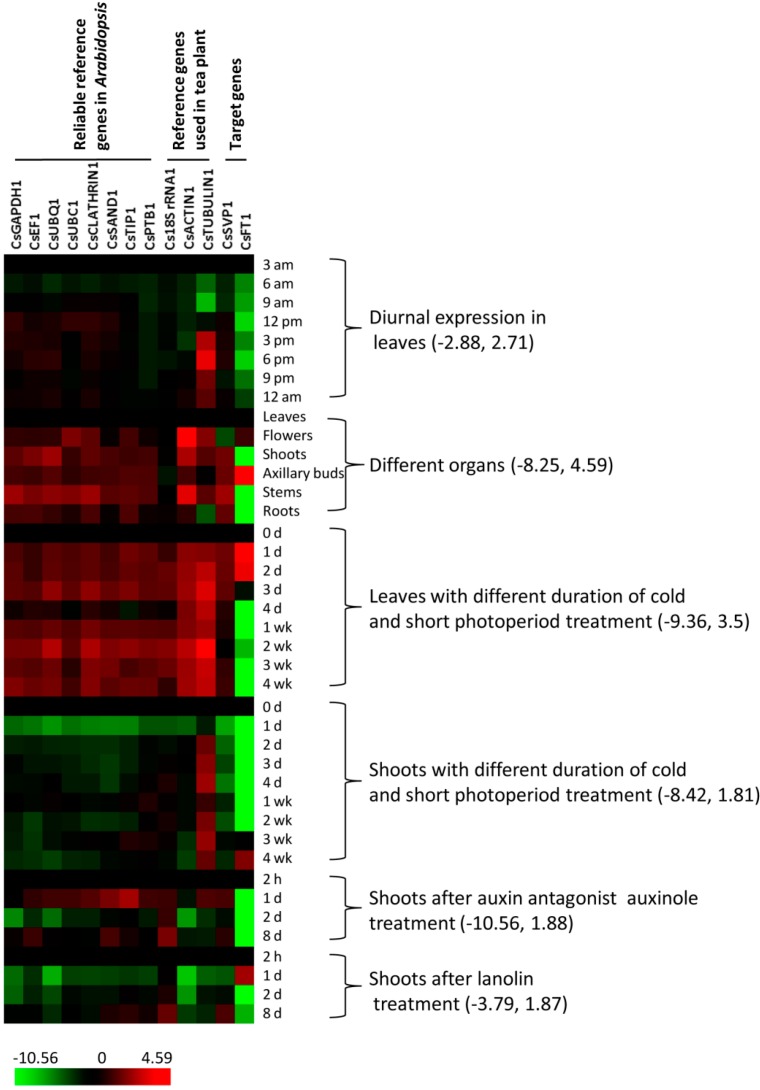
Reliable reference selection for the accurate quantification of gene expression under various experimental conditions is a crucial step in qRT-PCR normalization. To date, only a few housekeeping genes have been identified and used as reference genes in tea plant. The validity of those reference genes are not clear since their expression stabilities have not been rigorously examined. To identify more appropriate reference genes for qRT-PCR studies on tea plant, we examined the expression stability of 11 candidate reference genes from three different sources: the orthologs of Arabidopsis traditional reference genes and stably expressed genes identified from whole-genome GeneChip studies, together with three housekeeping gene commonly used in tea plant research. We evaluated the transcript levels of these genes in 94 experimental samples. The expression stabilities of these 11 genes were ranked using four different computation programs including geNorm, Normfinder, BestKeeper, and the comparative ∆CT method. Results showed that the three commonly used housekeeping genes of CsTUBULIN1, CsACINT1 and Cs18S rRNA1 together with CsUBQ1 were the most unstable genes in all sample ranking order. However, CsPTB1, CsEF1, CsSAND1, CsCLATHRIN1 and CsUBC1 were the top five appropriate reference genes for qRT-PCR analysis in complex experimental conditions.
在各种实验条件下准确量化基因表达时,可靠的内参基因选择是qRT-PCR标准化的关键步骤。到目前为止,茶树中仅鉴定出少数管家基因并用作内参基因。由于这些内参基因的表达稳定性尚未经过严格检测,其有效性尚不清楚。为了鉴定更适合茶树qRT-PCR研究的内参基因,我们检测了来自三个不同来源的11个候选内参基因的表达稳定性:拟南芥传统内参基因的直系同源基因、从全基因组基因芯片研究中鉴定出的稳定表达基因,以及茶树研究中常用的三个管家基因。我们评估了这些基因在94个实验样品中的转录水平。使用包括geNorm、Normfinder、BestKeeper和比较∆CT法在内的四种不同计算程序对这11个基因的表达稳定性进行了排名。结果表明,在所有样品排名顺序中,CsTUBULIN1、CsACINT1和Cs18S rRNA1这三个常用管家基因以及CsUBQ1是最不稳定的基因。然而,CsPTB1、CsEF1、CsSAND1、CsCLATHRIN1和CsUBC1是复杂实验条件下qRT-PCR分析的前五个合适内参基因。