Tsai Chun-Hao, Chuang Chieh-Sen, Hung Chih-Hung, Lin Cheng-Li, Sung Fung-Chang, Tang Chih-Hsin, Hsu Horng-Chang, Chung Chi-Jung
From the Graduate Institute of Clinical Medicine (C-HT, H-CH); Department of Orthopedics, China Medical University Hospital, Taichung (C-HT, C-HH, C-HT, H-CH); Graduate Institute of Clinical Medicine, College of Medicine, China Medical University, Taichung, Taiwan (C-HT, C-HT, H-CH); Department of Orthopedics, China Medical University Hospital, Taichung, Taiwan (C-HT,C-HH, H-CH); Department of Neurology, Changhua Christian Hospital, Changhua (C-SC); Department of Life Sciences, National Chung-Hsing University (C-SC); Management Office for Health Data, China Medical University Hospital (C-LL); Department of Public Health, China Medical University (C-LL, F-CS); Department of Pharmacology, School of Medicine (C-HT); Department of Medical Research, China Medical University Hospital (C-JC); and Department of Health Risk Management, China Medical University, Taichung, Taiwan (C-JC).
Medicine (Baltimore). 2014 Nov;93(26):e188. doi: 10.1097/MD.0000000000000188.
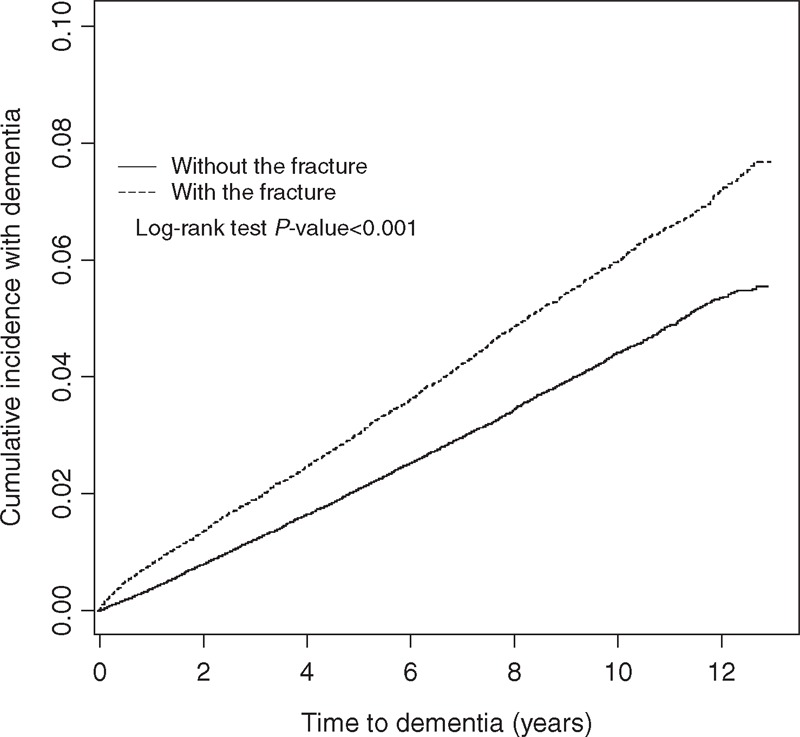
Dementia is among various diseases affecting the elderly, who is also at a high risk for fractures. This study aimed to evaluate the association between fracture history and sequential risk of dementia in Taiwan.A retrospective cohort study was designed using the claims data of the entire insured residents covered by Taiwan's universal health insurance from 1998 to 2010. A total of 66,797 patients with fractures and 133,594 control subjects without fractures were matched in terms of age (±5 years), sex, and index year and then recruited. Fractures and dementia were defined in accordance with the International Classification of Diseases, 9th Revision, Clinical Modification. The influence of fractures on the risk of dementia was analyzed using a Cox proportional hazards model.After a 12-year follow-up period, 2775 and 3991 incident cases of dementia were reported in exposed and unexposed cohorts, respectively. The overall incidence rate of dementia in individuals with fractures was 41% higher than that in individuals without fractures (6.05 vs 4.30 per 1000 person-years) at an adjusted hazard ratio of 1.38 (95% confidence interval 1.32-1.45) after age, sex, urbanization, and individual disorders or comorbidities were adjusted. Considering fracture location, we found that patients with hip fractures were at a slightly high risk for dementia. The occurrence of multiple fractures at a single visit was also significantly associated with an increased risk of dementia.Fracture history is regarded as an independent risk factor of dementia in individuals aged ≥65 years, particularly those who suffered from multiple fractures and/or fractures located in the hip. Further studies are needed to support an independent role of fracture in dementia considering the clinical information and other comorbidities.
痴呆症是影响老年人的多种疾病之一,老年人也是骨折的高危人群。本研究旨在评估台湾地区骨折史与痴呆症后续发病风险之间的关联。
本研究采用回顾性队列研究设计,利用了1998年至2010年台湾全民健康保险覆盖的所有参保居民的理赔数据。共纳入66797例骨折患者和133594例无骨折的对照对象,这些对象按年龄(±5岁)、性别和索引年份进行匹配后入组。骨折和痴呆症的定义依据《国际疾病分类》第九版临床修订本。采用Cox比例风险模型分析骨折对痴呆症风险的影响。
经过12年的随访期,暴露组和非暴露组分别报告了2775例和3991例痴呆症新发病例。在对年龄、性别、城市化程度以及个体疾病或合并症进行调整后,骨折患者的痴呆症总体发病率比无骨折患者高41%(每1000人年分别为6.05例和4.30例),校正风险比为1.38(95%置信区间为1.32 - 1.45)。考虑骨折部位,我们发现髋部骨折患者患痴呆症的风险略高。单次就诊时发生多处骨折也与痴呆症风险增加显著相关。
骨折史被视为≥65岁个体患痴呆症的独立风险因素,尤其是那些发生多处骨折和/或髋部骨折的个体。考虑到临床信息和其他合并症,需要进一步研究来支持骨折在痴呆症中的独立作用。