
成人注意力缺陷多动障碍认知功能的奖赏调节:纹状体多巴胺作用的初步研究
Reward modulation of cognitive function in adult attention-deficit/hyperactivity disorder: a pilot study on the role of striatal dopamine.
作者信息
Aarts Esther, van Holstein Mieke, Hoogman Martine, Onnink Marten, Kan Cornelis, Franke Barbara, Buitelaar Jan, Cools Roshan
机构信息
aCentre for Cognitive Neuroimaging, Donders Institute for Brain, Cognition and Behaviour, Radboud University Nijmegen bDepartment of Psychiatry cDepartment of Human Genetics dDepartment of Cognitive Neuroscience, Centre for Neuroscience, Radboud University Medical Center, Donders Institute for Brain, Cognition and Behaviour eKarakter Child and Adolescent Psychiatry University Centre, Nijmegen, The Netherlands.
出版信息
Behav Pharmacol. 2015 Feb;26(1-2):227-40. doi: 10.1097/FBP.0000000000000116.
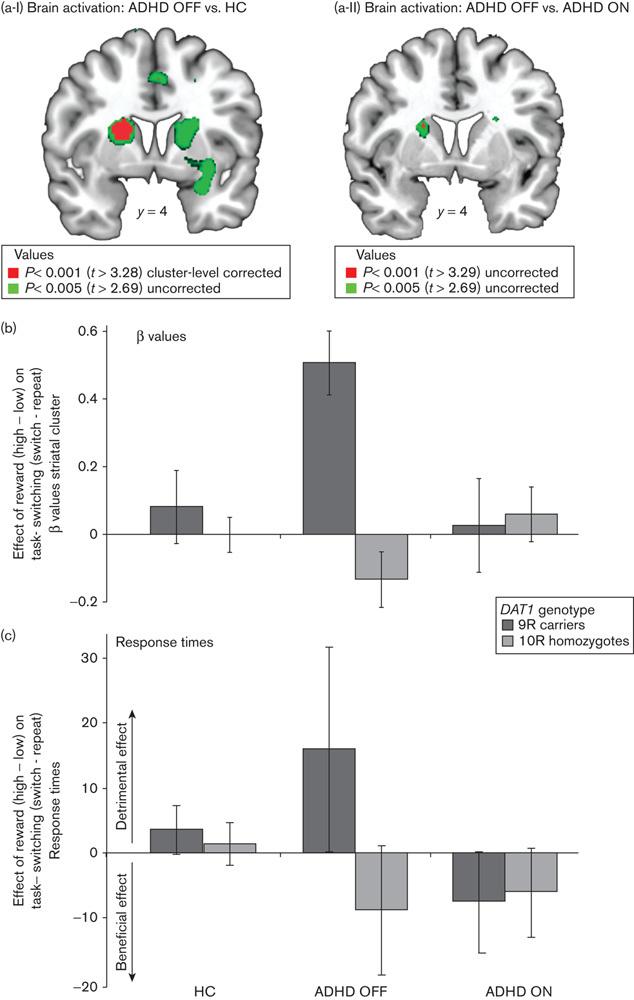
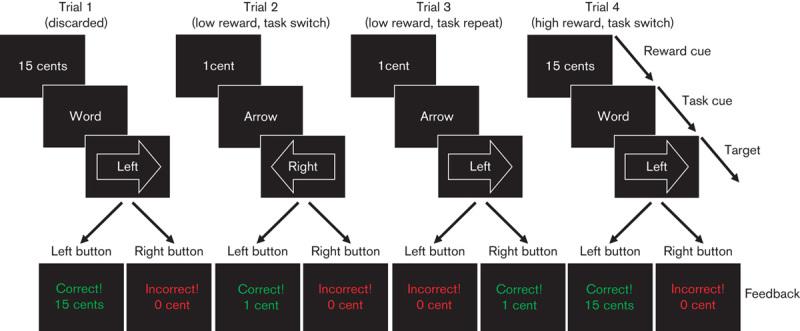
Attention-deficit/hyperactivity disorder (ADHD) is accompanied by impairments in cognitive control, such as task-switching deficits. We investigated whether such problems, and their remediation by medication, reflect abnormal reward motivation and associated striatal dopamine transmission in ADHD. We used functional genetic neuroimaging to assess the effects of dopaminergic medication and reward motivation on task-switching and striatal BOLD signal in 23 adults with ADHD, ON and OFF methylphenidate, and 26 healthy controls. Critically, we took into account interindividual variability in striatal dopamine by exploiting a common genetic polymorphism (3'-UTR VNTR) in the DAT1 gene coding for the dopamine transporter. The results showed a highly significant group by genotype interaction in the striatum. This was because a subgroup of patients with ADHD showed markedly exaggerated effects of reward on the striatal BOLD signal during task-switching when they were OFF their dopaminergic medication. Specifically, patients carrying the 9R allele showed a greater striatal signal than healthy controls carrying this allele, whereas no effect of diagnosis was observed in 10R homozygotes. Aberrant striatal responses were normalized when 9R-carrying patients with ADHD were ON medication. These pilot data indicate an important role for aberrant reward motivation, striatal dopamine and interindividual genetic differences in cognitive processes in adult ADHD.
注意缺陷多动障碍(ADHD)伴有认知控制方面的损害,如任务转换缺陷。我们研究了这些问题及其药物治疗效果是否反映了ADHD患者异常的奖励动机以及相关的纹状体多巴胺传递。我们使用功能基因神经影像学来评估多巴胺能药物和奖励动机对23名患有ADHD的成年人(服用和未服用哌甲酯)以及26名健康对照者任务转换和纹状体BOLD信号的影响。关键的是,我们通过利用编码多巴胺转运体的DAT1基因中的一种常见基因多态性(3'-UTR VNTR)来考虑纹状体多巴胺的个体间变异性。结果显示,纹状体中存在高度显著的组×基因型交互作用。这是因为一组ADHD患者在未服用多巴胺能药物时,在任务转换过程中奖励对纹状体BOLD信号的影响明显夸大。具体而言,携带9R等位基因的患者比携带该等位基因的健康对照者表现出更大的纹状体信号,而在10R纯合子中未观察到诊断的影响。当携带9R的ADHD患者服药时,异常的纹状体反应恢复正常。这些初步数据表明,异常的奖励动机、纹状体多巴胺以及个体间基因差异在成人ADHD的认知过程中起着重要作用。
 Zotero 插件