Fliegel Sarah, Brand Ines, Spanagel Rainer, Noori Hamid R
Institute of Psychopharmacology, Central Institute of Mental Health, Faculty of Medicine Mannheim, University of Heidelberg, J5, 68159 Mannheim, Germany.
In Silico Pharmacol. 2013 May 17;1:7. doi: 10.1186/2193-9616-1-7. eCollection 2013.
In recent years in vivo microdialysis has become an important method in research studies investigating the alterations of neurotransmitters in the extracellular fluid of the brain. Based on the major involvement of glutamate and γ-aminobutyric acid (GABA) in mediating a variety of alcohol effects in the mammalian brain, numerous microdialysis studies have focused on the dynamical behavior of these systems in response to alcohol.
Here we performed multiple meta-analyses on published datasets from the rat brain: (i) we studied basal extracellular concentrations of glutamate and GABA in brain regions that belong to a neurocircuitry involved in neuropsychiatric diseases, especially in alcoholism (Noori et al., Addict Biol 17:827-864, 2012); (ii) we examined the effect of acute ethanol administration on glutamate and GABA levels within this network and (iii) we studied alcohol withdrawal-induced alterations in glutamate and GABA levels within this neurocircuitry.
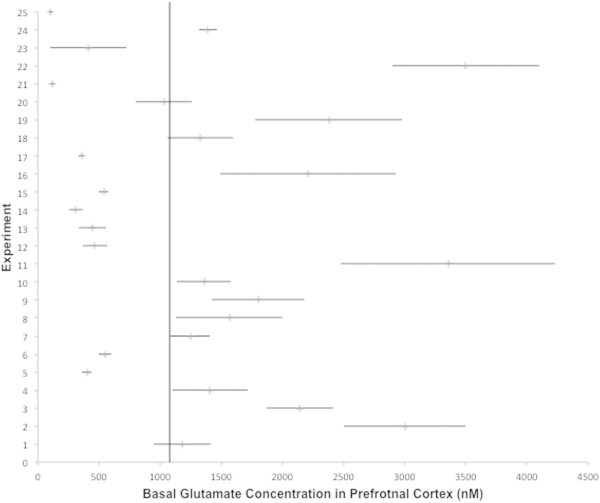
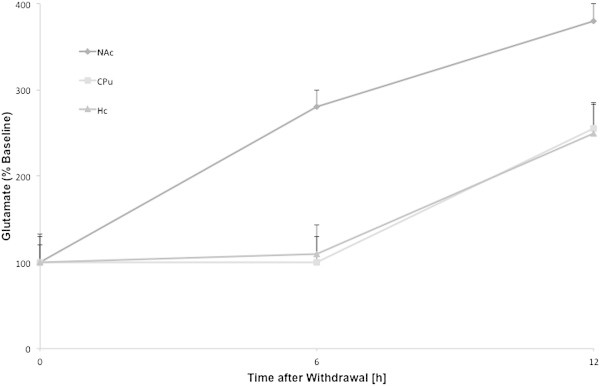
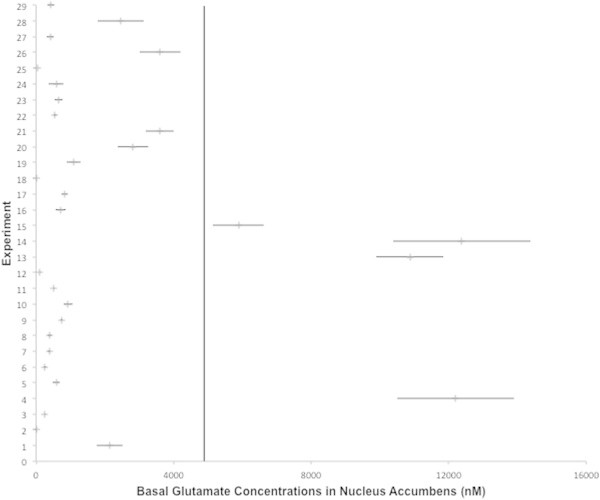
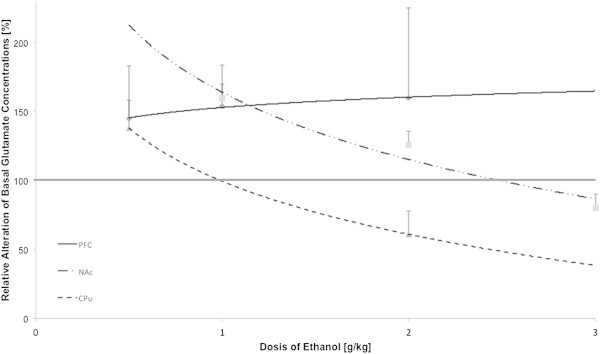
For extraction of basal concentrations of these neurotransmitters, datasets of 6932 rats were analyzed and the absolute basal glutamate and GABA levels were estimated for 18 different brain sites. In response to different doses of acute ethanol administration, datasets of 529 rats were analyzed and a non-linear dose response (glutamate and GABA release) relationship was observed in several brain sites. Specifically, glutamate in the nucleus accumbens shows a decreasing logarithmic dose response curve. Finally, regression analysis of 11 published reports employing brain microdialysis experiments in 104 alcohol-dependent rats reveals very consistent augmented extracellular glutamate and GABA levels in various brain sites that correlate with the intensity of the withdrawal response were identified.
In summary, our results provide standardized basal values for future experimental and in silico studies on neurotransmitter release in the rat brain and may be helpful to understand the effect of ethanol on neurotransmitter release. Furthermore, this study illustrates the benefit of meta-analyses using the generalization of a wide range of preclinical data.
近年来,体内微透析已成为研究大脑细胞外液中神经递质变化的重要方法。鉴于谷氨酸和γ-氨基丁酸(GABA)在介导哺乳动物大脑中多种酒精效应方面的主要作用,众多微透析研究聚焦于这些系统对酒精的动态反应。
在此,我们对已发表的大鼠脑数据集进行了多项荟萃分析:(i)我们研究了属于参与神经精神疾病,尤其是酒精中毒的神经回路的脑区中谷氨酸和GABA的基础细胞外浓度(Noori等人,《成瘾生物学》17:827 - 864,2012);(ii)我们研究了急性乙醇给药对该网络内谷氨酸和GABA水平的影响,以及(iii)我们研究了酒精戒断引起的该神经回路内谷氨酸和GABA水平的变化。
为了提取这些神经递质的基础浓度,分析了6932只大鼠的数据集,并估计了18个不同脑区的绝对基础谷氨酸和GABA水平。针对不同剂量的急性乙醇给药,分析了529只大鼠的数据集,在几个脑区观察到了非线性剂量反应(谷氨酸和GABA释放)关系。具体而言,伏隔核中的谷氨酸呈现出递减的对数剂量反应曲线。最后,对104只酒精依赖大鼠进行脑微透析实验的11篇已发表报告的回归分析表明,在与戒断反应强度相关的各个脑区中,细胞外谷氨酸和GABA水平非常一致地升高。
总之,我们的结果为未来关于大鼠脑中神经递质释放的实验和计算机模拟研究提供了标准化的基础值,可能有助于理解乙醇对神经递质释放的影响。此外,本研究说明了使用广泛的临床前数据进行荟萃分析的益处。