Xuan Le Thi Thanh, Egondi Thaddaeus, Ngoan Le Tran, Toan Do Thi Thanh, Huong Le Thi
Department of Environmental Health, Institute for Preventive Medicine and Public Health, Hanoi Medical University, Hanoi, Vietnam;
African Population and Health Research Center, Nairobi, Kenya; Epidemiology and Global Health, Department of Public Health and Clinical Medicine, Umeå University, Umeå, Sweden.
Glob Health Action. 2014 Dec 8;7:23115. doi: 10.3402/gha.v7.23115. eCollection 2014.
Several studies have established a relationship between temperature and mortality. In particular, older populations have been shown to be vulnerable to temperature effects. However, little information exists on the temperature-mortality relationship in Vietnam.
This article aims to examine the monthly temperature-mortality relationship among older people in Hanoi, Vietnam, over the period between 2005 and 2010, and estimate seasonal patterns in mortality.
We employed Generalized Additive Models, including smooth functions, to model the temperature-mortality relationships. A quasi-Poisson distribution was used to model overdispersion of death counts. Temporal trends, seasonality, and population size were adjusted for while estimating changes in monthly mortality over the study period. A cold month was defined as a month with a mean temperature below 19°C.
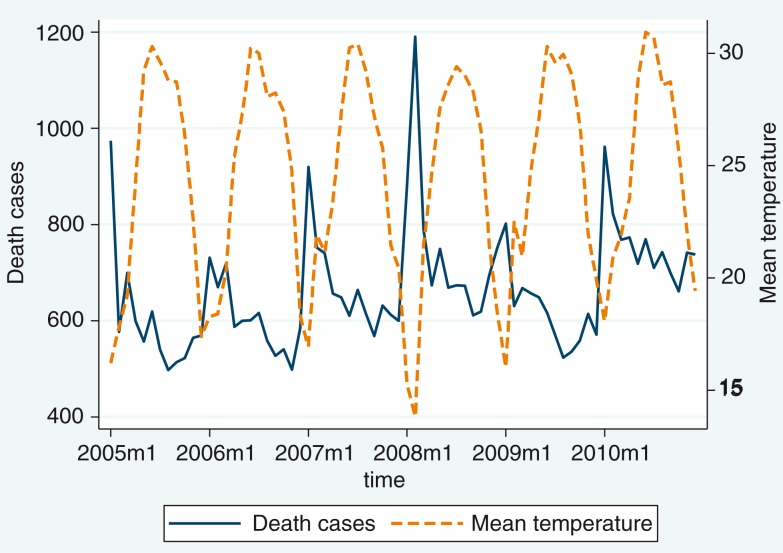
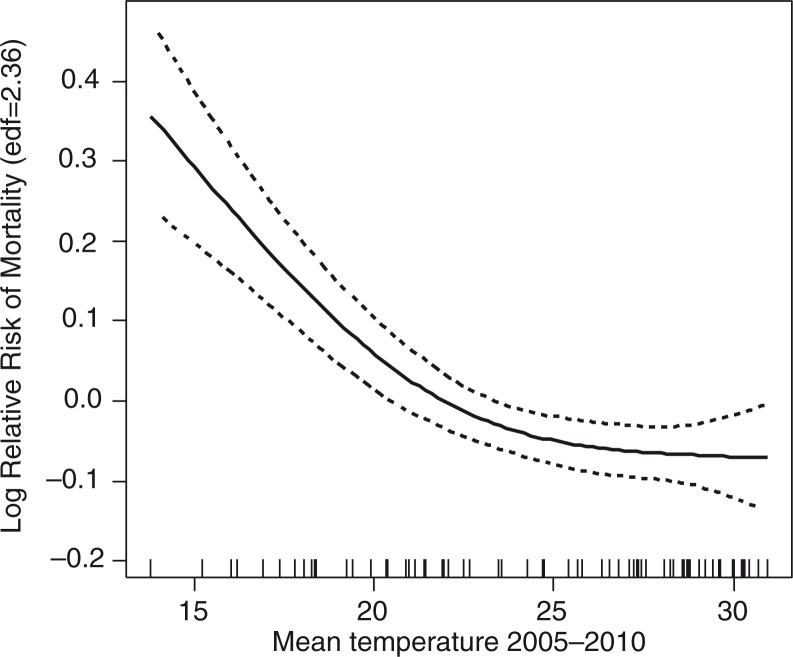
This study found that the high peak of mortality coincided with low temperatures in the month of February 2008, during which the mean temperature was the lowest in the whole study period. There was a significant relationship between mean monthly temperature and mortality among the older people (p<0.01). Overall, there was a significant decrease in the number of deaths in the year 2009 during the study period. There was a 21% increase in the number of deaths during the cold season compared to the warm season. The increase in mortality during the cold period was higher among females compared to males (female: IRR [incidence relative risk] =1.23; male: IRR=1.18).
Cold temperatures substantially increased mortality among the older population in Hanoi, Vietnam, and there were gender differences. Necessary preventive measures are required to mitigate temperature effects with greater attention to vulnerable groups.
多项研究已证实温度与死亡率之间存在关联。特别是,老年人群已被证明易受温度影响。然而,关于越南温度与死亡率关系的信息却很少。
本文旨在研究2005年至2010年期间越南河内老年人每月的温度与死亡率关系,并估计死亡率的季节性模式。
我们采用广义相加模型,包括平滑函数,来模拟温度与死亡率的关系。使用拟泊松分布来模拟死亡人数的过度离散。在估计研究期间每月死亡率变化时,对时间趋势、季节性和人口规模进行了调整。寒冷月份定义为平均温度低于19°C的月份。
本研究发现,死亡率的高峰与2008年2月的低温相吻合,该月平均温度是整个研究期间最低的。老年人的月平均温度与死亡率之间存在显著关系(p<0.01)。总体而言,研究期间2009年的死亡人数显著下降。与温暖季节相比,寒冷季节的死亡人数增加了21%。与男性相比,寒冷时期女性的死亡率上升幅度更高(女性:发病率相对风险[IRR]=1.23;男性:IRR=1.18)。
寒冷温度显著增加了越南河内老年人群的死亡率,且存在性别差异。需要采取必要的预防措施来减轻温度影响,同时更加关注弱势群体。