Institute of Training for Preventive Medicine and Public Health, Hanoi Medical University, Hanoi, Vietnam.
Glob Health Action. 2013 Jan 24;6:18632. doi: 10.3402/gha.v6i0.18632.
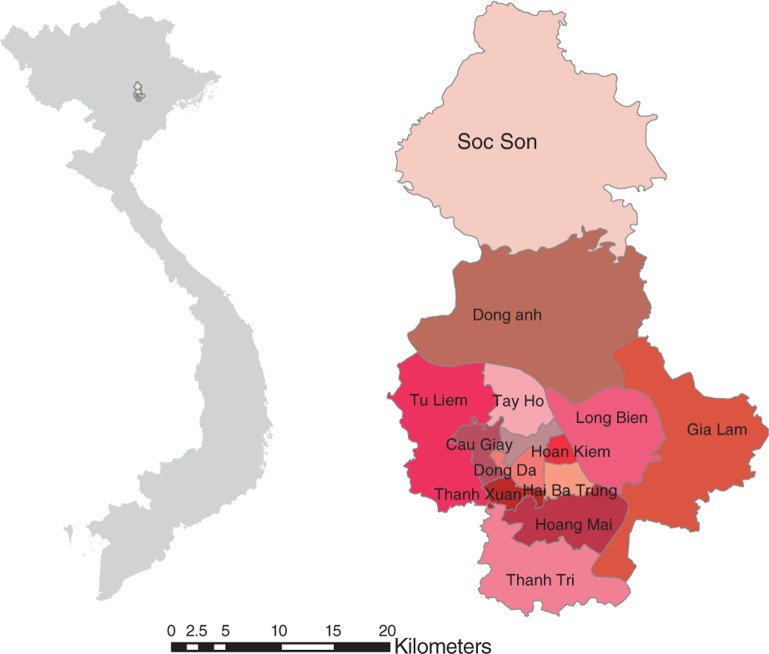
Dengue fever (DF) in Vietnam remains a serious emerging arboviral disease, which generates significant concerns among international health authorities. Incidence rates of DF have increased significantly during the last few years in many provinces and cities, especially Hanoi. The purpose of this study was to detect DF hot spots and identify the disease dynamics dispersion of DF over the period between 2004 and 2009 in Hanoi, Vietnam.
Daily data on DF cases and population data for each postcode area of Hanoi between January 1998 and December 2009 were obtained from the Hanoi Center for Preventive Health and the General Statistic Office of Vietnam. Moran's I statistic was used to assess the spatial autocorrelation of reported DF. Spatial scan statistics and logistic regression were used to identify space-time clusters and dispersion of DF.
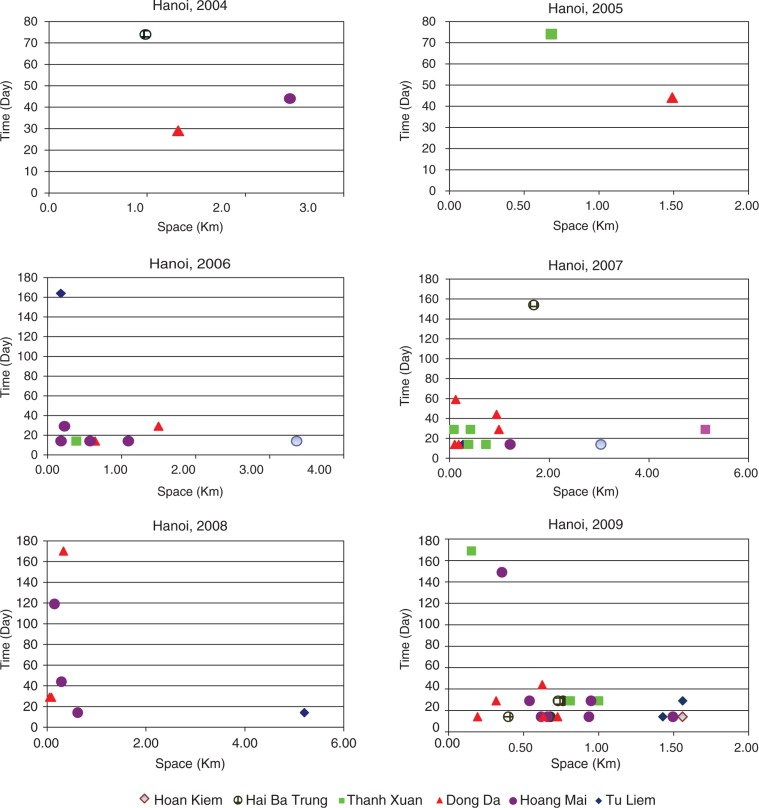
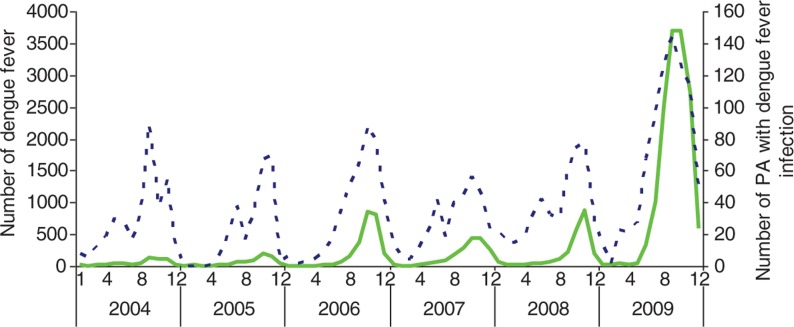
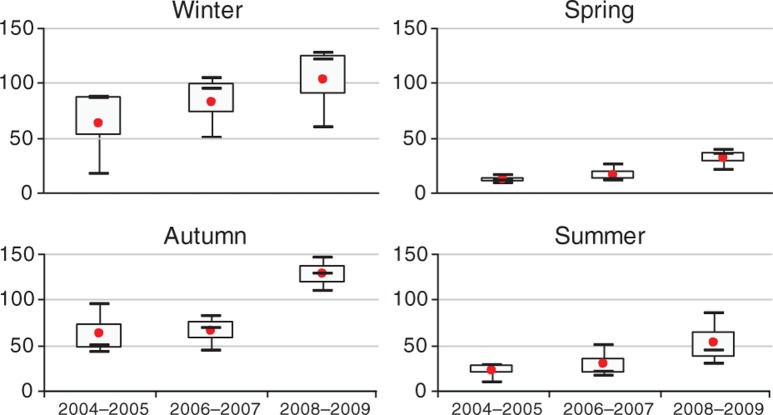
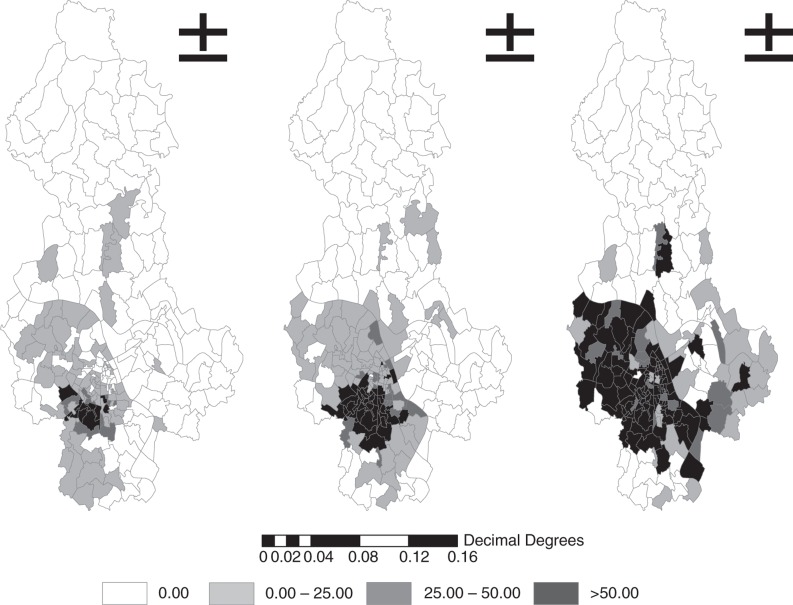
The study revealed a clear trend of geographic expansion of DF transmission in Hanoi through the study periods (OR 1.17, 95% CI 1.02-1.34). The spatial scan statistics showed that 6/14 (42.9%) districts in Hanoi had significant cluster patterns, which lasted 29 days and were limited to a radius of 1,000 m. The study also demonstrated that most DF cases occurred between June and November, during which the rainfall and temperatures are highest.
There is evidence for the existence of statistically significant clusters of DF in Hanoi, and that the geographical distribution of DF has expanded over recent years. This finding provides a foundation for further investigation into the social and environmental factors responsible for changing disease patterns, and provides data to inform program planning for DF control.
越南登革热(DF)仍然是一种严重的新兴虫媒病毒病,引起了国际卫生当局的高度关注。在过去几年中,许多省市,尤其是河内,DF 的发病率显著上升。本研究旨在检测 DF 热点,并确定 2004 年至 2009 年期间河内 DF 疾病动态的分布。
本研究从 1998 年 1 月至 2009 年 12 月期间,从河内预防保健中心和越南国家统计局获取了河内每个邮政编码地区的每日 DF 病例数据和人口数据。使用 Moran's I 统计量评估报告的 DF 的空间自相关。使用空间扫描统计和逻辑回归来识别 DF 的时空聚类和分布。
研究结果显示,通过研究期间(OR 1.17,95%CI 1.02-1.34),河内 DF 传播的地理范围明显扩大。空间扫描统计显示,河内 14 个区中的 6 个(42.9%)有显著的聚类模式,持续 29 天,半径限制在 1000 米以内。研究还表明,大多数 DF 病例发生在 6 月至 11 月之间,此时降雨量和温度最高。
有证据表明,河内存在具有统计学意义的 DF 聚类,DF 的地理分布近年来有所扩大。这一发现为进一步调查导致疾病模式变化的社会和环境因素提供了基础,并为 DF 控制规划提供了数据。