Li Yi, Nicoli Francesca, Chen Chang, Lagae Liesbet, Groeseneken Guido, Stakenborg Tim, Zandbergen Henny W, Dekker Cees, Van Dorpe Pol, Jonsson Magnus P
imec , Kapeldreef 75, Leuven B3001, Belgium.
Nano Lett. 2015 Jan 14;15(1):776-82. doi: 10.1021/nl504516d. Epub 2014 Dec 19.
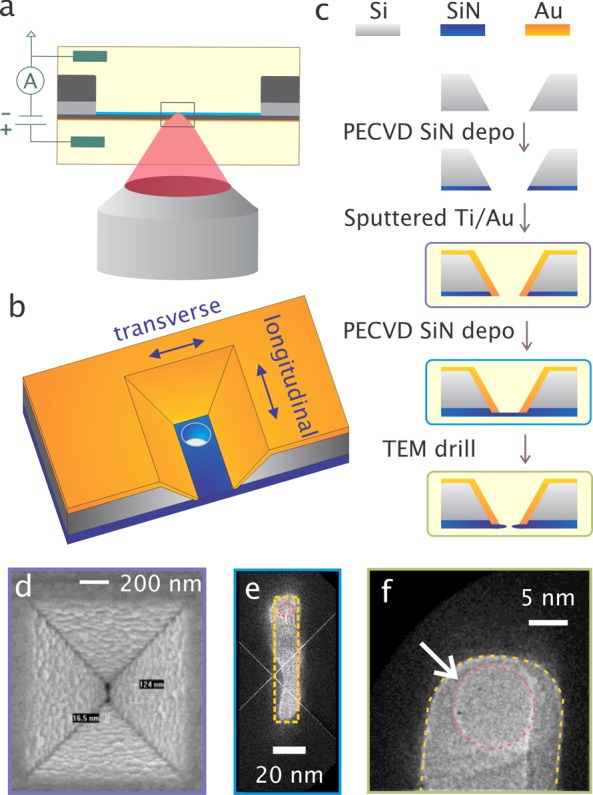
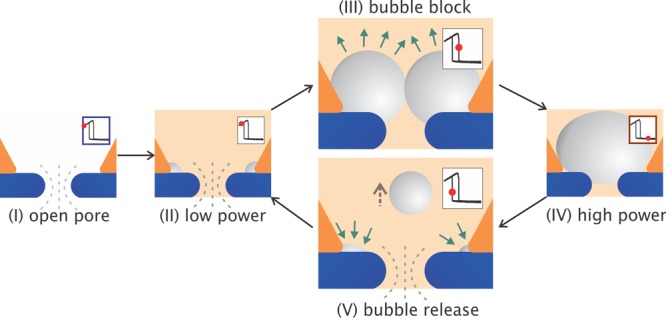
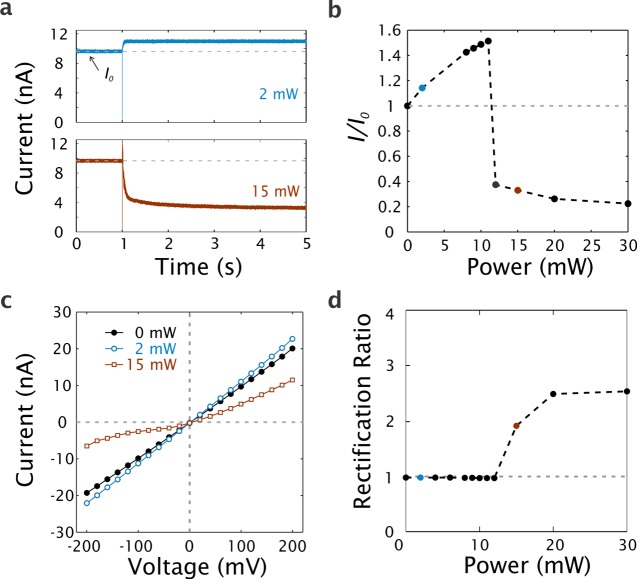
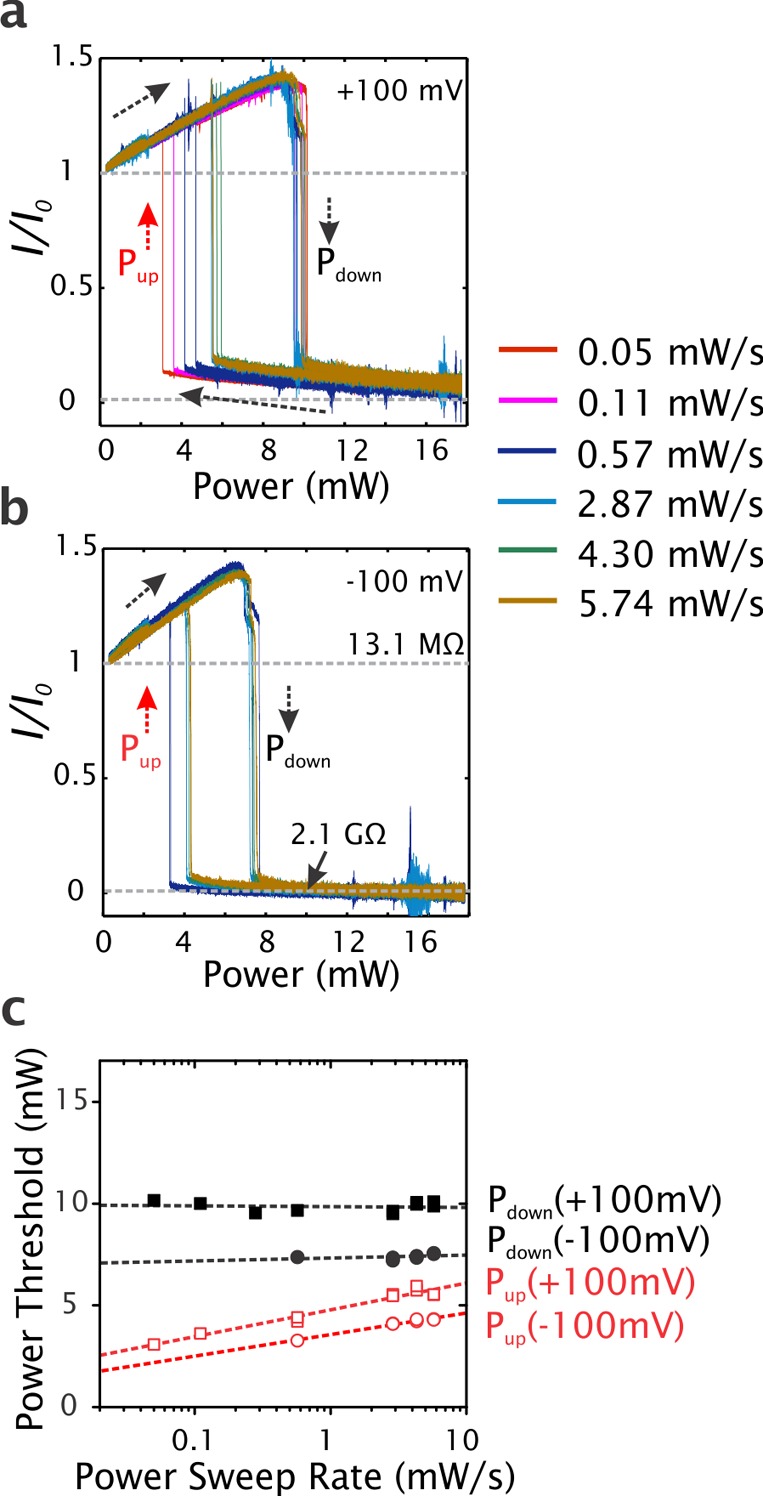
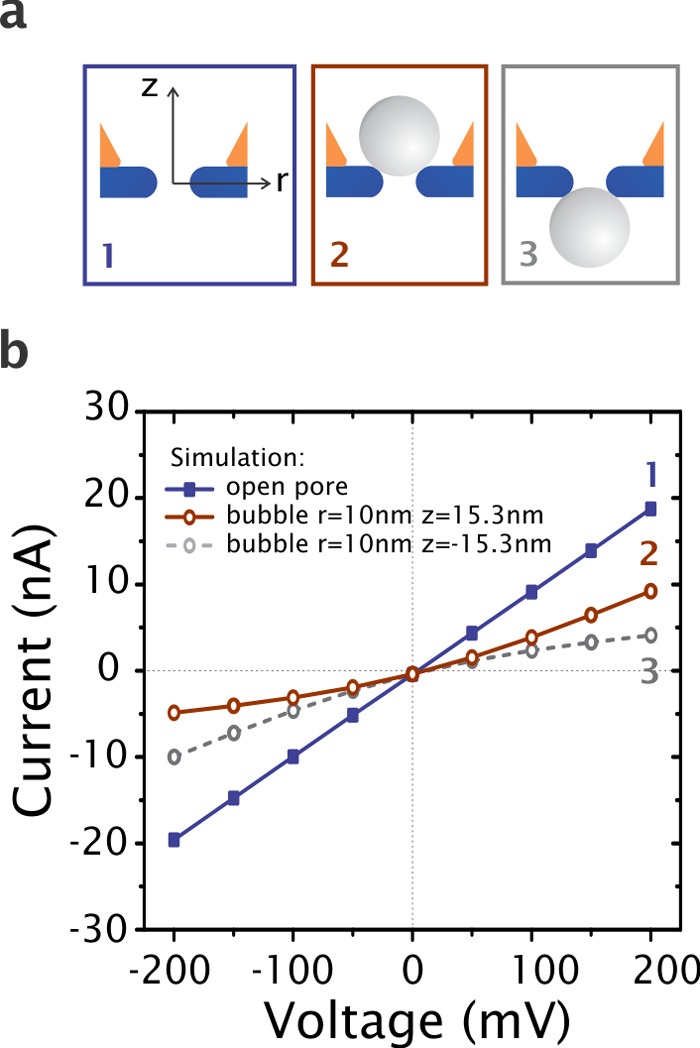
Fast and reversible modulation of ion flow through nanosized apertures is important for many nanofluidic applications, including sensing and separation systems. Here, we present the first demonstration of a reversible plasmon-controlled nanofluidic valve. We show that plasmonic nanopores (solid-state nanopores integrated with metal nanocavities) can be used as a fluidic switch upon optical excitation. We systematically investigate the effects of laser illumination of single plasmonic nanopores and experimentally demonstrate photoresistance switching where fluidic transport and ion flow are switched on or off. This is manifested as a large (∼ 1-2 orders of magnitude) increase in the ionic nanopore resistance and an accompanying current rectification upon illumination at high laser powers (tens of milliwatts). At lower laser powers, the resistance decreases monotonically with increasing power, followed by an abrupt transition to high resistances at a certain threshold power. A similar rapid transition, although at a lower threshold power, is observed when the power is instead swept from high to low power. This hysteretic behavior is found to be dependent on the rate of the power sweep. The photoresistance switching effect is attributed to plasmon-induced formation and growth of nanobubbles that reversibly block the ionic current through the nanopore from one side of the membrane. This explanation is corroborated by finite-element simulations of a nanobubble in the nanopore that show the switching and the rectification.
对于包括传感和分离系统在内的许多纳米流体应用而言,快速且可逆地调节通过纳米尺寸孔径的离子流至关重要。在此,我们首次展示了一种可逆的等离子体控制纳米流体阀。我们表明,等离子体纳米孔(与金属纳米腔集成的固态纳米孔)在光激发时可作为流体开关。我们系统地研究了单个等离子体纳米孔的激光照射效应,并通过实验证明了光电阻切换,即流体传输和离子流被开启或关闭。这表现为在高激光功率(数十毫瓦)照射时,离子纳米孔电阻大幅增加(约1 - 2个数量级)以及伴随的电流整流。在较低激光功率下,电阻随功率增加单调下降,然后在某个阈值功率下突然转变为高电阻。当功率从高到低扫描时,观察到类似的快速转变,尽管阈值功率较低。发现这种滞后行为取决于功率扫描速率。光电阻切换效应归因于等离子体诱导的纳米气泡的形成和生长,这些纳米气泡从膜的一侧可逆地阻断通过纳米孔的离子电流。纳米孔中纳米气泡的有限元模拟证实了这种解释,该模拟显示了切换和整流现象。